Allergy & immunology has quietly become one of the most revenue-sensitive specialties in the United States. While patient volumes continue rising due to environmental allergens, chronic asthma, food sensitivities, and immune-related disorders, payer reimbursement is not keeping pace. What many practices don’t realize is that the same clinical growth driving their schedule is also increasing their billing risk.
In 2025 and into 2026, payers have tightened rules for allergy testing, immunotherapy, biologics, respiratory care, and even routine office visits. Small coding gaps now trigger disproportionately large consequences denials, recoupments, prior authorization delays, and audit exposure. For high-volume allergy clinics, this financial pressure is unsustainable without a modernized billing strategy.
This comprehensive guide breaks down the latest challenges, updated rules for 2025–2026, No Surprises Act requirements, CY-2026 Medicare payment changes, and the exact revenue traps damaging allergy & immunology practices today. You will also see how HealthQuest Billing helps clinics stay profitable, compliant, and audit-ready.
Why Allergy & Immunology Billing Is More Difficult Than Ever
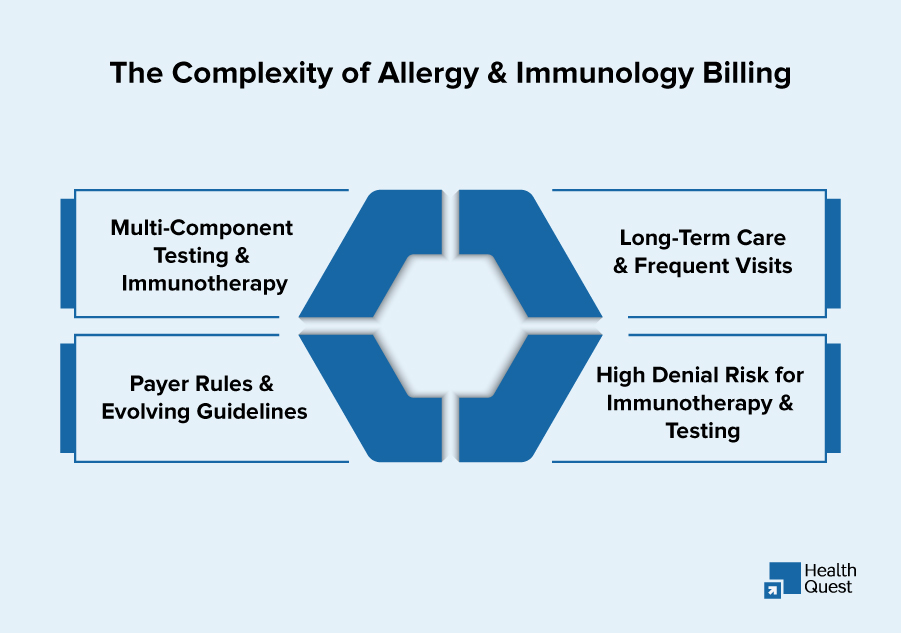
Allergy & immunology billing is unlike standard outpatient billing. It is multi-component, unit-driven, and deeply payer-regulated. This makes it vulnerable to mistakes that providers often don’t see until months later, when denials or audits surface.
1. Multi-Step Testing Requires Exact Documentation
Skin testing, patch tests, intradermal tests, food challenges, and pulmonary function testing all require:
- A defined CPT code
- Correct unit counts
- Side-specific documentation
- Dilution levels and lot numbers
- Test result interpretation
Allergists often perform dozens of tests in a single encounter. Missing just one element or using “units” instead of the payer-required “per test count” causes immediate denials.
2. Immunotherapy Billing Is Highly Technical
Immunotherapy requires separate billing for:
- Antigen preparation
- Multi-vial preparation
- Mixing
- Dose adjustments
- Injection administration
- Multi-injection treatment days
Codes like 95115, 95117, and 95144–95170 are among the most frequently denied codes in the specialty because payers require perfect consistency between clinical notes, dosing logs, and claim units.
3. Coverage Policies Change Constantly
Medicare, Medicaid, and commercial insurers update rules every year for:
- Covered allergens
- Testing frequencies
- Appropriate documentation
- Component-based billing
- Prior authorizations
- Respiratory therapy
Practices that fail to follow updated LCDs, PA rules, and payer billing manuals are forced into unnecessary A/R cycles and often permanent write-offs.
4. Immunotherapy & Respiratory Claims Face the Most Scrutiny
Payers aggressively flag:
- Incorrect modifiers
- Overbilling of antigen doses
- Unbundling of prep and injections
- Missing treatment plans
- Missing medical necessity details
As a result, allergy & immunology has one of the highest denial rates among outpatient specialties.
U.S. Trends Increasing Allergy Billing Complexity
The demand for allergy care continues rising in nearly every region of the United States.
Rising Patient Volume
- Asthma affects more than 26 million Americans.
- Seasonal allergies impact over 25% of adults annually.
- Food allergies and sensitivities are sharply increasing among children and adults.
This growth leads to increased testing, more complex diagnoses, and ongoing immunotherapy each requiring precise billing.
High-Volume States With Increased Denial Pressure
States with the highest allergy visit volumes include:
- Texas
- Florida
- California
- New York
- Georgia
- Arizona
These regions have more aggressive payer oversight due to high utilization, making compliance mission-critical.
Hidden Revenue Leaks in Allergy & Immunology Practices
More than 60% of revenue leakage in allergy practices traces back to just a handful of errors:
1. Incorrect Immunotherapy Billing
Medicare requires component-based billing.
Many commercial plans instead require per-dose or per-vial billing.
When clinics mix these rules even unintentionally claims are denied or flagged for audit.
2. Overbilling Antigen Doses
Some practices bill based on extract volume rather than payer-defined units.
Most payers define:
- 1 cc = 1 billable unit (regardless of the extract concentration)
Incorrect conversions lead to costly recoupments.
3. Wrong Use of Injection Codes
Never bill 95115 (single injection) and 95117 (multiple injections) on the same date of service. Many clinics do this unintentionally when multiple providers administer injections.
4. Missing Proof of Medical Necessity
Payers require clear and complete documentation:
- Symptom history
- Environmental exposure
- Failed conservative treatments
- Dosing schedules
- Ongoing monitoring
Missing one element can invalidate the entire encounter.
5. Prior Authorization Gaps
Many tests including patch testing, food challenges, and biologics require PAs.
Without same-day PA verification and follow-up, denials automatically occur.
Essential CPT Codes in Allergy & Immunology
| Category | CPT Codes | Description |
| Allergy Testing | 95004–95078 | Skin, patch, intradermal, challenge tests |
| Antigen Prep | 95144–95170 | Allergen extract preparation & mixing |
| Immunotherapy Injections | 95115 | Single injection |
| 95117 | Multiple injections | |
| Spirometry | 94010 | Pulmonary function test |
| Respiratory Treatment | 94640 | Airway inhalation treatment |
| Biologic Administration | 96372 | Subcutaneous/therapeutic injection |
No Surprises Act Compliance: What Allergy & Immunology Practices Must Follow in 2025–2026
The No Surprises Act (NSA) directly affects allergy & immunology practices, especially those treating out-of-network or multi-insurance patients.
Key NSA Requirements Affecting Allergists
1. No Balance Billing in Protected Situations
In emergency and certain non-emergency scenarios, you cannot charge patients more than their in-network cost share even if your practice is out-of-network.
This applies in many hospital-based or facility-based settings.
2. Mandatory Use of Good Faith Estimates (GFE)
Self-pay and uninsured patients must receive:
- A written estimate
- Breakdown of expected services
- Antigen prep expectations
- All expected testing charges
GFEs must reflect the real scope of testing (e.g., number of prick tests, intradermal tests, challenge procedures).
3. Independent Dispute Resolution (IDR) Requirements
If a payer underpays an out-of-network claim, the dispute must go through the federal IDR portal.
Allergists must be prepared to supply:
- Antigen preparation logs
- Dilution details
- Lot numbers
- Injection notes
- PA documentation
- Fee schedules
- Clinical rationale
Incomplete documentation leads to unfavorable IDR outcomes.
4. Workflow Changes Required for NSA Compliance
Allergy practices need:
- Updated intake forms showing payer status
- Scripts for NSA notice delivery
- Tracking tools for OON insurance
- Storage of signed NSA notices
- Centralized documentation for IDR cases
Without these systems, practices risk NSA penalties and revenue loss.
CY-2026 CMS Payment Changes Affecting Allergy & Immunology
Medicare’s CY-2026 Physician Fee Schedule (PFS) brings several important updates for allergists.
1. Updated Conversion Factor (+2% to +2.5% Range)
CMS finalized an updated conversion factor reflecting statutory adjustments and budget updates.
Though modest, the increase improves Medicare payments for:
- E/M visits
- Spirometry
- Antigen prep
- Injection administration
- Biologic administration
This helps offset some of the inflationary costs in allergy practices.
2. Separate Conversion Factors for APM vs. Non-APM Practices
Allergists participating in Advanced Payment Model programs may see different reimbursement updates than non-APM peers.
This affects:
- Budgeting
- Contracting
- Forecasting
- RVU modeling
Practices must map their 2026 RVU distribution against the correct CF group.
3. Telehealth Policy Updates
CMS confirmed expanded telehealth flexibilities and clarified time-based E/M coding rules.
This is particularly helpful for:
- Biologic follow-ups
- Medication management
- Treatment plan adjustments
- Symptom monitoring
Hybrid visit models now factor into reimbursement logic.
4. Drug Administration & Biologic Updates
Biologics (e.g., omalizumab, dupilumab, tezepelumab) continue to be high-value allergy services.
CY-2026 clarifies:
- Crosswalk RVUs
- Admin code valuations
- Bundling edits
- Billing frequency rules
Practices must update fee schedules accordingly.
5. Prior Authorization & Utilization Management Impact
Though not officially part of the PFS, Medicare Advantage plans now increasingly implement:
- Stricter PA rules
- Dose-tracking audits
- Step therapy requirements
- Increased documentation validation
These payer-side changes significantly affect allergy revenue.
How HealthQuest Billing Protects Allergy Practice Revenue
HealthQuest Billing provides a full end-to-end revenue cycle system built specifically to handle the complexities of allergy & immunology.
1. Coding Expertise for Allergy & Immunology
Our specialty coders understand:
- Component-based immunotherapy coding
- Dose-specific billing rules
- Antigen prep documentation
- Multi-vial billing accuracy
- Annual LCD and payer updates
2. Medical Necessity & Documentation Support
We ensure your notes include:
- Clear symptom history
- Failed conservative therapy
- Treatment plan rationale
- Exposure context
- Dosing escalation logs
- Monitoring notes
This reduces denials and supports IDR disputes.
3. Denial Prevention & A/R Recovery
Our system automatically flags:
- Wrong modifiers
- Duplicate services
- Incorrect dose counts
- Missing PAs
- Unbundled prep codes
- Payer-specific conflicts
Result: clean claims, faster payment, fewer write-offs.
4. Prior Authorization Management
We handle:
- Eligibility checks
- PA submission
- Follow-ups
- Expiration tracking
- Renewal alerts
Allergists see improved scheduling, smoother patient flow, and lower denial rates.
5. NSA & 2026 Compliance Integration
We help practices set up:
- NSA-compliant workflows
- Good Faith Estimates
- IDR-ready documentation packets
- Updated 2026 fee schedules
- Correct payer-required billing structures
Why 2025–2026 Is a Critical Period for Allergy Practices
With expanding patient needs, tighter payer rules, more audits, NSA enforcement, and evolving CMS payment structures, allergy & immunology billing requires strategic, proactive management.
Practices without specialized billing support risk:
- Higher denial rates
- Increased payer audits
- Revenue leakage
- Compliance penalties
- Slower cash flow
- Operational inefficiencies
HealthQuest Billing ensures every step from coding to compliance to collections is optimized for sustainable growth.
Conclusion
Allergy & immunology billing is more complex in 2025–2026 than at any point in the last decade. Payer rules, NSA protections, and Medicare payment models continue to evolve, placing financial pressure on practices already managing high patient volumes.
HealthQuest Billing provides complete RCM support with specialty-trained coders, prior authorization experts, denial management teams, and compliance resources that keep your practice profitable and protected.