
As healthcare reimbursement becomes increasingly complex, providers are under growing pressure to improve financial performance while maintaining compliance and delivering quality patient care. In 2026, challenges such as rising denial rates, evolving payer requirements, staffing shortages, increasing patient responsibility, and reimbursement delays continue to impact healthcare organizations of all sizes. Are your claims getting stuck in long AR cycles, or are denials quietly draining your revenue without clear visibility? Traditional billing processes are no longer sufficient to keep pace with today’s revenue cycle demands. This is where Modern Billing becomes essential. Modern billing combines automation, advanced analytics, real-time eligibility verification, denial prevention, AI-driven workflows, and proactive revenue cycle management to help providers reduce revenue leakage and accelerate reimbursements.
This guide explores the biggest revenue cycle challenges facing healthcare providers and explains how modern billing solutions can improve collections, strengthen cash flow, and optimize financial performance in 2026.
What Is Modern Billing?
Modern Billing is an advanced healthcare revenue cycle approach that uses technology, automation, and data intelligence to manage claims, payments, denials, and patient billing more efficiently.
Unlike traditional billing systems that rely heavily on manual work, modern billing focuses on:
- Automated claims submission
- AI-based error detection
- Real-time eligibility verification
- Predictive denial management
- Revenue cycle analytics
- Faster reimbursement cycles
In simple terms, modern billing ensures that claims move faster, errors are reduced, and revenue is collected efficiently.
Why Healthcare Providers Are Losing Revenue in 2026
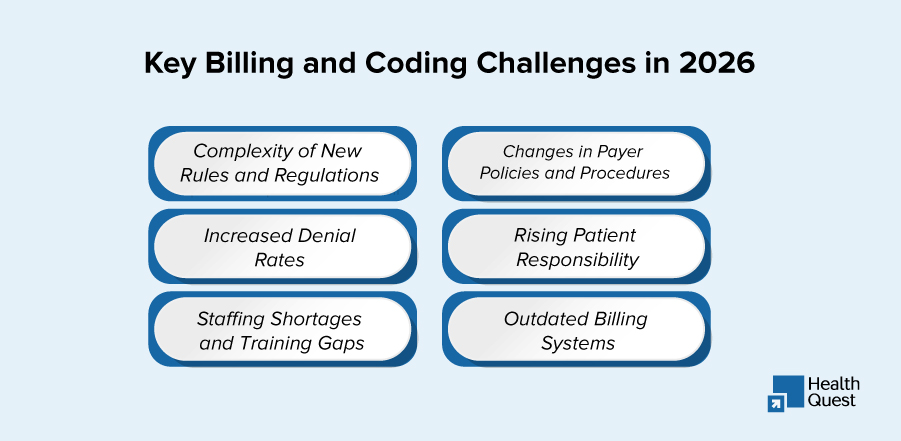
Revenue loss in healthcare is no longer caused by a single issue. It is the result of multiple small inefficiencies across the revenue cycle. Below are the most critical reasons providers are experiencing financial leakage.
1. Increasing Complexity of Payer Rules
Insurance companies are continuously updating their reimbursement policies, including prior authorization requirements, documentation standards, coverage rules, and coding validation processes. Because each payer operates with different rules and workflows, manual billing systems often struggle to keep up with these changes.
Even a small mismatch in payer requirements can lead to claim rejections, delayed reimbursements, repeated documentation requests, and extended accounts receivable (AR) cycles. Over time, these delays create revenue leakage and disrupt overall cash flow stability.
2. Increased Denial Rates
Claim denials are becoming more frequent across all healthcare specialties due to stricter payer review systems and evolving claim validation rules. Common causes include missing or incorrect modifiers, insufficient medical necessity documentation, authorization issues, coding mismatches, and missed timely filing limits.
What makes this even more critical is not just the denial itself, but the time and resources required to resolve it. Every denied claim extends AR days, increases administrative workload, and directly reduces predictable cash flow for healthcare providers.
3. Staffing Shortages and Training Gaps
Healthcare billing departments continue to face significant staffing shortages, leaving existing teams overburdened and under constant pressure. As coding systems and payer guidelines become more complex, the responsibility of maintaining billing accuracy often falls on staff who may not have sufficient training or support.
This results in delayed claim submissions, missed follow-ups, unworked AR aging buckets, and higher rates of human error. Over time, these operational gaps contribute to revenue leakage and slower reimbursement cycles.
4. Outdated Billing Systems
Many healthcare organizations still depend on legacy billing systems that are not designed to integrate with modern payer platforms or automation tools. These systems often require manual claim tracking, lack real-time alerts, and provide limited reporting or analytics capabilities.
As a result, billing teams operate with limited visibility into claim status, allowing unpaid claims to age silently in the revenue cycle. This leads to inefficiencies, delayed reimbursements, and increased financial losses over time.
5. Rising Patient Financial Responsibility
With the growing adoption of high-deductible health plans (HDHPs), patients are now responsible for a larger portion of their healthcare costs. This shift has significantly increased the administrative burden on healthcare providers who must now manage more patient-related billing and collections.
The result is slower patient payments, higher outstanding balances, increased collection efforts, and more frequent payment disputes. These challenges directly impact cash flow and overall revenue cycle performance.
6. Lack of Real-Time Revenue Visibility
One of the most critical challenges in modern healthcare billing is the lack of real-time financial visibility. Many practices only become aware of revenue cycle issues after claims are denied, AR has already aged, or revenue has already been lost.
Without real-time analytics and proactive monitoring, financial inefficiencies remain hidden until they become major revenue problems. This delay in detection leads to reduced control over cash flow and weaker overall financial performance.
Also Read: AI Technologies for Small Medical Practices
What Makes Modern Billing Different From Traditional Billing?
The difference between traditional billing and modern billing is not just operational—it is structural. Healthcare organizations are no longer just improving billing processes; they are completely transforming how revenue is captured, managed, and optimized.
Traditional billing systems rely heavily on manual work, delayed reporting, and reactive follow-ups. In contrast, modern billing introduces automation, real-time intelligence, and AI-driven workflows that help providers prevent errors before they happen and accelerate reimbursement cycles.
Here’s a simple comparison to highlight the difference:
| Feature | Traditional Billing | Modern Billing |
|---|---|---|
| Claim Processing | Manual submission and tracking | Automated, AI-assisted claim processing |
| Error Detection | Identified after submission | Detected and corrected before submission |
| Eligibility Checks | Manually verified | Real-time eligibility verification |
| Denial Management | Reactive response after denial | Predictive + proactive prevention |
| AR Follow-up | Delayed and inconsistent | Automated, rule-based workflows |
| Reporting | Monthly or static reports | Real-time dashboards and insights |
| Revenue Visibility | Limited financial visibility | Full-cycle, end-to-end transparency |
In short, traditional billing reacts to problems after they occur, while modern billing prevents them before they impact revenue.
Core Components of Modern Billing Systems
Modern billing is not a single tool or software—it is a connected ecosystem of intelligent systems that work together across the entire revenue cycle. Each component plays a specific role in reducing errors, preventing denials, and ensuring that revenue moves smoothly from patient encounter to final payment.
Below is a deeper breakdown of how each component actually works in practice and why it matters for healthcare financial performance.
1. AI-Powered Claim Scrubbing
AI-powered claim scrubbing is the first line of defense in modern billing. Before a claim is ever submitted to a payer, the system performs a detailed automated review to identify potential issues that could lead to denial or delay.
This includes checking:
- Coding accuracy and consistency
- Correct use of modifiers
- Missing or incomplete documentation
- Payer-specific billing rules and requirements
- Duplicate or conflicting entries
Instead of waiting for payers to reject a claim, AI flags issues immediately so they can be corrected upfront. This significantly improves clean claim rates, reduces rework, and helps practices get paid faster on the first submission.
2. Real-Time Eligibility Verification
Real-time eligibility verification ensures that a patient’s insurance coverage is confirmed instantly before services are provided or claims are submitted.
This step is critical because many denials occur simply due to eligibility issues that could have been prevented.
Modern billing systems verify:
- Active insurance coverage status
- Plan type and benefits
- Co-pay, deductible, and patient responsibility
- Coverage limitations for specific services
By identifying coverage issues early, providers can prevent:
- Coverage-related claim denials
- Patient billing disputes
- Delayed or rejected reimbursements
This improves both financial accuracy and patient transparency at the point of care.
3. Predictive Denial Prevention
Predictive denial prevention is one of the most powerful features of modern billing systems. Instead of reacting to denials after they occur, the system uses historical data and payer behavior patterns to anticipate them in advance.
It analyzes:
- Past denial trends by payer
- High-risk CPT and ICD code combinations
- Common documentation gaps
- Payer-specific rejection patterns
- Procedure-level risk scoring
This allows billing teams to correct potential issues before claims are submitted. The result is fewer denials, reduced rework, and a smoother revenue cycle with less disruption to cash flow.
4. Automated Accounts Receivable (AR) Management
Accounts Receivable is one of the most critical and high-risk areas in healthcare revenue cycle management. When claims age beyond 30, 60, or 90 days, the probability of full reimbursement decreases significantly.
Modern billing systems automate AR management by:
- Identifying aging claims in real time
- Prioritizing high-value outstanding balances
- Assigning follow-up tasks automatically
- Triggering escalation workflows for delayed claims
- Preventing claims from aging beyond critical thresholds
This ensures that no claim is forgotten or left unworked. The goal is simple: faster follow-up = faster payment = stronger cash flow stability.
5. Revenue Cycle Analytics
Modern billing platforms provide deep financial visibility through real-time analytics and reporting dashboards. Instead of waiting for monthly reports, providers can continuously monitor revenue performance.
These analytics include:
- Denial trends by payer and service type
- AR aging breakdown across time intervals
- Clean claim rate performance tracking
- Revenue leakage identification
- Payment delay patterns by procedure or payer
With this level of insight, healthcare organizations can make data-driven decisions instead of relying on guesswork. It transforms billing from a reactive process into a strategic financial management system.
6. Patient Payment Automation
Modern billing also improves the patient financial experience by simplifying how payments are collected and managed.
Instead of manual billing and delayed collections, automation enables:
- Secure digital payment portals
- Automated billing and payment reminders
- Flexible installment or payment plans
- Clear and transparent billing statements
This reduces confusion, improves patient satisfaction, and increases collection rates. With rising patient financial responsibility in healthcare, this component is essential for maintaining healthy cash flow.
How Modern Billing Improves Revenue Cycle Performance
The impact of Modern Billing is not theoretical—it is directly measurable across every major financial indicator in the healthcare revenue cycle. When organizations shift from traditional manual billing processes to modern, technology-driven billing systems, they see clear improvements in speed, accuracy, and overall revenue performance.
Modern billing works by reducing errors at the source, accelerating claim submission, improving follow-up efficiency, and providing real-time financial visibility. Together, these improvements create a more predictable and stable revenue cycle.
Below is a clear breakdown of how performance changes before and after implementing modern billing systems:
Performance Improvements
| Metric | Before Modern Billing | After Modern Billing |
|---|---|---|
| Clean Claim Rate | 70–80% | 90–98% |
| AR Days | 60–120 days | 25–45 days |
| Denial Rate | High and inconsistent | Significantly reduced through prevention systems |
| Payment Speed | Slow reimbursement cycles | Faster and more predictable payments |
| Revenue Leakage | Frequent due to manual errors and missed follow-ups | Controlled through automation and analytics |
Key Financial Improvements Explained
- Higher clean claim rates through AI-based pre-submission validation
- Reduced AR days through automated follow-ups and prioritization
- Lower denial rates through predictive analytics
- Faster reimbursement cycles with streamlined workflows
- Controlled revenue leakage through real-time monitoring
The Role of AI in Modern Billing
Artificial Intelligence (AI) has become a core driver of efficiency in modern healthcare billing, fundamentally changing how revenue cycle operations are managed. Instead of relying on manual review and reactive correction, AI enables billing systems to work proactively—detecting issues early, learning from payer behavior, and continuously improving claim accuracy over time.
In traditional billing workflows, most errors are identified only after claims are submitted, often resulting in denials, delays, and extended accounts receivable (AR) cycles. AI shifts this model from reactive to predictive, allowing healthcare organizations to prevent revenue leakage before it occurs.
AI enables:
- Real-time coding error detection
- Denial risk prediction before submission
- Automation of repetitive billing tasks
- Identification of payer behavior patterns
- Smarter claim routing and prioritization
This reduces dependency on manual billing teams while significantly improving accuracy and efficiency.
How Health Quest Modern Billing Can Help Practices Overcome Revenue Cycle Challenges
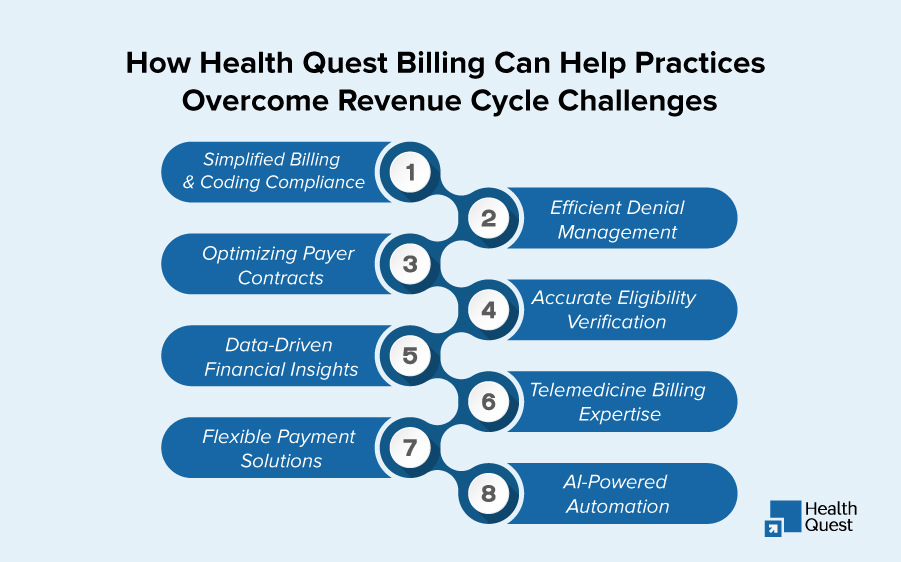
In today’s increasingly complex healthcare environment, providers need more than basic billing support—they need a strategic revenue cycle partner. Health Quest Billing helps practices overcome billing, coding, and reimbursement challenges through comprehensive RCM solutions designed to improve financial performance. Our team stays current with evolving payer regulations and coding requirements to reduce claim errors, denials, and payment delays. We provide proactive denial management, real-time eligibility verification, payer contract optimization, and data-driven revenue analysis to identify and eliminate revenue leakage. From telehealth billing compliance and patient payment solutions to AI-powered automation that accelerates claims processing and improves accuracy, we streamline every stage of the revenue cycle. The result is faster reimbursements, stronger cash flow, reduced administrative burden, and sustainable revenue growth for healthcare providers in 2026 and beyond.
Conclusion:
Healthcare billing in 2026 requires more than traditional processes. Rising complexity, payer restrictions, and financial pressures demand a smarter, technology-driven approach. Modern Billing is not just an upgrade; it is a complete transformation of the revenue cycle. By integrating AI, automation, and real-time analytics, healthcare providers can significantly improve financial performance while reducing administrative burden.
With the right Modern Billing system in place, practices can move from reactive billing management to proactive revenue optimization ensuring financial stability and long-term success in an increasingly complex healthcare environment.
Frequently asked questions
How does Modern Billing reduce claim denials in 2026?
Modern billing systems use automation, AI-driven claim scrubbing, real-time eligibility checks, and predictive denial management to catch errors before claims are submitted. This leads to cleaner claims, faster reimbursements, and improved cash flow.
Why is Modern Billing important for reducing AR days and improving cash flow?
Modern Billing improves AR performance by automating follow-ups, prioritizing high-value claims, and preventing aging accounts from exceeding 60–90 days. With real-time tracking and intelligent workflows, providers get faster claim resolution, reduced delays, and more predictable cash flow compared to traditional manual billing systems.
Is AI-based medical billing really effective for healthcare practices?
Yes. AI and machine learning help identify coding errors, predict denials, automate repetitive billing tasks, and improve overall billing accuracy. These technologies reduce manual workload, speed up claims processing, and significantly improve reimbursement rates.
How does AI improve Modern Billing systems?
AI enhances Modern Billing by detecting coding errors, predicting denial risks, analyzing payer behavior, and automating repetitive billing tasks. It also improves claim routing and prioritization within integrated EHR systems. This reduces dependency on manual billing teams while increasing accuracy, speed, and overall revenue cycle efficiency.
How can Health Quest Modern Billing help providers recover lost revenue in 2026?
Health Quest Modern Billing offers end-to-end revenue cycle management, including compliant coding, denial management, payer contract optimization, AI-powered automation, telehealth billing expertise, and patient payment solutions, helping practices maximize reimbursement and stay financially healthy.
For general informational purposes. Payer requirements, contractual terms, and applicable rules should be verified for the situation involved.