
If your sleep center is performing more sleep studies but facing increasing denials, delayed payments, and growing accounts receivable, you’re not alone. Industry reports estimate that 10–15% of healthcare claims are initially denied, while Medicare and commercial payers continue increasing scrutiny of sleep study and CPAP-related claims. A single denied PSG or HST claim can delay reimbursement for weeks, increase administrative workload, and quietly reduce profitability. Many sleep centers lose revenue long before a claim is denied due to authorization issues, documentation gaps, coding errors, and underpayments that often go unnoticed.
That’s why specialized Sleep Medicine Billing Services have become essential for providers looking to improve collections, reduce denials, and maintain a healthy revenue cycle in today’s increasingly complex reimbursement environment.
What Is Sleep Medicine Billing Services?
Sleep medicine billing is the specialized process of coding, documenting, submitting, tracking, and managing reimbursement for sleep-related diagnostic testing, physician services, CPAP therapy management, durable medical equipment (DME), and ongoing treatment of sleep disorders.
A successful sleep medicine revenue cycle includes:
- Insurance eligibility verification
- Prior authorization management
- Medical necessity documentation
- Sleep study coding and billing
- CPAP and DME reimbursement
- Claim submission and tracking
- Denial management and appeals
- Accounts receivable follow-up
- Revenue cycle reporting
Because sleep medicine often combines diagnostic testing, physician interpretation, and equipment-related services, even minor documentation or coding errors can result in claim denials, underpayments, or audit risks.
Why Sleep Medicine Billing Is More Complex Than Most Medical Specialties
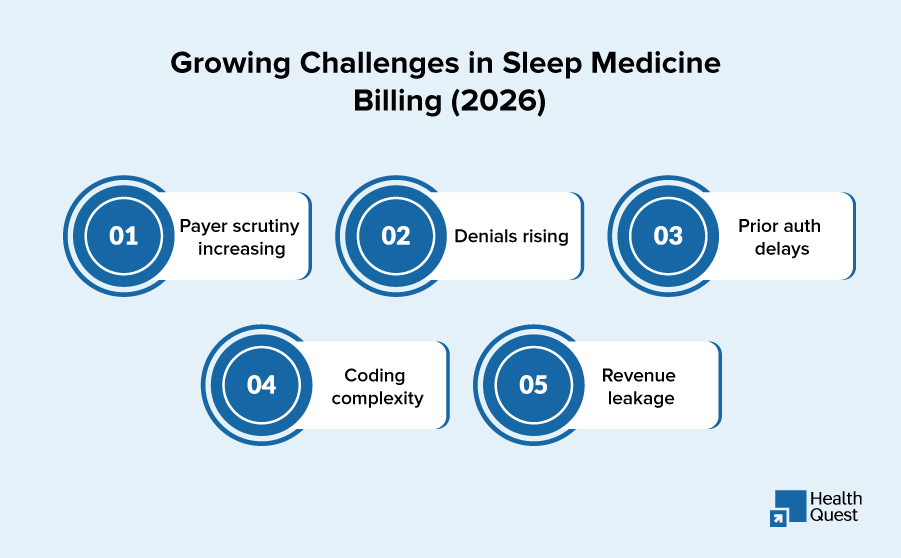
Many healthcare specialties primarily bill for office visits, procedures, and follow-up care. Sleep medicine is different because providers must manage reimbursement across an entire patient journey that includes diagnostic testing, physician evaluations, prior authorizations, payer compliance requirements, and long-term therapy monitoring.
Providers frequently encounter challenges involving:
1. Prior Authorization Requirements
Commercial insurers increasingly require prior authorization before approving polysomnography (PSG) and other sleep studies. Missing or inaccurate authorizations often lead to automatic denials regardless of medical necessity.
2. Medical Necessity Documentation
Payers require detailed documentation demonstrating that sleep testing is clinically appropriate. Missing symptom history, physician assessments, or supporting clinical evidence can result in denied claims.
3. Home Sleep Testing (HST) Coverage Rules
Many insurers encourage lower-cost home sleep testing before approving facility-based studies. Providers must carefully document patient eligibility and comply with payer-specific requirements.
4. CPAP & DME Compliance Requirements
Reimbursement for CPAP equipment and related supplies depends on strict qualification criteria, compliance monitoring, physician documentation, and ongoing patient follow-up.
5. Payer-Specific Billing Rules
Medicare, Medicaid, and commercial insurers often maintain different coverage policies, coding requirements, authorization standards, and reimbursement methodologies. Because of these complexities, successful reimbursement depends on far more than claim submission. It requires a specialized billing strategy designed specifically for sleep medicine.
Common Causes of Sleep Study Claim Denials
Claim denials remain one of the largest obstacles to financial success for sleep centers. While payer policies vary, most denied sleep study claims can be traced to a small group of recurring billing, coding, documentation, and authorization issues.
Understanding why claims are denied allows providers to proactively address revenue cycle weaknesses before they affect cash flow.
1. Missing or Incorrect Prior Authorizations
Prior authorization requirements continue to expand across commercial health plans. Many insurers require approval before diagnostic polysomnography (PSG), CPAP titration studies, and certain home sleep testing services.
Common authorization-related denials occur when:
- Authorization was never obtained
- Authorization expired before the date of service
- Authorized services differ from services performed
- Clinical documentation fails to support approval criteria
- Authorization information is entered incorrectly on the claim
Because these denials often occur before medical necessity is even reviewed, authorization management remains one of the most important denial prevention strategies for sleep centers.
2. Insufficient Medical Necessity Documentation
Medical necessity remains one of the most scrutinized components of sleep medicine reimbursement.
Payers expect providers to document:
- Excessive daytime sleepiness
- Witnessed apnea episodes
- Chronic fatigue
- Snoring and sleep disturbances
- Relevant comorbid conditions
- Physician assessment and testing rationale
Incomplete documentation frequently results in denials, even when testing was clinically appropriate.
3. CPT and ICD-10 Coding Errors
Sleep medicine involves specialized diagnostic testing and disorder-specific diagnoses that require precise coding.
Common coding mistakes include:
- Incorrect sleep study CPT selection
- Diagnosis codes that do not support medical necessity
- Missing modifiers
- Coding services not supported by documentation
- Incorrect linkage between diagnosis and procedure codes
Even small coding inaccuracies can trigger claim rejections, delayed payments, or reduced reimbursement.
4. Insurance Eligibility and Benefit Verification Failures
Many reimbursement problems begin before a patient ever arrives for testing.
Common eligibility issues include:
- Inactive coverage
- Incorrect insurance information
- Benefit limitations
- Non-covered services
- Missing referrals
Verifying coverage before scheduling services helps reduce preventable denials and patient billing disputes.
5. CPAP and DME Documentation Deficiencies
CPAP therapy reimbursement requires ongoing compliance monitoring and documentation.
Common reasons for CPAP-related denials include:
- Missing sleep study documentation
- Failure to meet qualification criteria
- Missing physician evaluations
- Lack of compliance records
- Insufficient follow-up documentation
Because CPAP reimbursement often extends beyond the initial diagnosis, documentation consistency remains critical throughout the patient’s treatment journey.
HST vs PSG Billing: Understanding the Reimbursement Differences
Selecting the appropriate sleep study impacts both clinical outcomes and reimbursement success. Although Home Sleep Testing (HST) and Polysomnography (PSG) serve similar diagnostic purposes, they involve different coverage criteria, documentation requirements, and reimbursement structures.
| Category | Home Sleep Testing (HST) | Polysomnography (PSG) |
| Testing Location | Patient Home | Sleep Lab |
| Common Codes | 95806, G0398-G0400 | 95810, 95811 |
| Clinical Application | Suspected OSA | Complex Sleep Disorders |
| Prior Authorization | Often Required | Frequently Required |
| Documentation Burden | Moderate | Extensive |
| Reimbursement Value | Lower | Higher |
| Audit Risk | Moderate | Higher |
Home Sleep Testing (HST) Billing Considerations
Home Sleep Testing continues to gain popularity because many insurers view it as a cost-effective alternative for evaluating patients with suspected obstructive sleep apnea.
Although reimbursement for HST is generally less complex than PSG, providers must still comply with payer-specific eligibility requirements. Documentation should clearly demonstrate that the patient is an appropriate candidate for home testing and that the study meets coverage guidelines.
Successful HST reimbursement requires:
- Proper patient selection
- Physician documentation
- Coverage verification
- Medical necessity support
- Accurate coding
Polysomnography (PSG) Billing Considerations
Polysomnography remains the gold standard for diagnosing complex sleep disorders and evaluating patients who require more comprehensive monitoring. Because PSG involves extensive testing and higher reimbursement rates, payers often apply greater scrutiny to these claims.
Providers must typically maintain detailed documentation that supports medical necessity, physician evaluation findings, testing rationale, and prior authorization approvals when required. Missing or incomplete documentation can quickly result in claim denials or audit requests.
PSG billing also requires careful attention to coding accuracy, particularly when CPAP titration studies or multiple testing components are involved.
Sleep Medicine Coding Cheat Sheet (CPT, ICD-10, Modifiers & Documentation)
Accurate coding directly impacts reimbursement, compliance, and denial prevention. Sleep medicine providers must ensure that procedure codes accurately reflect services performed and that diagnosis codes support medical necessity. The following codes are among the most commonly reported in sleep medicine practices.
| Sleep Medicine Service | Common CPT / HCPCS Codes | Common ICD-10-CM Codes | Key Billing Considerations |
| Diagnostic Polysomnography (PSG) | 95810 | G47.33, G47.30 | Verify medical necessity, prior authorization (if required), and complete physician documentation. |
| PSG with CPAP/BiPAP Titration | 95811 | G47.33 | Document titration details, therapy settings, and physician interpretation. |
| Home Sleep Testing (HST) | 95806, G0398–G0400 | G47.33, G47.30 | Confirm patient eligibility and payer-specific HST coverage requirements. |
| Multiple Sleep Latency Test (MSLT) | 95805 | G47.10, G47.411, G47.419 | Support testing with physician evaluation and clinical indications. |
| Limited Sleep Study | 95807, 95808 | G47.33, G47.00 | Ensure documentation supports the selected study type. |
| Pediatric Sleep Study | 95782, 95783 | Appropriate pediatric sleep disorder diagnosis | Include age-appropriate documentation and medical necessity. |
| CPAP & PAP Therapy Management | Varies by DME HCPCS codes* | G47.33 | Document PAP compliance, physician follow-up, and payer qualification criteria. |
| Physician Interpretation & Follow-up | E/M codes (as applicable) | Based on diagnosis | Link documentation to diagnostic findings and treatment plan. |
*Note: CPAP equipment and supplies are typically billed using DMEPOS HCPCS codes (e.g., E0601 and related supply codes), which vary depending on the equipment or accessory provided.
Sleep Medicine Billing Case Study: DE, USA
A multi-provider sleep center in Dallas was losing revenue due to frequent authorization denials, incomplete documentation, and aging accounts receivable. Many sleep study claims required rework, creating payment delays and increasing administrative burden.
After optimizing the practice’s billing workflows, authorization processes, and claim review procedures, the results within six months included:
- 38% reduction in claim denials
- 24% improvement in clean claim rates
- 31% reduction in A/R over 90 days
- Faster reimbursements and healthier cash flow
The most significant gains came from addressing authorization gaps and documentation issues before claims were submitted, helping the practice capture more revenue while reducing time spent on appeals.
Client details have been anonymized to protect confidentiality.
Provider Self-Assessment: Is Your Sleep Medicine Billing Process Losing Revenue?
Sleep medicine billing requires accurate coding, complete documentation, timely prior authorizations, and continuous monitoring of revenue cycle performance. If you answer “No” to any of the questions below, your practice may have opportunities to reduce claim denials, improve cash flow, and maximize reimbursement.
| Question | Yes / No |
| Are your polysomnography (PSG) and home sleep testing (HST) claims submitted accurately with minimal denials? | ☐ |
| Are prior authorizations obtained and verified before sleep studies are performed? | ☐ |
| Does your clinical documentation consistently support medical necessity for sleep testing and CPAP therapy? | ☐ |
| Are CPAP and DME claims submitted with complete compliance and physician documentation? | ☐ |
| Are underpayments for sleep studies, physician interpretation, or CPAP-related services identified and recovered? | ☐ |
| Are your billing processes aligned with the latest CMS and commercial payer requirements? | ☐ |
| Is your Clean Claim Rate above 95%? | ☐ |
| Is your First-Pass Acceptance Rate between 90%–95% or higher? | ☐ |
| Is your overall claim denial rate below 5% and your Days in A/R below 40 days? | ☐ |
| Are you confident your practice captures every reimbursable service while maintaining a Net Collection Rate above 95%? | ☐ |
Assessment: If you answered “No” to any of these questions, your sleep center may be losing revenue due to coding errors, documentation gaps, authorization issues, claim denials, underpayments, or inefficient revenue cycle processes. Health Quest Billing’s Sleep Medicine Billing Services help practices improve coding accuracy, strengthen payer compliance, reduce denials, optimize A/R, and maximize reimbursement across the entire revenue cycle.
Frequently asked questions
Does Medicare cover sleep studies?
Yes. Medicare generally covers medically necessary sleep studies when coverage criteria, documentation requirements, and applicable billing guidelines are met.
How can sleep centers reduce claim denials?
Providers can reduce denials by verifying insurance eligibility, obtaining prior authorizations, maintaining strong documentation, improving coding accuracy, monitoring payer requirements, and proactively managing denied claims.
For general informational purposes. Payer requirements, contractual terms, and applicable rules should be verified for the situation involved.