A Single Case Agreement (SCA) can provide an out-of-network healthcare provider with a pathway to treat a patient when an appropriate in-network provider is unavailable, inaccessible, or unable to meet a specific clinical need. An SCA is generally a patient-specific arrangement between a health plan and an out-of-network provider that establishes terms for defined services.
For healthcare providers, obtaining approval is only one part of the process. Effective Single Case Agreement medical billing requires network-gap documentation, payer verification, reimbursement negotiation, authorization management, accurate claim submission, payment reconciliation, and denial follow-up.
What Is a Single Case Agreement?
A Single Case Agreement (SCA) is a case-specific arrangement between an insurance payer and an out-of-network provider for defined services. It generally does not make the provider in-network for other members.
Depending on the payer, an SCA may be called a network gap exception, out-of-network exception, or Letter of Agreement (LOA). It may define approved services, reimbursement, effective dates, authorized units, and claim requirements, making it an important part of out-of-network billing.
When Should a Provider Request an SCA?
An SCA may be appropriate when the health plan cannot reasonably provide access to an appropriate participating provider.
Common circumstances include:
- No qualified in-network specialist is available
- The required specialty or treatment is not adequately represented
- Geographic access is unreasonable
- Available providers cannot meet the patient’s clinical requirements
- The patient is already receiving treatment and changing providers could disrupt continuity of care
- A specialized service is unavailable through participating providers
- A payer permits an out-of-network exception during a credentialing or transition period
A strong request should demonstrate the actual access or clinical gap rather than simply stating that the patient prefers an out-of-network provider.
SCA vs. Network Gap Exception vs. LOA: What’s the Difference?
Healthcare providers and billing teams may encounter the terms Single Case Agreement (SCA), network gap exception, and Letter of Agreement (LOA) when seeking reimbursement for care provided by an out-of-network provider. Although these terms are sometimes used interchangeably, they can represent different steps or documents within a payer’s process.
These terms are frequently used together, but they may represent different parts of the payer’s process.
| Factor | Network Gap Exception | Single Case Agreement (SCA) | Letter of Agreement (LOA) |
|---|---|---|---|
| Primary purpose | Establishes or supports the need for an out-of-network provider because the network cannot reasonably meet the patient’s needs | Establishes case-specific terms for an out-of-network provider and approved services | Documents agreed-upon terms between the payer and provider |
| Typical role | Addresses why an OON provider is needed | Establishes how approved care will be provided and reimbursed | Records the negotiated arrangement, depending on payer terminology |
| Provider status | Does not generally make the provider a network participant | Generally applies only to the specified case and services | Usually case-specific unless the document states otherwise |
| Patient-specific? | Usually tied to a patient’s access need | Generally yes | Often yes, depending on the document |
| Reimbursement Rate | May not establish a final rate | May establish a negotiated payment amount or methodology | May establish negotiated payment terms |
| Services | Supports the need for specific OON care | Should identify covered services, codes, units, or visits | Should identify applicable services and conditions |
| Authorization | May involve separate approval | May have an authorization/reference number | May be linked to separate authorization |
| Effective dates | Determined by payer policy | Should identify the approved period | Should identify the applicable period |
| Documentation | Evidence of network limitations, provider availability, geographic access, or clinical need may be required. | May include provider information, CPT/HCPCS codes, reimbursement terms, authorized units, dates, and patient-specific conditions. | Usually contains the negotiated terms, parties, services, reimbursement, dates, and applicable conditions. |
| Billing impact | Supports the exception pathway | Provides billing terms for claims and payment reconciliation | Provides evidence of agreed terms |
| Does it guarantee payment? | No | No blanket guarantee | No blanket guarantee |
| Best billing practice | Retain evidence of the network-access determination | Retain the signed agreement and related billing records | Retain the executed document and payer instructions |
Why the Difference Matters for Medical Billing
The distinction matters because a network gap determination does not necessarily provide the same information as a negotiated SCA or LOA. A billing team needs to know which services are approved, how they will be reimbursed, how long the arrangement remains effective, what authorization or reference number must be reported, and what patient cost-sharing applies.
For example, a payer may determine that an out-of-network specialist is appropriate because no suitable participating provider is available. The payer may then negotiate an SCA that establishes reimbursement for specific CPT codes and a defined number of visits. The resulting agreement should be reviewed before services are provided and again before claims are submitted.
What Providers Should Verify
- Whether the payer considers the request a network gap exception, SCA, LOA, or another type of out-of-network arrangement
- Whether the agreement is patient-specific
- Approved provider and tax identification information
- Patient eligibility and out-of-network benefits
- Approved CPT/HCPCS codes
- Authorized units, visits, or sessions
- Effective and expiration dates
- Negotiated reimbursement methodology
- Authorization and reference numbers
- Patient copay, deductible, and coinsurance requirements
- Claim-submission instructions
- Process for adding services or extending the agreement
- Process for disputing an underpayment or denial
Because Medicaid managed-care requirements can vary by state and MCO contract, providers should not assume that an SCA or network-gap process works the same way across every Medicaid plan. CMS notes that state Medicaid managed-care contracts establish important requirements for MCO operations, while federal managed-care rules include requirements related to reasonable provider access.
A network gap exception generally addresses why an out-of-network provider is needed, while an SCA or LOA may establish how the provider will deliver and be reimbursed for the approved services. Because payer terminology varies, the billing team should always review the actual written payer documentation rather than relying on the name of the arrangement alone.
SCA vs. Prior Authorization
A prior authorization and an SCA serve different purposes. Prior authorization generally addresses whether a requested service meets applicable coverage or utilization-management requirements. An SCA addresses the case-specific arrangement for an out-of-network provider and may establish negotiated reimbursement and other conditions.
A provider may therefore need both an SCA and prior authorization.
For 2026, CMS requires certain impacted payers to issue applicable prior-authorization decisions within 72 hours for expedited requests and 7 calendar days for standard requests. Beginning in 2026, applicable payers must also provide a specific reason for a denied prior-authorization request. These are prior-authorization requirements and should not be treated as universal SCA approval deadlines.
How to Request a Single Case Agreement
A provider’s SCA workflow should include:
- Verify patient eligibility and benefits.
- Determine whether out-of-network exceptions are available.
- Confirm the payer’s SCA or network-gap process.
- Document the available in-network alternatives.
- Explain why those alternatives cannot reasonably meet the patient’s needs.
- Gather clinical and billing documentation.
- Submit the request through the payer’s required channel.
- Negotiate the reimbursement and service terms.
- Obtain the finalized agreement in writing.
- Verify claim-submission requirements before billing.
Depending on the payer and case, documentation may include the diagnosis, medical-necessity information, provider NPI and TIN, specialty, CPT/HCPCS codes, anticipated units, dates of service, treatment plan, and evidence of the network-access problem.
How to Negotiate an SCA Reimbursement Rate
SCA negotiation is one of the most important parts of the process because the negotiated terms can directly affect provider reimbursement and patient financial responsibility.
Providers should not treat the payer’s initial proposal as automatically acceptable. Before negotiating, the practice or its medical billing representative should understand:
- The provider’s standard charges
- Applicable contracted or benchmark reimbursement rates
- The CPT/HCPCS codes involved
- Expected units or visits
- Complexity of the services
- Length of the treatment episode
- Whether multiple services will be performed
- Documentation and administrative requirements
- Whether the proposed amount is intended as payment in full
A negotiation may involve a flat dollar amount, percentage of a fee schedule, percentage of charges, per-service rate, per-diem arrangement, or another payer-approved methodology.
The provider should also negotiate the scope of services rather than focusing only on the rate. A favorable rate is less useful if the agreement excludes necessary CPT codes, limits the number of visits, or expires before the treatment episode is completed.
What Should Providers Negotiate?
| Term | What to Confirm |
|---|---|
| Reimbursement | Exact amount or payment methodology |
| CPT/HCPCS | Covered procedure and service codes |
| Units | Authorized units, visits, or sessions |
| Dates | Start and expiration dates |
| Authorization | Required reference or authorization number |
| Patient responsibility | Copay, deductible, coinsurance, if applicable |
| Payment in full | Whether the negotiated amount satisfies the provider’s contractual payment obligation |
| Additional services | Process for requesting amendments |
| Claims | Required claim fields and documentation |
| Disputes | Process for underpayment or disagreement |
Do not rely on a verbal rate quote. The final written agreement should contain the terms the billing team will use when reconciling claims.
What to Verify Before Providing Services
Before treatment begins, the practice should maintain a copy of the written agreement and verify:
- Patient eligibility
- Effective dates
- Approved provider
- Approved CPT/HCPCS codes
- Authorized units
- Authorization/reference numbers
- Reimbursement terms
- Patient cost-sharing terms
- Claim-submission instructions
- Whether additional services require an amendment
This step can prevent a common revenue-cycle problem: the clinical team believes the service is approved, while the billing system does not contain the same information.
How to Bill an SCA Claim
SCA billing still requires accurate coding, documentation, modifiers, timely filing, and payer-specific claim requirements. Before submission, compare the claim against the agreement:
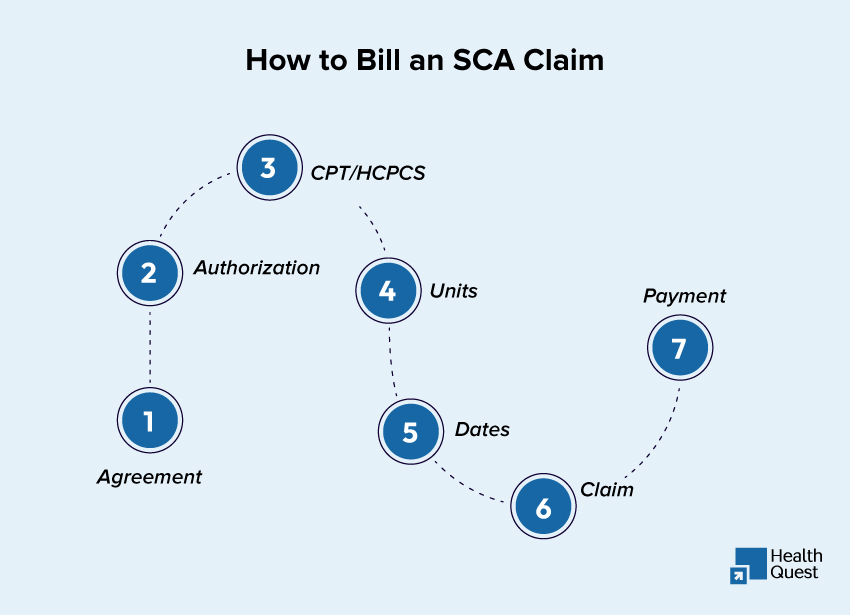
If any element does not match, the claim may require correction or additional documentation. Providers should also avoid assuming that one payer’s SCA claim instructions apply to another payer. Requirements for reporting authorization numbers, claim references, supporting records, or specific claim fields can vary.
SCA Payment Reconciliation: The Step Competitors Often Miss
Obtaining an SCA does not guarantee that the payer’s adjudication system will calculate payment correctly.
After the EOB or ERA is received, the billing team should compare:
Expected negotiated amount vs. allowed amount vs. payer payment vs. patient responsibility.
If the payment does not match the written agreement, the account should be flagged for SCA underpayment review.
The billing team should retain:
- Signed SCA
- Authorization
- Submitted claim
- Clearinghouse acceptance
- EOB/ERA
- Payment record
- Payer correspondence
- Appeal or reconsideration documentation
This creates an audit trail for underpayments and denials.
Common SCA Denials and Payment Problems
Common problems include:
- Missing SCA or authorization reference
- Incorrect CPT/HCPCS code
- Service outside the agreement dates
- Units exceeding authorization
- Payer system not updated
- Incorrect member information
- Missing medical records
- Timely-filing issues
- Payment below the negotiated amount
- Services outside the agreement scope
- Agreement terms not reflected in the billing system
- Additional services performed without an amendment
The solution is not always to simply resubmit the claim. First determine whether the problem originates with the claim, agreement, authorization, eligibility, or payer adjudication.
Medicaid and SCA Requirements
Medicaid SCA requirements vary by state and managed care organization (MCO). CMS guidance indicates that certain out-of-network providers under a single case agreement are not considered network providers for the federal managed-care screening and enrollment requirement addressed in that guidance. However, providers should still verify applicable state and MCO requirements before providing services.
For Medicaid medical billing and out-of-network billing, practices should confirm the payer’s enrollment, authorization, SCA, and claim-submission requirements rather than assuming that every SCA provider must follow the same process as an in-network provider.
Medicare and SCA Considerations
Original Medicare does not operate like a commercial health-plan network, so providers should not automatically apply commercial SCA concepts to Original Medicare.
Medicare Advantage is different because plans may have network and out-of-network rules. Providers should verify the specific MA plan’s requirements rather than assuming that an SCA is available or required.
2026 No Surprises Act and Federal IDR
The No Surprises Act provides federal protections for certain surprise out-of-network services and established the Federal Independent Dispute Resolution (IDR) process for eligible payment disputes. CMS reported that the Federal IDR process had received more than 5 million disputes since April 2022, demonstrating the scale of out-of-network payment disputes in the healthcare system.
For disputes initiated on or after June 11, 2026, the Federal IDR administrative fee is $15 per party per dispute. Providers should first determine whether the particular dispute meets the Federal IDR eligibility requirements rather than assuming every SCA underpayment qualifies.
Provider Self-Assessment: Is Your SCA Process Protecting Your Reimbursement?
A Single Case Agreement (SCA) can create a valuable reimbursement pathway for out-of-network care, but unclear terms, missed authorization requirements, incorrect claim submission, and payment discrepancies can create avoidable revenue leakage. Use this checklist to determine whether your practice has the right processes in place for SCA negotiation, billing, payment reconciliation, denial management, and A/R follow-up.
| Question | Yes | No |
|---|---|---|
| Does your billing team verify patient eligibility and out-of-network benefits before requesting an SCA? | ☐ | ☐ |
| Do you document the network gap or reason an out-of-network provider is needed? | ☐ | ☐ |
| Are SCA reimbursement rates and payment terms negotiated before services are provided whenever possible? | ☐ | ☐ |
| Does your team verify that the written SCA clearly lists approved CPT/HCPCS codes, units, dates, and reimbursement terms? | ☐ | ☐ |
| Are authorization and SCA reference numbers verified before claim submission? | ☐ | ☐ |
| Does your billing team compare each claim against the final SCA before submission? | ☐ | ☐ |
| Do you reconcile payer payments against the negotiated SCA reimbursement amount? | ☐ | ☐ |
| Does your team investigate SCA-related denials, underpayments, and payment discrepancies? | ☐ | ☐ |
| Are SCA expiration dates and authorized visits or units tracked to prevent services outside the agreement? | ☐ | ☐ |
| Do you monitor SCA-related A/R, denial trends, payment variances, and reimbursement performance by payer? | ☐ | ☐ |
Strengthen SCA Billing and Reimbursement with Expert RCM Support
Managing a Single Case Agreement requires more than obtaining payer approval. Health Quest Billing helps healthcare providers manage SCA-related billing workflows, including payer coordination, claim submission, payment reconciliation, denial follow-up, underpayment review, and A/R management. Our team helps providers identify billing discrepancies and strengthen revenue-cycle processes around out-of-network reimbursement.