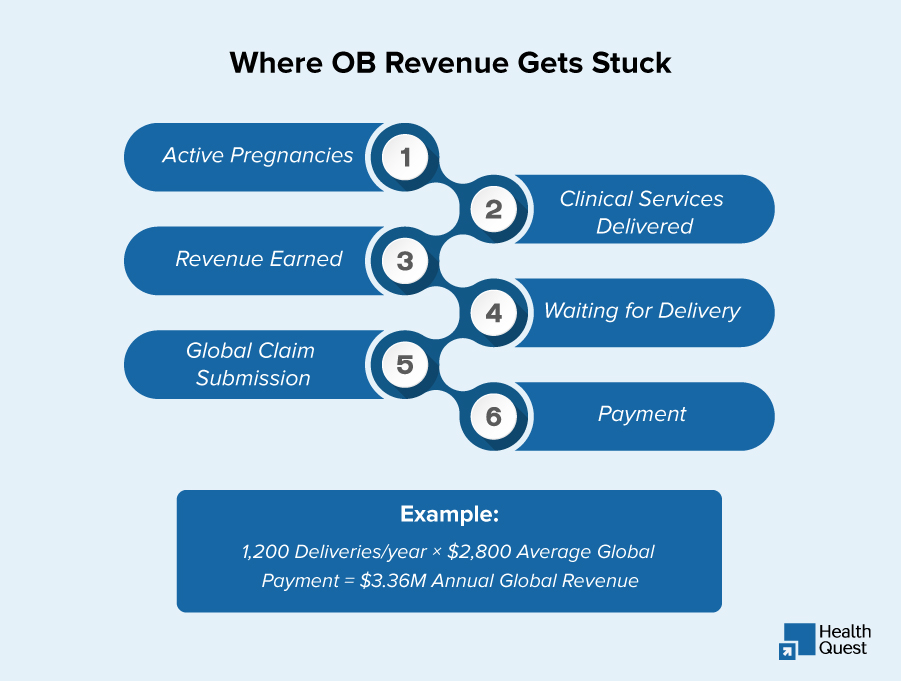
OB-GYN global billing can create a hidden cash flow gap because practices provide 9–10 months of maternity care before receiving payment through a single bundled claim after delivery. While clinical work and expenses continue throughout pregnancy, earned revenue may remain invisible until the global claim is submitted.
In this guide, we explore how delayed global billing affects cash flow, where revenue gets stuck, and how OB-GYN practices can improve revenue visibility through better billing workflows, exception billing capture, and revenue integrity strategies.
Why OB-GYN Global Billing Creates Cash Flow Problems
Global maternity billing was designed to simplify reimbursement by combining routine pregnancy-related services into one payment.
Common global OB billing codes include:
- CPT 59400 – Vaginal delivery with antepartum and postpartum care
- CPT 59510 – Cesarean delivery with antepartum and postpartum care
- CPT 59610 – Vaginal delivery after previous cesarean with global care
- CPT 59618 – Cesarean delivery after attempted VBAC with global care
Instead of submitting a separate claim for every routine prenatal visit, the practice generally submits one global claim after delivery.
This structure can reduce administrative complexity, but it also creates a delayed cash cycle.
The 9–10 Month Revenue Timing Gap
During pregnancy, OB-GYN practices continue paying for:
- Physician services
- Nursing support
- Care coordination
- Ultrasound management
- Administrative operations
- Insurance verification
- Technology systems
These costs occur immediately. However, reimbursement visibility may not occur until the pregnancy episode reaches delivery and the global claim is submitted.
For practices managing hundreds of active pregnancies, this creates significant unbilled earned revenue that does not appear in traditional accounts receivable reports.
The Hidden Revenue Float Inside OB Global Episodes
Traditional AR reporting answers:
“How much money is currently unpaid?”
But OB-GYN practices need another financial question:
“How much revenue has already been earned but has not entered the billing system yet?”
This difference is important because global maternity billing delays claim creation until delivery.
A pregnancy that begins in the first trimester may involve 30–40 weeks of clinical activity before reimbursement begins.
Example: Understanding the OB Revenue Float
Consider an OB-GYN group with:
- 10 providers
- 1,200 deliveries annually
- Average global reimbursement of $2,800
Estimated annual global maternity revenue:
1,200 × $2,800 = $3.36 million
At any point during the year, hundreds of pregnancies may be actively receiving care. This means a portion of future reimbursement remains tied to ongoing pregnancy episodes.
| Revenue Factor | Financial Impact |
|---|---|
| Active pregnancies | Represents future unbilled revenue |
| Delivery volume | Determines upcoming reimbursement |
| Global fee | Defines expected episode payment |
| Submission delay | Creates cash acceleration opportunities |
For practice leaders, improving cash flow starts with visibility into active pregnancy episodes before claims are created.
5 Reasons OB Practices Lose Cash During Global Billing
1. Delivery-to-Claim Submission Delays
The time between delivery and claim submission is one of the easiest opportunities to improve OB-GYN cash flow.
Many practices experience delays because they wait for:
- Provider signatures
- Final documentation review
- Postpartum records
- Coding confirmation
- Internal approvals
Every additional day delays revenue visibility. A practice that submits global claims quickly after delivery can improve its cash conversion cycle compared with organizations waiting weeks.
Recommended KPI: Delivery-to-submission time
| Timeline | Performance Indicator |
|---|---|
| Less than 5 days | Efficient workflow |
| 5–15 days | Improvement opportunity |
| 30+ days | Significant revenue delay |
2. Missed Separately Billable Services
One of the biggest OB billing revenue leakage risks is assuming every pregnancy-related service belongs inside the global package.
Depending on payer rules, documentation, and medical necessity, some services may qualify for separate reimbursement.
Examples include:
Ultrasounds
Medically necessary ultrasound services may require separate billing review instead of automatically being absorbed into global maternity care.
Non-Stress Tests (NST)
CPT 59025 may be separately reportable when performed for appropriate clinical reasons and supported by documentation.
High-Risk Pregnancy Management
Additional monitoring may be required for conditions such as:
- Gestational diabetes
- Hypertension
- Pregnancy complications
Complication Management
Visits related to conditions outside routine maternity care may require separate evaluation and management billing.
When these services are missed, practices lose revenue that was already generated through clinical work.
3. Insurance Changes During Pregnancy
Pregnancy episodes often cross insurance periods, creating additional billing risks.
Common challenges include:
- Employer insurance changes
- Medicaid eligibility changes
- Coverage termination
- Patient transfers between providers
Without ongoing eligibility verification, coverage issues may appear only after delivery.
This can lead to:
- Global claim denials
- Split billing complexity
- Delayed reimbursement
- Increased patient balances
A proactive eligibility process throughout pregnancy helps reduce these risks.
4. Documentation and Coding Gaps
Accurate documentation supports both compliance and reimbursement.
Common OB-GYN billing errors include:
- Missing pregnancy episode information
- Incorrect delivery details
- Incomplete provider documentation
- Poor tracking of additional services
Documentation gaps make it difficult to determine:
- Which services belong in the global package
- Which services qualify separately
- Whether coding supports reimbursement
Strong documentation improves billing accuracy and reduces preventable denials.
5. Limited Revenue Forecasting
Many practices forecast revenue only from submitted claims. This creates an incomplete financial picture because future maternity revenue already exists within active pregnancy episodes.
Without episode-based forecasting, leadership may lack visibility into:
- Upcoming deliveries
- Expected reimbursement
- Staffing needs
- Future cash flow
Effective OB billing management requires forecasting revenue before claims are created.
How Revenue Integrity Improves OB Billing Cash Flow
Traditional revenue cycle management often focuses after services are billed:
Claim → Payment → Denial → Appeal
Revenue integrity starts earlier:
Documentation → Coding → Billing → Payment
For OB-GYN practices, revenue integrity ensures every maternity episode is accurately captured from the first prenatal visit through final reimbursement.
A revenue integrity program helps identify:
- Missing charges
- Coding inconsistencies
- Incorrect global billing
- Underpayments
- Denial trends
- Documentation gaps
Instead of reacting to revenue problems after payment issues occur, practices can prevent leakage before claims leave the organization. For older unpaid balances and unresolved claims, practices should also review strategies to recover legacy AR and improve overall revenue recovery.
OB Billing Metrics Every Practice Should Monitor
Days in AR alone does not provide a complete picture of OB financial performance. OB-GYN leaders should monitor episode-level metrics to understand where revenue is delayed or lost.
| Metric | Target |
|---|---|
| Delivery-to-submission time | Less than 5 days |
| Clean claim rate | 95%+ |
| Denial rate | Consistently monitored |
| Exception billing capture | 100% tracking |
| AR days | Within benchmark |
Additional metrics include:
- Active pregnancy revenue forecast
- Expected delivery volume
- Payer reimbursement accuracy
- Global payment variance
- Patient responsibility collection rate
How 2027 OB Billing Changes May Impact Cash Flow
The OB-GYN billing environment continues to evolve as healthcare organizations move toward more detailed service reporting and stronger documentation requirements. Practices should stay informed about 2027 maternity coding changes to prepare their workflows, systems, and billing processes.
Future maternity billing updates may require practices to strengthen:
CPT Framework Readiness
Practices should monitor official CPT updates and payer guidance to understand future reporting requirements.
Encounter-Based Documentation
More detailed reporting may require stronger tracking of individual services and clinical encounters.
Documentation Accuracy
Detailed reporting depends on complete documentation for:
- Prenatal care
- Delivery services
- Postpartum management
Workflow Improvements
Practices should evaluate:
- EHR templates
- Charge capture processes
- Coding workflows
- Staff education
Preparing early helps minimize reimbursement disruption during future changes.
OB-GYN Cash Flow Self-Assessment: Where Is Your Maternity Revenue Getting Stuck?
Use this checklist to identify potential gaps affecting OB-GYN cash flow, including global maternity billing delays, missed revenue opportunities, documentation issues, payer payment variations, and revenue forecasting challenges.
| OB-GYN Cash Flow Assessment | Status |
|---|---|
| Are active pregnancy episodes tracked with expected delivery dates (EDD) and estimated reimbursement so your leadership team knows how much revenue is currently tied up before billing? | ☐ |
| Are global maternity claims reviewed to ensure the correct CPT codes, documentation requirements, payer rules, and global package guidelines are applied before submission? | ☐ |
| Is your practice tracking delivery-to-submission time to identify whether completed maternity episodes are being delayed before reaching payers? | ☐ |
| Are separately billable OB services, such as medically necessary ultrasounds, non-stress tests (NSTs), high-risk pregnancy management, and complication-related visits, reviewed to prevent missed revenue opportunities? | ☐ |
| Are payer underpayments and global payment variances analyzed to confirm your practice is receiving the expected reimbursement for completed maternity episodes? | ☐ |
| Are recurring OB billing denials being reviewed for root causes, including coding errors, documentation gaps, eligibility issues, and payer-specific requirements? | ☐ |
| Does your practice measure exception billing capture rates to determine how much eligible revenue is being captured outside the global maternity package? | ☐ |
| Are revenue forecasts based on expected deliveries and active pregnancy volume instead of only submitted claims and current accounts receivable? | ☐ |
Find the Hidden Revenue Gaps Behind Your OB-GYN Billing
Unchecked gaps can reveal opportunities to improve maternity billing accuracy, claim submission speed, revenue capture, payer payments and cash flow visibility. The goal isn’t just to collect delayed payments; it’s to identify why revenue gets stuck and fix the workflow causing the delay.