Accounts Receivable (AR) management has evolved from a back-office function to a critical financial lever that determines the sustainability and growth of healthcare practices in 2026. With 20% of claims facing delays or denials, practices face unpredictable cash flow, growing AR backlogs, and revenue leakage.
Effective AR management is about more than chasing unpaid claims; it is about proactively monitoring revenue, optimizing workflows, and recovering every dollar earned. Practices that master AR management experience:
- Faster reimbursements and reduced AR days
- Lower denial rates and improved first-pass clean claim rates
- Stronger cash flow, enabling predictable budgeting and growth
- Operational efficiency, reducing manual work and freeing staff for patient care
In 2026, AR management is not just an operational necessity; it is a strategic advantage. Practices leveraging automation, AI, and data-driven insights outperform their peers in revenue recovery, denial prevention, and financial stability.
Understanding Accounts Receivable (AR) Aging
Accounts Receivable (AR) aging categorizes unpaid claims based on the length of time they remain outstanding. Beyond a reporting tool, AR aging is a performance indicator that reveals:
- How efficiently your practice converts services into revenue
- Payer responsiveness and payment trends
- Operational gaps affecting cash flow
A well-managed AR aging process allows billing teams to prioritize high-risk claims, reduce delays, and improve collections, which directly strengthens the practice’s financial health.
Typical AR Aging Buckets
| AR Days | Description | Risk Level | Recommended Action |
|---|---|---|---|
| 0–30 | Newly submitted claims | Low | Verify eligibility, confirm coding, submit clean claims |
| 31–60 | Under payer review | Medium | Follow up on missing documentation or secondary billing issues |
| 61–90 | Aging claims | High | Escalate claims, contact payers, identify denial reasons |
| 90+ | Critical/High-risk | Very High | Intensive follow-up, appeals, possible collections |
Claims aging beyond 60 days significantly reduce reimbursement likelihood, making timely action critical.
AR Aging KPIs & Benchmarks
Monitoring AR KPIs ensures healthy revenue cycles. Key metrics include:
- Days in AR: Average <45 days is ideal
- First-pass clean claim rate: Target ≥95%
- Denial rate: Maintain <5%
- Revenue leakage: Reduced by proactive AR management
Practices that monitor these KPIs consistently recover more revenue and maintain predictable cash flow, even in complex billing environments.
Common Causes of AR Delays and Denials
Understanding why claims get delayed or denied is crucial to protecting revenue and maintaining predictable cash flow. Even small inefficiencies can snowball into extended AR days and lost income if not addressed proactively.
- Authorization Issues
Missing or expired prior authorizations are a leading reason high-value claims get rejected. Delays in approval push claims into riskier aging categories and create unnecessary follow-ups. Practices that verify authorizations upfront and track payer-specific rules see faster reimbursements and fewer denials.
- Documentation and Coding Errors
Errors in CPT or ICD-10 coding, incomplete clinical notes, or mismatched EHR-billing data are major contributors to claim denials. Even minor mistakes require manual rework, slowing collections and increasing operational costs. Standardized documentation and automated coding checks help reduce errors and improve first-pass acceptance rates.
- Credentialing and Enrollment Gaps
Claims submitted under inactive or non-credentialed providers are almost always denied. Lapses in provider enrollment or credentialing not only delay payments but also increase staff workload. Monitoring credentials and payer enrollment status ensures claims are submitted correctly the first time.
- Manual Processes and Low Prioritization
Without automation, billing teams often focus on routine claims while high-value accounts age unnoticed. Manual follow-ups are time-consuming and error-prone, slowing revenue cycles. Intelligent claim prioritization helps staff focus on high-impact accounts, reducing AR days and improving cash flow predictability.
- Inconsistent Write-Off Policies
Unclear policies for patient balances and write-offs create delays and lost revenue. Standardizing rules and combining them with patient engagement ensures timely collections and accurate financial reporting.
Practices relying on manual AR workflows face up to 20% more denied claims compared to those using AI-assisted RCM solutions, highlighting the value of automation and proactive management.
Financial Implications of Ineffective AR Management
Inefficient AR management doesn’t just create administrative headaches; it has a direct impact on a practice’s bottom line. Delayed or denied claims, manual processes, and unclear policies can quietly erode revenue, increase costs, and destabilize cash flow.
- Revenue Leakage: Every delayed or denied claim represents lost revenue. Studies show that practices with inefficient AR workflows can lose up to 30% of potential reimbursements. Over time, these losses compound, reducing the funds available for staff, equipment, and growth initiatives.
- Higher Operational Costs: Manual claim follow-ups, repeated rework due to errors, and inefficient staffing contribute to 15–20% higher operational costs. Without streamlined workflows, teams spend more time fixing problems than proactively collecting payments.
- Cash Flow Challenges: Backlogged AR makes revenue unpredictable, complicating budgeting, payroll, and investments in practice expansion. Inconsistent cash flow can force practices into reactive decision-making, increasing financial stress and limiting growth opportunities.
Leveraging AI and Automation for AR
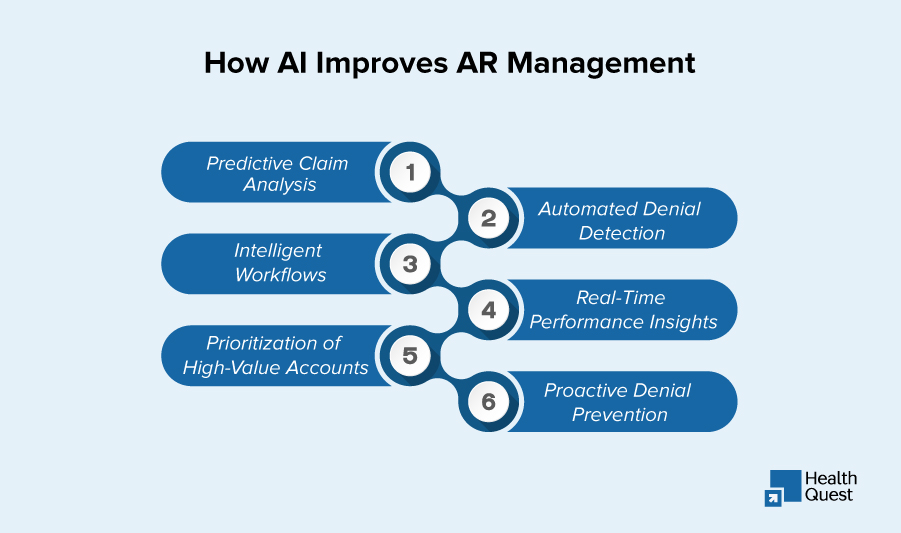
In 2026, artificial intelligence (AI) and automation are transforming how healthcare practices manage Accounts Receivable. No longer is AR management solely about chasing unpaid claims—today, it’s about predicting issues, prioritizing high-value accounts, and acting proactively to protect revenue.
- Predictive Analytics
AI can analyze historical claim data and payer behavior to identify claims that are likely to be delayed or denied before submission. By flagging these high-risk claims early, billing teams can take corrective action, such as updating documentation or verifying eligibility, significantly increasing the likelihood of successful reimbursement.
- Automated Denial Prevention
Modern AI systems detect patterns in payer decisions, coding errors, and documentation gaps, allowing practices to prevent denials before they occur. Automated alerts and validation checks help ensure that claims are submitted correctly the first time, improving first-pass clean claim rates and reducing rework.
- Intelligent Workflow Prioritization
Automation can prioritize claims based on financial impact and risk, ensuring that high-value accounts receive immediate attention. This not only accelerates collections but also frees staff from repetitive follow-ups, allowing them to focus on strategic revenue recovery tasks.
- Real-Time Dashboards & Metrics
AI-powered AR dashboards provide instant visibility into claim trends, aging accounts, and payer behavior, empowering decision-makers to monitor performance and adjust workflows in real-time. These insights help practices identify bottlenecks, track key performance indicators, and make data-driven decisions that improve overall revenue cycle efficiency.
- Impact on Financial Performance
Studies and real-world implementations show that AI-enabled AR management can reduce AR days by 30–40% and denial rates by 15–25%, significantly enhancing revenue recovery. Practices that adopt AI and automation not only collect faster but also improve cash flow predictability and reduce operational strain.
By leveraging AI-driven predictive analytics, automated denial prevention, and intelligent workflows, practices can turn AR management into a proactive, revenue-generating process rather than a reactive, time-consuming task.
Emerging 2026 Healthcare Trends Impacting AR
The healthcare revenue cycle is evolving rapidly, and 2026 brings new challenges that directly impact Accounts Receivable (AR) management. Understanding these trends is essential for practices that want to maintain predictable cash flow, reduce denials, and optimize collections.
- Telehealth Expansion
Telehealth adoption continues to grow, offering patients greater access and convenience. However, this rapid expansion introduces a host of new CPT codes, payer-specific billing rules, and documentation requirements. Even minor coding errors in telehealth claims can lead to delays or denials, making proactive claim verification essential. Practices that stay current with telehealth regulations and integrate automated coding checks can minimize errors and maintain faster reimbursement cycles.
- Payer Policy Updates & Stricter Audits
Payers are updating policies more frequently and enforcing stricter audit protocols. These changes require continuous monitoring of claims, documentation, and eligibility rules. Practices that fail to adapt risk increased denial rates, slower reimbursements, and AR backlogs. A proactive approach—using real-time analytics and automated alerts- ensures compliance and reduces the administrative burden associated with manual claim corrections.
- Interoperability Challenges
Disconnected EMR, billing, and payer systems remain a persistent source of AR delays. Misaligned data between systems can lead to claim mismatches, lost documentation, or incorrect submissions. Addressing interoperability gaps through system integration, automated data validation, and secure data exchanges ensures smoother claim processing and fewer avoidable denials.
Documentation & Compliance Requirements
Incomplete or inconsistent clinical documentation is a leading cause of denied or delayed claims. In 2026, payers increasingly demand detailed records, correct coding, and compliance with evolving regulations. Practices that standardize documentation workflows, implement quality audits, and train staff on compliance best practices can improve first-pass claim acceptance, reduce AR days, and protect revenue.
By understanding and adapting to these trends, healthcare practices can transform potential challenges into opportunities, ensuring more accurate claims, faster reimbursements, and stronger financial stability in a complex and changing landscape.
CMS & Regulatory Updates for 2026
Keeping up with CMS and regulatory changes is critical for healthcare practices looking to protect revenue and optimize AR in 2026. Evolving guidelines impact telehealth billing, quality reporting, and multi-payer coordination, making proactive compliance a key factor in reducing denials and ensuring timely reimbursement.
- Telehealth CPT Codes
Telehealth continues to be a major focus for CMS, with permanent CPT codes and evolving payer-specific guidelines. While these codes expand access to virtual care, they also increase the complexity of billing. Practices must stay updated on approved telehealth services, documentation requirements, and payer rules to avoid claim rejections or delayed reimbursements. Implementing automated coding validation and telehealth-specific workflows can help ensure claims are submitted accurately the first time.
- MACRA & MIPS Updates
The 2026 updates to MACRA and MIPS place greater emphasis on quality reporting and value-based care metrics. Performance on MIPS quality measures directly affects reimbursement levels, making accurate reporting and documentation more important than ever. Practices that track metrics in real time, audit data regularly, and align workflows with MIPS requirements can maximize incentives while minimizing penalties.
- COB & Secondary Claims Rules
CMS is enforcing stricter rules for Coordination of Benefits (COB) and secondary claims submission. Accurate multi-payer coordination is now essential to avoid denials and lost revenue. Ensuring that primary and secondary payer information is correct, along with timely submission of supporting documentation, helps practices reduce delays and recover revenue from secondary payers more efficiently.
By staying proactive with CMS updates, telehealth billing, and multi-payer coordination, practices can improve first-pass claim acceptance, minimize AR delays, and maintain predictable cash flow even in a rapidly changing regulatory environment.
In-House vs Outsourced AR Management
Healthcare practices face a critical decision in 2026: whether to manage Accounts Receivable (AR) internally or leverage outsourced expertise. Both approaches have advantages and trade-offs, but understanding the key differences can help practices optimize revenue, reduce AR days, and improve operational efficiency.
Pros and Cons
| Factor | In-House | Outsourced |
|---|---|---|
| Staffing | Limited by team size; high volumes often overwhelm staff and slow collections. | Scalable and specialized resources that can handle large claim volumes efficiently. |
| Technology | Typically relies on EMR-integrated tools and manual follow-ups, which are time-consuming and prone to error. | AI-driven analytics, predictive dashboards, and automated workflows streamline AR management and reduce manual tasks. |
| Denial Management | Reactive: issues are identified after claims are denied, requiring manual rework. | Predictive and proactive: AI identifies high-risk claims, prevents denials before submission, and prioritizes follow-ups. |
| Cost | Fixed salaries and overhead; efficiency depends on internal team capacity and expertise. | Flexible cost structure with ROI-focused solutions; faster collections and reduced AR days translate directly into revenue gains. |
Hybrid Model Advantages
A hybrid approach combines the best of both worlds—retaining internal expertise for strategic decision-making while leveraging external resources and automation for day-to-day AR management. Practices can maintain control over high-value claims while reducing manual workload and improving cash flow predictability.
Cost & ROI Comparison
Outsourced or hybrid AR solutions consistently demonstrate measurable financial benefits. Practices can recover 15–30% more revenue, reduce AR days significantly, and allow internal staff to focus on patient care and growth initiatives rather than manual follow-ups. The investment in predictive analytics and workflow automation often pays for itself through faster collections and fewer denials.