
In colon and rectal surgery, patient care is the priority, but is your revenue care receiving the same level of attention? Billing and coding errors often go unnoticed but can silently drain your margins. Practices facing rising denial rates, underpayments, and coding errors can no longer afford to ignore this critical aspect of revenue cycle management.
If your practice is losing revenue, it’s likely due to denials, underpayments, or errors that are quietly chipping away at your margins.
This blog highlights the complex billing challenges in colon and rectal surgery, common coding risks, state-level reimbursement pressures, and how Health Quest Billing can help you recover revenue without disrupting your workflows.
Why Colon & Rectal Surgery Billing Is Uniquely Challenging
Colon and rectal surgeons perform procedures that often fall into gray areas of coding and reimbursement. Many services involve overlapping CPT codes, bundled procedures, and payer-specific rules that differ by state and plan.
Key challenges include:
- Global surgical period disputes
- Modifier usage for multiple procedures
- Inpatient vs. outpatient classification
- Medicare vs. commercial payer reimbursement differences
- Documentation requirements tied to medical necessity
Even small errors, such as incorrect modifier placement or incomplete operative notes, can lead to denials, audits, or payment reductions. For high-volume colorectal practices, these issues compound quickly.
The Financial Risk of Billing Errors in Colorectal Surgery
Many practices assume that denied or delayed claims are simply “part of the system.” However, these losses are often preventable. Industry data shows that:
- 10–15% of surgical claims are denied on first submission
- Claims older than 90 days have less than a 20% chance of full recovery
- 3–6% of surgical revenue is lost annually due to underpayments
- Modifier-related errors are one of the top causes for denials in surgical specialties
Because colorectal procedures carry higher reimbursement values, each denied or underpaid claim has a disproportionate impact on overall margins.
Common Colon & Rectal Surgery Billing Mistakes
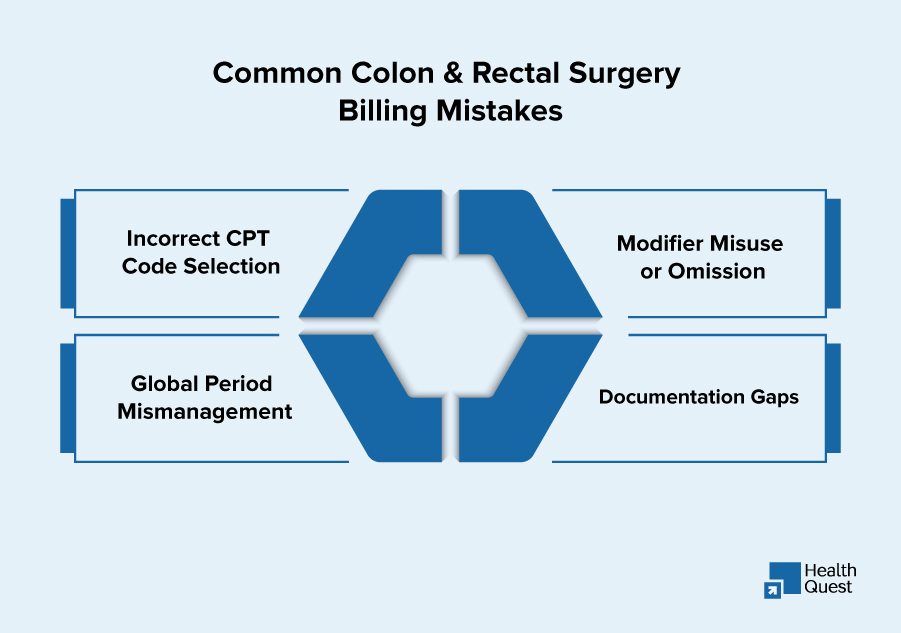
From a billing perspective, the most frequent issues include:
Incorrect CPT Code Selection
Many colorectal procedures have similar descriptions but very different reimbursement implications. Choosing the wrong code, even when clinically similar, can result in reduced payment or denial.
Modifier Misuse or Omission
Modifiers such as -51, -59, -22, -78, and -79 are frequently required in colorectal surgery. Missing or incorrect modifiers are a leading cause of payer rejections.
Global Period Mismanagement
Post-operative visits, reoperations, and related procedures are often incorrectly billed during global periods, triggering automatic denials.
Documentation Gaps
Operative reports that lack:
- Clear procedural detail
- Medical necessity justification
- Distinction between separate procedures
Often fail payer audits, especially under Medicare and Medicare Advantage plans.
Colon & Rectal Surgery Coding Cheat Sheet
Here’s a high-level coding reference for commonly billed colorectal procedures. This is not exhaustive but highlights frequent risk areas:
| Procedure Description | Common CPT Codes | Billing Notes |
| Colonoscopy (diagnostic) | 45378 | Modifier may apply if therapeutic service added |
| Colonoscopy with biopsy | 45380 | Documentation must support biopsy necessity |
| Colonoscopy with polypectomy | 45385 | High audit frequency under Medicare |
| Hemorrhoidectomy | 46250, 46260 | Global period applies |
| Anal fistula repair | 46270–46288 | Correct code depends on complexity |
| Colectomy (partial) | 44140–44147 | Inpatient vs outpatient status matters |
| Laparoscopic colectomy | 44204–44208 | Modifier -22 may apply for complexity |
| Rectal prolapse repair | 45540–45562 | Documentation must support approach |
| Sigmoidectomy | 44140, 44204 | Bundling rules vary by payer |
| Ostomy creation | 44186–44188 | Often bundled with primary procedure |
Accurate coding depends on operative detail, payer policy, and correct modifier use, not just code selection.
State-by-State Billing Pressure in Colon & Rectal Surgery
Reimbursement challenges vary by state, driven by Medicaid policies, Medicare Advantage penetration, and payer audits. Practices in the following states experience the highest billing pressure:
- California: Aggressive audit activity, high denial rates tied to documentation detail
- Texas: Complex Medicaid managed care structure, frequent eligibility changes
- Florida: High Medicare Advantage enrollment, post-payment audits
- New York: Strict Medicaid oversight, high denial rates for bundled procedures
- Illinois: Increased scrutiny on surgical necessity, delayed reimbursements
In these states, manual billing workflows often struggle to keep up with payer demands.
How Colon & Rectal Surgery Billing Impacts Cash Flow
From a revenue cycle standpoint, billing delays directly affect:
- Payroll stability
- Equipment investment
- Staff retention
- Expansion planning
When claims age beyond 60–90 days, practices face cash flow gaps that cannot be solved by seeing more patients. Better billing, not higher volume, is what stabilizes revenue.
Specialty-Specific Billing Risks in Colorectal Surgery
Colon & rectal surgery spans multiple care settings, each with different billing rules:
- Hospital-based surgery
- Ambulatory surgery centers (ASCs)
- Office procedures
- Inpatient admissions
Each setting carries different place-of-service codes and reimbursement structures. Common risks include:
- ASC vs hospital reimbursement differences
- Inpatient admission criteria disputes
- Overlapping E/M and procedure billing
- Incorrect place-of-service coding
Why Many Surgical Practices Outsource Billing
Many colorectal surgeons and administrators reach the conclusion that billing complexity has outgrown in-house capacity. Reasons to outsource include:
- Difficulty keeping up with payer changes
- Inconsistent follow-up on denied claims
- Limited insight into underpayments
- Staff burnout and turnover
- Rising audit risk
Outsourcing is no longer about convenience; it’s about financial protection.
How Health Quest Billing Supports Colon & Rectal Surgery Practices

Health Quest Billing partners with colon and rectal surgery practices that need specialty-specific billing expertise, not one-size-fits-all medical billing.
Our support focuses on what directly impacts surgical revenue:
- Accurate CPT, ICD-10, and modifier usage for colorectal procedures
- Timely follow-up on surgical claims and structured denial resolution
- Identification and recovery of underpayments tied to contracted rates
- State-specific payer rule compliance for Medicare, Medicaid, and commercial plans
- Clear, actionable reporting that helps leadership track performance and risk areas
Rather than disrupting workflows, Health Quest Billing integrates into existing operations to strengthen revenue performance over time. We don’t promise shortcuts. We focus on consistency, accuracy, and accountability because that’s what surgical billing demands.
What Practices Should Evaluate in Their Current Billing Process
If you manage or own a colon & rectal surgery practice, ask:
- How many claims exceed 60 or 90 days?
- Are underpayments being tracked—or ignored?
- Are modifier denials trending upward?
- Do we know which payers delay payment the most?
- Are audits increasing year over year?
If you’re unsure of the answers, revenue risk is already present.
Final Thoughts:
Colon & rectal surgery is too complex and valuable to leave billing to chance. In today’s environment, coding accuracy, documentation strength, and proactive follow-up determine whether your revenue is collected or quietly lost. Health Quest Billing helps you transition from reactive billing to controlled revenue management without overwhelming your team. Because in surgical billing, what isn’t billed correctly doesn’t get paid, no matter how well the procedure was performed.
Ready to optimize your billing process and protect your margins? Contact Health Quest Billing today to discover how we can help you streamline your revenue cycle management.