A dermatologist can have the right license, training, and board certification and still face delays getting paid by insurance. Credentialing and enrollment establish the payer relationships needed for participating insurance billing, but missing documents, outdated CAQH information, NPI discrepancies, or incomplete applications can delay the process.
CAQH reports that 80% of U.S. MDs, DOs, and DMDs share their provider data through its platform to simplify credentialing, highlighting the importance of accurate provider information in the payer enrollment process.
This guide covers dermatology credentialing and enrollment services, including CAQH, payer enrollment, required documents, timelines, common delays, and a provider self-assessment checklist.
What Is Dermatology Credentialing and Enrollment?
Dermatology credentialing is the process of verifying a provider’s education, training, licenses, certifications, work history, and other professional information. Enrollment registers the provider and when applicable, the practice entity with individual insurance payers so the provider can participate in their networks and submit claims according to payer requirements.
- Credentialing: Verifies whether the provider meets the payer’s professional requirements.
- Enrollment: Establishes the provider’s participation and billing relationship with the payer.
- Contracting: Establishes the terms of participation between the provider or practice and the payer.
- Recredentialing/revalidation: Keeps provider information current after initial approval.
For Medicare, CMS uses PECOS (Provider Enrollment, Chain, and Ownership System) to manage enrollment information for physicians and other providers. A dermatologist can complete credentialing requirements without necessarily having every payer enrollment and billing relationship activated.
Why Credentialing Matters to Dermatology Practices
Dermatology practices may combine medical, surgical, procedural, and cosmetic services, creating different payer and documentation requirements.
Credentialing becomes particularly important when a practice:
- Opens a new dermatology location
- Adds a dermatologist, NP, or PA
- Joins a medical group
- Adds Medicare or Medicaid patients
- Expands into another state
- Adds Mohs surgery or other specialized services
- Begins teledermatology
- Changes ownership or organizational structure
- Needs to revalidate or recredential with a payer
Dermatology Credentialing and Enrollment Process
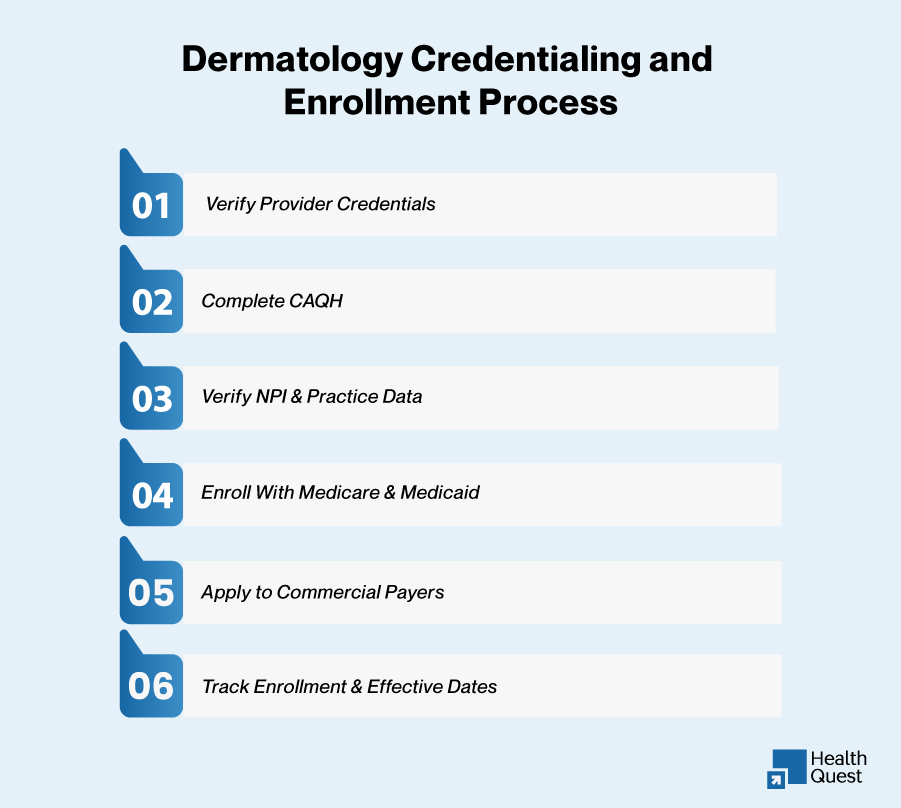
A reliable process moves from provider verification through payer approval and billing activation.
1. Verify Provider Credentials
Create a complete credentialing file with documents such as:
- Medical degree and residency information
- Fellowship documentation, when applicable
- State medical licenses
- Board certification
- DEA registration, when applicable
- NPI
- CV and professional history
- Malpractice insurance
- Hospital privileges, when applicable
- Practice information
- Tax ID/EIN and group NPI
- Payer-specific forms
Requirements vary by payer and provider type, so applications should be reviewed individually.
2. Complete CAQH
CAQH ProView stores provider information used by participating health plans. Keeping licenses, practice locations, certifications, and supporting documents current helps prevent application delays.
3. Verify NPI and Practice Data
Individual NPI, group NPI, taxonomy, Tax ID/EIN, legal entity name, and practice locations should match across enrollment records. Inconsistent information can cause processing issues.
4. Enroll With Medicare and Medicaid
Medicare enrollment is generally managed through PECOS, while Medicaid enrollment follows state-specific requirements. Multi-state practices may need separate Medicaid enrollments.
5. Apply to Commercial Payers
Commercial payer enrollment requires provider information and supporting documentation according to each plan’s requirements. Network participation and contracting rules vary by payer.
6. Track Applications and Effective Dates
After submission, applications should be monitored for missing information, payer requests, approval status, and effective dates. Confirming the effective date is important before billing claims under the new payer relationship.
How Long Does Dermatology Credentialing Take?
Credentialing timelines vary by payer, state, documentation, and provider type. Typical planning ranges are:
| Enrollment Type | Typical Timeline |
|---|---|
| Commercial Payers | 45–90 days |
| Medicare/PECOS | 60–120 days |
| Medicaid | Varies by state |
| Complex Enrollment | May take longer |
Dermatology-Specific Credentialing Considerations
- Medical Dermatology: Providers treating acne, psoriasis, eczema, infections, and skin cancer may require enrollment with multiple government and commercial payers.
- Cosmetic Dermatology: Cosmetic and medically necessary services may follow different coverage and payment rules, requiring clear payer workflows.
- Mohs Surgery: Mohs surgeons may need additional documentation for specialized training, qualifications, privileges, and payer requirements.
- Dermatopathology: Dermatopathology services may involve additional facility, laboratory, and billing considerations depending on the practice structure.
- NP and PA Enrollment: Requirements can vary by payer, state, provider type, supervision rules, and billing arrangements.
- Teledermatology: Multi-state teledermatology requires attention to state licensing and applicable payer enrollment requirements.
Common Dermatology Credentialing Problems and Solutions
| Problem | Solution |
|---|---|
| Incomplete Documentation | Maintain a complete credentialing file with current licenses, malpractice coverage, training records, and payer-required documents. |
| Outdated CAQH Profile | Review CAQH information regularly and complete required re-attestation on time. |
| NPI and Tax ID Mismatches | Verify individual NPI, group NPI, Tax ID/EIN, taxonomy, and practice information before submission. |
| Incorrect Taxonomy | Confirm that the provider taxonomy matches the provider and enrollment requirements. |
| Expired Licenses or Insurance | Track expiration dates and renew required credentials before they expire. |
| Lack of Payer Follow-Up | Track application status, payer requests, reference numbers, and follow-ups until enrollment is approved. |
Questions to Ask a Dermatology Credentialing Company
- Do you have experience with dermatology credentialing, including medical, cosmetic, Mohs, and dermatopathology practices?
- Do you handle both provider credentialing and payer enrollment?
- Do you manage CAQH setup, updates, and re-attestation?
- Do you handle Medicare, Medicaid, and commercial payer enrollment?
- How do you track applications, follow up with payers, and report delays?
- What support do you provide after approval, including effective-date verification and recredentialing?
Provider Self-Assessment: Is Your Dermatology Practice Ready for Credentialing and Enrollment?
Use this checklist to identify gaps in provider credentialing, payer enrollment, documentation, compliance, and enrollment maintenance.
| Credentialing and Enrollment Task | Status |
|---|---|
| Are all dermatologists, NPs, and PAs credentialed with the payers they serve? | ☐ |
| Is each provider’s CAQH ProView profile complete, accurate, and properly attested? | ☐ |
| Are state medical licenses current in every state where providers practice? | ☐ |
| Are board certifications, education, training, and work history properly documented? | ☐ |
| Are malpractice insurance certificates current and available for payer applications? | ☐ |
| Are individual and group NPIs, taxonomy codes, and Tax ID/EIN information accurate and consistent? | ☐ |
| Has the practice completed applicable Medicare PECOS enrollment and reassignment requirements? | ☐ |
| Are Medicaid provider enrollments active and compliant with state-specific requirements? | ☐ |
| Are commercial payer applications submitted, tracked, and followed up consistently? | ☐ |
| Are payer approval and effective dates documented before claims are submitted? | ☐ |
| Does your practice monitor CAQH, license, malpractice, and recredentialing deadlines? | ☐ |
| Are new dermatologists, NPs, and PAs credentialed before their planned start dates? | ☐ |
| Are specialized providers, such as Mohs surgeons and dermatopathologists, supported with required documentation? | ☐ |
| Does your team maintain an updated record of each provider’s payer participation status? | ☐ |
| Do you regularly review credentialing and enrollment gaps that could affect billing and reimbursement? | ☐ |
Improve Dermatology Credentialing With Health Quest Billing
Incomplete applications, outdated provider information, missed enrollment deadlines, and payer-specific requirements can delay network participation and create downstream billing problems. Health Quest Billing provides medical credentialing, payer enrollment, CAQH maintenance, and revenue cycle management support for dermatology practices.
Schedule Your Dermatology Credentialing Consultation Today and get expert support with provider credentialing, payer enrollment, CAQH, and enrollment follow-up.