f your sleep center is performing more sleep studies but facing increasing denials, delayed payments, and growing accounts receivable, you’re not alone. Industry reports estimate that 10–15% of healthcare claims are initially denied, while Medicare and commercial payers continue increasing scrutiny of sleep study and CPAP-related claims.
A single denied PSG or HST claim can delay reimbursement for weeks, increase administrative workload, and quietly reduce profitability. Many sleep centers lose revenue long before a claim is denied due to authorization issues, documentation gaps, coding errors, and underpayments that often go unnoticed.
That’s why specialized Sleep Medicine Billing Services have become essential for providers looking to improve collections, reduce denials, and maintain a healthy revenue cycle in today’s increasingly complex reimbursement environment.
Warning Signs Your Sleep Center Has a Revenue Cycle Problem
Many providers don’t realize revenue cycle issues exist until cash flow begins to suffer. If your practice is experiencing any of the following challenges, your billing process may require immediate attention.
| Warning Sign | Potential Impact |
|---|---|
| Denial rate above 5% | Lost revenue and delayed payments |
| A/R over 40 days | Cash flow disruption |
| Frequent authorization denials | Increased reimbursement delays |
| Growing unpaid claims | Revenue leakage |
| High staff time spent on appeals | Increased administrative costs |
| Recurring coding errors | Higher denial rates |
| Underpaid claims | Reduced collections |
Even one of these indicators can signal inefficiencies that negatively affect financial performance.
The Hidden Cost of Sleep Study Claim Denials
Claim denials are more than a billing inconvenience. They create additional administrative work, delay payments, increase operating costs, and reduce overall collections.
Financial Impact of Common Billing Issues
| Revenue Issue | Financial Consequence |
| Authorization Denials | Lost reimbursement opportunities |
| Coding Errors | Payment delays and rework |
| Documentation Deficiencies | Claim denials and audits |
| Underpayments | Revenue leakage |
| Aging A/R | Reduced cash flow |
| Missed Appeals | Permanent revenue loss |
For sleep centers performing dozens or hundreds of studies each month, these issues can translate into thousands of dollars in preventable revenue loss annually.
Where Sleep Centers Commonly Lose Revenue
Many providers assume revenue loss occurs only when a claim is denied. In reality, reimbursement problems often begin long before a claim is submitted.
Before the Sleep Study
Common pre-service revenue leaks include:
- Incomplete insurance verification
- Missing referrals
- Incorrect patient insurance information
- Expired authorizations
- Failure to verify sleep study benefits
- Scheduling services that do not meet payer criteria
During Documentation
Documentation issues frequently include:
- Missing physician orders
- Incomplete symptom documentation
- Weak medical necessity support
- Missing sleep study reports
- Inadequate CPAP compliance records
During Coding and Claim Submission
Common billing errors include:
- Incorrect CPT coding
- Diagnosis code mismatches
- Missing modifiers
- Delayed charge entry
- Failure to follow payer-specific billing rules
After Payment
Many providers overlook revenue leakage after claims are paid.
Common issues include:
- Underpaid claims
- Unworked denials
- Missed appeals
- Aging accounts receivable
- Incorrect payer adjustments
Protecting revenue requires attention at every stage of the patient journey, not simply at claim submission.
What Is Sleep Medicine Billing?
Sleep medicine billing is the specialized process of coding, documenting, submitting, tracking, and managing reimbursement for sleep-related diagnostic testing, physician services, CPAP therapy management, durable medical equipment (DME), and ongoing treatment of sleep disorders.
A successful sleep medicine revenue cycle includes:
- Insurance eligibility verification
- Prior authorization management
- Medical necessity documentation
- Sleep study coding and billing
- CPAP and DME reimbursement
- Claim submission and tracking
- Denial management and appeals
- Accounts receivable follow-up
- Revenue cycle reporting
Because sleep medicine often combines diagnostic testing, physician interpretation, and equipment-related services, even minor documentation or coding errors can result in claim denials, underpayments, or audit risks.
Why Sleep Medicine Billing Is More Complex Than Most Medical Specialties
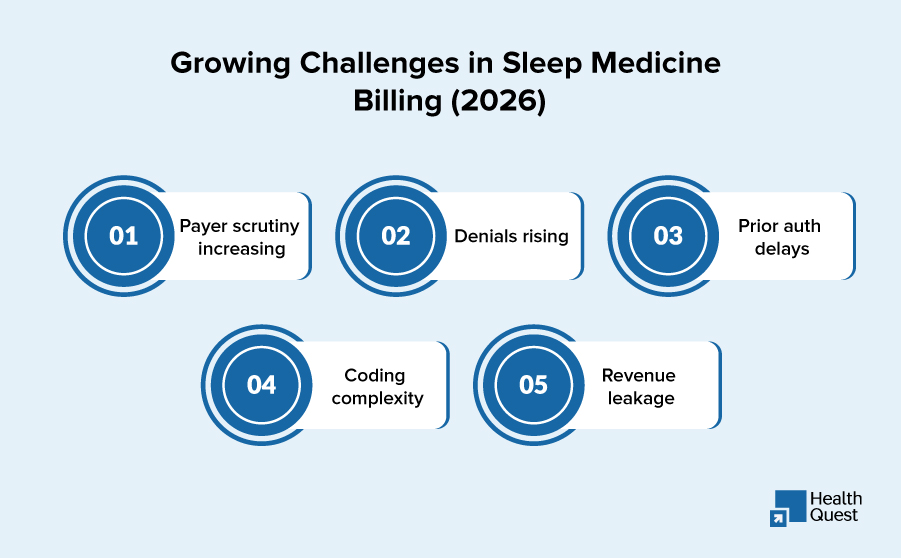
Many healthcare specialties primarily bill for office visits, procedures, and follow-up care. Sleep medicine is different because providers must manage reimbursement across an entire patient journey that includes diagnostic testing, physician evaluations, prior authorizations, payer compliance requirements, and long-term therapy monitoring.
Providers frequently encounter challenges involving:
Prior Authorization Requirements
Commercial insurers increasingly require prior authorization before approving polysomnography (PSG) and other sleep studies. Missing or inaccurate authorizations often lead to automatic denials regardless of medical necessity.
Medical Necessity Documentation
Payers require detailed documentation demonstrating that sleep testing is clinically appropriate. Missing symptom history, physician assessments, or supporting clinical evidence can result in denied claims.
Home Sleep Testing (HST) Coverage Rules
Many insurers encourage lower-cost home sleep testing before approving facility-based studies. Providers must carefully document patient eligibility and comply with payer-specific requirements.
CPAP & DME Compliance Requirements
Reimbursement for CPAP equipment and related supplies depends on strict qualification criteria, compliance monitoring, physician documentation, and ongoing patient follow-up.
Payer-Specific Billing Rules
Medicare, Medicaid, and commercial insurers often maintain different coverage policies, coding requirements, authorization standards, and reimbursement methodologies.
Because of these complexities, successful reimbursement depends on far more than claim submission. It requires a specialized billing strategy designed specifically for sleep medicine.
The Most Common Causes of Sleep Study Claim Denials
Claim denials remain one of the largest obstacles to financial success for sleep centers. While payer policies vary, most denied sleep study claims can be traced to a small group of recurring billing, coding, documentation, and authorization issues.
Understanding why claims are denied allows providers to proactively address revenue cycle weaknesses before they affect cash flow.
1. Missing or Incorrect Prior Authorizations
Prior authorization requirements continue to expand across commercial health plans. Many insurers require approval before diagnostic polysomnography (PSG), CPAP titration studies, and certain home sleep testing services.
Common authorization-related denials occur when:
- Authorization was never obtained
- Authorization expired before the date of service
- Authorized services differ from services performed
- Clinical documentation fails to support approval criteria
- Authorization information is entered incorrectly on the claim
Because these denials often occur before medical necessity is even reviewed, authorization management remains one of the most important denial prevention strategies for sleep centers.
2. Insufficient Medical Necessity Documentation
Medical necessity remains one of the most scrutinized components of sleep medicine reimbursement.
Payers expect providers to document:
- Excessive daytime sleepiness
- Witnessed apnea episodes
- Chronic fatigue
- Snoring and sleep disturbances
- Relevant comorbid conditions
- Physician assessment and testing rationale
Incomplete documentation frequently results in denials, even when testing was clinically appropriate.
3. CPT and ICD-10 Coding Errors
Sleep medicine involves specialized diagnostic testing and disorder-specific diagnoses that require precise coding.
Common coding mistakes include:
- Incorrect sleep study CPT selection
- Diagnosis codes that do not support medical necessity
- Missing modifiers
- Coding services not supported by documentation
- Incorrect linkage between diagnosis and procedure codes
Even small coding inaccuracies can trigger claim rejections, delayed payments, or reduced reimbursement.
4. Insurance Eligibility and Benefit Verification Failures
Many reimbursement problems begin before a patient ever arrives for testing.
Common eligibility issues include:
- Inactive coverage
- Incorrect insurance information
- Benefit limitations
- Non-covered services
- Missing referrals
Verifying coverage before scheduling services helps reduce preventable denials and patient billing disputes.
5. CPAP and DME Documentation Deficiencies
CPAP therapy reimbursement requires ongoing compliance monitoring and documentation.
Common reasons for CPAP-related denials include:
- Missing sleep study documentation
- Failure to meet qualification criteria
- Missing physician evaluations
- Lack of compliance records
- Insufficient follow-up documentation
Because CPAP reimbursement often extends beyond the initial diagnosis, documentation consistency remains critical throughout the patient’s treatment journey.
HST vs PSG Billing: Understanding the Reimbursement Differences
Selecting the appropriate sleep study impacts both clinical outcomes and reimbursement success. Although Home Sleep Testing (HST) and Polysomnography (PSG) serve similar diagnostic purposes, they involve different coverage criteria, documentation requirements, and reimbursement structures.
| Category | Home Sleep Testing (HST) | Polysomnography (PSG) |
| Testing Location | Patient Home | Sleep Lab |
| Common Codes | 95806, G0398-G0400 | 95810, 95811 |
| Clinical Application | Suspected OSA | Complex Sleep Disorders |
| Prior Authorization | Often Required | Frequently Required |
| Documentation Burden | Moderate | Extensive |
| Reimbursement Value | Lower | Higher |
| Audit Risk | Moderate | Higher |
Home Sleep Testing (HST) Billing Considerations
Home Sleep Testing continues to gain popularity because many insurers view it as a cost-effective alternative for evaluating patients with suspected obstructive sleep apnea.
Although reimbursement for HST is generally less complex than PSG, providers must still comply with payer-specific eligibility requirements. Documentation should clearly demonstrate that the patient is an appropriate candidate for home testing and that the study meets coverage guidelines.
Successful HST reimbursement requires:
- Proper patient selection
- Physician documentation
- Coverage verification
- Medical necessity support
- Accurate coding
Polysomnography (PSG) Billing Considerations
Polysomnography remains the gold standard for diagnosing complex sleep disorders and evaluating patients who require more comprehensive monitoring. Because PSG involves extensive testing and higher reimbursement rates, payers often apply greater scrutiny to these claims.
Providers must typically maintain detailed documentation that supports medical necessity, physician evaluation findings, testing rationale, and prior authorization approvals when required. Missing or incomplete documentation can quickly result in claim denials or audit requests.
PSG billing also requires careful attention to coding accuracy, particularly when CPAP titration studies or multiple testing components are involved.
Essential Sleep Medicine CPT and ICD-10 Codes for 2026
Accurate coding directly impacts reimbursement, compliance, and denial prevention. Sleep medicine providers must ensure that procedure codes accurately reflect services performed and that diagnosis codes support medical necessity. The following codes are among the most commonly reported in sleep medicine practices.
CPT Codes 2026
| CPT Code | Description |
|---|---|
| 95810 | Diagnostic Polysomnography (PSG) |
| 95811 | PSG with CPAP/BiPAP Titration |
| 95805 | Multiple Sleep Latency Test (MSLT) |
| 95806 | Home Sleep Testing (HST) |
| 95807 | Sleep Study with Limited Parameters |
| 95808 | Polysomnography with Limited Parameters |
| 95782 | Pediatric PSG |
| 95783 | Pediatric PSG with CPAP/BiPAP Titration |
HCPCS Codes
| HCPCS Code | Description |
| G0398 | Type II Home Sleep Test |
| G0399 | Type III Home Sleep Test |
| G0400 | Type IV Home Sleep Test |
ICD-10 Codes
| ICD-10 Code | Description |
| G47.33 | Obstructive Sleep Apnea (OSA) |
| G47.30 | Sleep Apnea, Unspecified |
| G47.10 | Hypersomnia |
| G47.411 | Narcolepsy with Cataplexy |
| G47.419 | Narcolepsy Without Cataplexy |
| G47.52 | REM Sleep Behavior Disorder |
| G47.61 | Periodic Limb Movement Disorder |
| G47.00 | Insomnia, Unspecified |
Why Coding Accuracy Matters
Proper coding helps providers:
- Improve clean claim rates
- Reduce claim denials
- Accelerate reimbursement
- Minimize audit risk
- Strengthen payer compliance
- Improve overall revenue cycle performance
As Medicare and commercial payers continue increasing scrutiny, coding accuracy has become one of the most important drivers of financial success in sleep medicine.
Where Sleep Centers Commonly Lose Revenue
Many sleep centers assume revenue loss occurs only when a claim is denied. In reality, revenue leakage can occur at every stage of the patient journey—from scheduling and insurance verification to payment posting and denial follow-up.
Even small inefficiencies can significantly impact profitability over time.
Revenue Leakage Before the Sleep Study
The reimbursement process begins long before testing is performed.
Common pre-service revenue leaks include:
- Incomplete insurance verification
- Missing referrals
- Incorrect payer information
- Expired authorizations
- Unverified sleep study benefits
- Scheduling services that fail payer coverage criteria
These issues often result in denials that could have been prevented before the patient ever arrived for testing.
Revenue Leakage During Clinical Documentation
Documentation remains one of the most important factors influencing reimbursement.
Common documentation-related problems include:
- Missing physician orders
- Incomplete patient history
- Weak medical necessity support
- Missing sleep study reports
- Inadequate symptom documentation
- Incomplete CPAP compliance records
Because payers frequently request supporting documentation during audits and appeals, documentation quality directly impacts revenue performance.
Revenue Leakage During Coding and Claim Submission
Coding and billing errors continue to be among the leading causes of payment delays and denials.
Common billing-related issues include:
- Incorrect CPT coding
- Diagnosis code mismatches
- Missing modifiers
- Claim formatting errors
- Delayed charge entry
- Failure to follow payer-specific billing requirements
Without strong quality control processes, these issues can quickly reduce collections and increase accounts receivable balances.
Revenue Leakage After Payment
Many providers focus on claim submission but overlook post-payment analysis.
Hidden revenue losses often include:
- Underpaid claims
- Unidentified payer adjustments
- Unworked denials
- Aging A/R balances
- Missed appeal opportunities
- Outstanding patient balances
A comprehensive revenue cycle strategy addresses each of these areas to ensure providers collect the maximum reimbursement available.
Sleep Medicine Billing Case Study: Reducing Denials and Accelerating Cash Flow
A multi-provider sleep center was experiencing:
- High authorization-related denials
- Delayed payments
- Increasing A/R balances
- Coding inconsistencies
- Limited denial follow-up
After implementing a specialty-focused sleep medicine billing strategy, the practice achieved:
Results Within Six Months
- 38% reduction in claim denials
- 24% improvement in clean claim rates
- 31% reduction in accounts receivable over 90 days
- Faster reimbursement turnaround times
- Improved collection performance
The largest improvements came from enhanced authorization management, stronger documentation review processes, coding accuracy initiatives, and proactive denial prevention strategies.
While results vary by practice, this example demonstrates how specialized billing expertise can significantly improve financial outcomes.
Key Revenue Cycle Metrics Every Sleep Center Should Track
Successful sleep centers continuously monitor revenue cycle performance to identify operational weaknesses, reduce revenue leakage, and improve reimbursement outcomes. Tracking the following key performance indicators (KPIs) helps providers measure the effectiveness of their billing operations and uncover opportunities for financial improvement.
| Revenue Cycle Metric | Industry Benchmark | Why It Matters |
|---|---|---|
| Clean Claim Rate | 95% or Higher | Measures the percentage of claims submitted without errors. A higher clean claim rate leads to fewer denials and faster reimbursement. |
| First-Pass Acceptance Rate | 90–95% | Indicates how many claims are accepted on the first submission without requiring corrections or resubmission. |
| Net Collection Rate | 95% or Higher | Evaluates how effectively the practice collects reimbursement that is contractually owed. |
| Denial Rate | Less Than 5% | A higher denial rate may indicate problems with prior authorizations, documentation, coding accuracy, or payer compliance. |
| Days in Accounts Receivable (A/R) | Less Than 40 Days | Reflects how quickly services are converted into collected revenue. Lower A/R days generally indicate healthier cash flow. |
| A/R Over 90 Days | Less Than 15% | Measures aging balances that are at greater risk of becoming difficult or impossible to collect. |
| Authorization Denial Rate | Less Than 2% | Tracks denials related to missing, expired, or incorrect prior authorizations. |
| Underpayment Rate | Less Than 3% | Identifies claims paid below contracted reimbursement rates, helping providers recover lost revenue. |
Practices that consistently fall below these benchmarks may benefit from reviewing their billing workflows, authorization processes, coding practices, and denial management strategies. Strong revenue cycle performance is not simply about submitting claims; it is about protecting revenue at every stage of the patient journey.
How Specialized Sleep Medicine Billing Services Improve Revenue Performance
As reimbursement rules become more complex, sleep centers need more than basic billing support. Specialized sleep medicine billing improves every stage of the revenue cycle to reduce denials and speed up payments.
- Insurance verification & eligibility:
Ensures coverage is confirmed early to avoid preventable claim denials and payment delays. - Prior authorization management:
Tracks and secures approvals for sleep studies to reduce authorization-related denials. - Coding & documentation support:
Improves accuracy in CPT, ICD-10, and modifier usage to support clean claim submission. - Claim scrubbing & submission:
Identifies errors before submission to increase first-pass acceptance rates. - Denial management & appeals:
Quickly resolves denied claims and reduces repeat denial patterns. - Accounts receivable follow-up:
Tracks unpaid claims to improve cash flow and reduce aging balances. - Revenue cycle reporting:
Provides performance insights to identify trends and improve financial outcomes.
Strong billing support improves accuracy, reduces denials, and creates a more stable and predictable revenue cycle for sleep medicine practices.
Why Health Quest Billing Is the Right Partner for Sleep Medicine Practices
Sleep medicine billing involves complex coding, strict payer rules, prior authorizations, and detailed documentation requirements that can overwhelm in-house teams and impact revenue performance.
Health Quest Billing supports sleep centers and specialty providers with end-to-end revenue cycle management tailored specifically for sleep medicine, including sleep study billing, CPAP and DME reimbursement, and payer compliance. Our focus is on accurate coding, proactive denial prevention, claim review, and A/R optimization to improve collections and reduce administrative burden.
We help providers strengthen financial performance, reduce denials, and maintain a more efficient and reliable revenue cycle in an increasingly complex reimbursement environment.
Conclusion
Sleep medicine providers face growing reimbursement challenges driven by rising denial rates, stricter documentation requirements, evolving payer policies, and increasing administrative complexity.
In today’s healthcare environment, protecting revenue requires more than simply submitting claims. Success depends on accurate coding, proactive authorization management, comprehensive documentation, effective denial prevention, and strong revenue cycle oversight. Specialized sleep medicine billing and coding services help providers reduce denials, improve clean claim rates, accelerate reimbursement, and strengthen long-term financial performance.
Whether your practice performs polysomnography, home sleep testing, CPAP management, or comprehensive sleep disorder treatment, a specialized billing strategy can help ensure every service is properly documented, coded, billed, and reimbursed.