
Telehealth has swiftly become a cornerstone of healthcare delivery in 2026, with virtual visits now accounting for nearly 30% of all patient encounters across specialties such as oncology, behavioral health, and primary care. In states like California and New York, over 40% of behavioral health consultations are conducted virtually. But while telehealth usage surges, many providers are still struggling to get paid. With issues like credentialing gaps, coding errors, and payer rule inconsistencies on the rise, telehealth claim denials are becoming a major financial hurdle.
As telehealth continues to grow, so do the risks. Practices that fail to streamline their telehealth billing processes are seeing delayed payments and rising AR days, threatening their bottom line. To avoid turning telehealth into a financial liability, providers must address these billing challenges head-on. By optimizing workflows and staying compliant with ever-changing payer policies, you can turn telehealth into a powerful revenue driver and secure consistent reimbursement for the virtual care you provide.
Why Telehealth Denials Are Increasing in 2026
Telehealth has rapidly transformed from an emergency solution to a permanent aspect of modern healthcare, now accounting for a significant percentage of patient encounters. By 2026, telehealth is a mainstay across numerous specialties, including behavioral health, oncology follow-ups, chronic disease management, and dermatology. However, as its adoption grows, telehealth billing and revenue cycles are becoming increasingly complex, presenting financial risks for providers. Unlike in-person visits, telehealth billing requires precise adherence to place-of-service (POS) codes, telehealth modifiers, and payer-specific documentation guidelines. Even minor discrepancies in these areas can lead to claim denials, disrupting cash flow and threatening profitability.
Despite the growth of telehealth, billing challenges have intensified. Providers are experiencing rising claim denial rates, with some specialties facing rejections as high as 25%. In addition to coding complications, each state has distinct reimbursement policies, and each payer has unique requirements, adding layers of complexity to the telehealth billing process. Navigating this evolving landscape is essential for ensuring timely reimbursements and safeguarding revenue stability for telehealth providers.
Key Points to Consider:
- Telehealth billing requires accurate place-of-service (POS) codes and telehealth-specific modifiers like GT or 95.
- Small errors in coding or documentation can result in automatic claim denials, affecting revenue.
- Telehealth claim denial rates are increasing, ranging from 10% to 25% nationwide, with some specialties experiencing even higher rejection rates.
- Behavioral health providers are experiencing particularly high claim rejection rates due to telehealth-specific requirements.
- Providers must navigate state-specific reimbursement policies, which vary widely.
- Staying up to date with payer-specific requirements is crucial for reducing denials and improving cash flow.
As telehealth continues to grow, it introduces a set of unique challenges. According to a 2025 report by the American Medical Association (AMA), telehealth claim denials are surging, with credentialing issues, misapplied billing codes, and payer inconsistencies being the primary causes. These issues are not just a nuisance but a significant financial burden, leading to cash flow disruptions and increased administrative costs for healthcare providers.
Financial Impact on AR & Cash Flow
Credentialing Gaps:
Many telehealth providers are not fully credentialed with certain payers, which leads to automatic claim denials. This can severely affect cash flow and create delays in payment processing.
Billing Inaccuracies:
Incorrect CPT codes, missing POS codes, and the failure to apply telehealth-specific modifiers like GT or 95 often result in claim rejections. These errors can delay payment and require time-consuming resubmissions.
Payer Policy Variability:
Different payers have unique rules for telehealth reimbursement. This leads to confusion and errors in claim submission, as practices struggle to stay up to date with frequently changing payer policies.
These challenges underline the importance of having a robust telehealth revenue cycle management (RCM) strategy to address the growing complexity of telehealth billing in 2026.
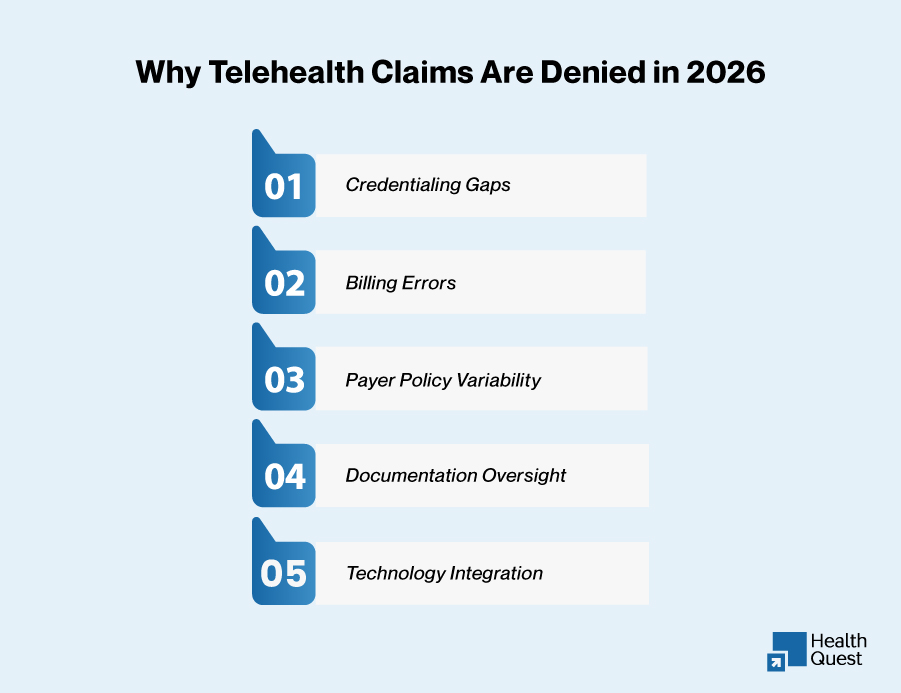
The Growing Telehealth Claim Denial Problem in 2026: Key Factors Affecting Providers
Telehealth has evolved from a temporary solution to a permanent fixture in healthcare, with virtual visits now an essential part of care delivery across specialties such as behavioral health, oncology follow-ups, chronic disease management, and dermatology. As telehealth use continues to grow in 2026, healthcare providers are facing increasing challenges with billing, leading to claim denials and disruptions in revenue cycles.
However, the complexity of telehealth billing is not just a matter of convenience; it’s a matter of financial health. Incorrect coding, credentialing gaps, payer-specific inconsistencies, and state-to-state reimbursement variations are all contributing to a rise in telehealth claim denials. If not addressed, these challenges could impact cash flow and overall profitability, making efficient billing practices essential to sustaining a practice’s financial stability.
The Complexity of Telehealth Billing: Minor Mistakes, Major Impact
Telehealth billing requires a level of precision that traditional in-person visits do not. It’s not just about basic coding; it requires specific place-of-service (POS) codes, telehealth modifiers (such as GT or 95), and meticulous documentation. Missing or misapplying these can lead to immediate claim denials, delaying reimbursement and creating unnecessary administrative burden.
A 2025 report by the American Medical Association (AMA) found that billing errors ranging from incorrect CPT codes to missing telehealth-specific modifiers are among the leading causes of the growing telehealth claim rejection rates. In some specialties, denial rates are as high as 25%, causing significant revenue loss. These errors are often small but critical, and they highlight the need for billing teams to be highly trained and diligent in applying telehealth-specific rules.
The Challenge of Payer and State-Specific Rules
Another hurdle that telehealth providers must navigate is the variability in reimbursement policies from different payers and across states. Medicare, Medicaid, and private insurers all have distinct rules when it comes to telehealth services. For instance, while some states allow telehealth for a broad range of services, others restrict it to specific circumstances or patient populations. Navigating these state-specific rules can be a daunting task for providers.
Additionally, Medicare policies may differ based on patient location, service type, and telehealth modality. Payer-specific nuances can cause confusion among billing teams and lead to claim rejections when policies aren’t correctly followed. With each insurer potentially having its own set of rules, ensuring compliance becomes even more challenging.
Credentialing Gaps: A Silent Revenue Killer
Even when telehealth services are delivered flawlessly, credentialing gaps can cause substantial delays or denials. Many providers who are credentialed for in-person visits may not be properly enrolled for telehealth services, particularly with Medicare Advantage or Medicaid. These gaps often lead to automatic denials, even when the service provided meets clinical needs.
Credentialing is a critical yet often overlooked part of the revenue cycle. Telehealth-specific credentialing is not always prioritized, but without it, practices risk losing significant reimbursement. States with larger Medicare and Medicaid populations, like California, Texas, and New York, are particularly impacted by these gaps.
Key Challenges Leading to Telehealth Claim Denials
Billing Mistakes:
Small errors such as incorrect CPT codes, missing POS codes, or improper modifiers can lead to significant claim rejections.
Payer and State Variability:
Different payers and states have specific telehealth reimbursement rules, adding complexity to claims submission.
Credentialing Gaps:
Incomplete or inaccurate credentialing for telehealth services can result in automatic claim denials and lost revenue.
Documentation Oversight:
Inadequate or improper documentation of telehealth visits, such as missed details on patient location or service type, can cause denials.
As telehealth continues to expand, these issues are only becoming more pronounced, and without proper oversight, practices will experience longer accounts receivable (AR) cycles, increasing the financial strain.
How These Issues Impact Your Practice
The financial repercussions of telehealth claim denials go beyond simple delays. With denials adding up, practices may experience significant cash flow disruption, leaving providers struggling to balance their books. What’s worse, if issues like credentialing gaps and billing mistakes are not caught in time, they can lead to long-term revenue instability.
Addressing these challenges requires a strategic approach, one that ensures your billing team is well-equipped with the right knowledge, tools, and resources to navigate the complexities of telehealth billing in 2026.
Credentialing Gaps and Provider Enrollment Issues in Telehealth Billing
Credentialing remains one of the most significant but often overlooked risks in telehealth revenue cycle management. As telehealth continues to expand in 2026, the need for proper provider enrollment becomes even more crucial.
Telehealth-Specific Credentialing Requirements
Telehealth billing is not as simple as in-person visits. To receive reimbursement for telehealth services, providers must be enrolled specifically for telehealth services with Medicare, Medicaid, and commercial insurers. Being credentialed for in-person care does not automatically ensure eligibility for telehealth reimbursement. States with large Medicare Advantage and Medicaid populations, including California, Texas, Florida, and New York, have varying enrollment requirements that providers must navigate. Failing to confirm proper enrollment can result in automatic claim denials.
According to the Medical Group Management Association (MGMA), approximately 25% of telehealth claims are delayed or denied due to issues related to credentialing or enrollment documentation. This highlights the importance of ensuring that providers are fully enrolled and updated across all relevant payers, especially for multi-state practices.
How Credentialing Errors Lead to Automatic Claim Denials
Credentialing errors are often flagged by automated payer systems, leading to immediate claim rejections. If a provider is not properly enrolled to offer telehealth services, even the most accurate claim will be rejected without review. For practices offering telehealth across state lines, the issue becomes more complicated. Providers must ensure that their licensure, payer enrollment, and telehealth authorization are valid in every state where they are offering services. Missing this step can cause unnecessary claim denials and delay revenue.
Telehealth Billing Errors and Coding Mistakes Providers Must Avoid
Accurate coding is crucial to ensuring that telehealth services are reimbursed correctly. Without the right codes and documentation, providers risk claim denials, which can disrupt cash flow and delay revenue.
-
Common CPT and E/M Coding Errors in Telehealth
Evaluation and Management (E/M) coding plays a crucial role in telehealth billing. However, incomplete or vague documentation can lead to downcoding, where services are billed at a lower level than they should be, resulting in reduced reimbursement. Behavioral health providers, for example, must document session lengths precisely to support time-based CPT codes. If this detail is missing, reimbursement could be cut or the claim might be denied.
-
Place of Service (POS) Code Mistakes in Virtual Visits
Telehealth claims must include the correct Place of Service (POS) codes to accurately reflect the patient’s location during the virtual visit. Medicare distinguishes between POS 02 (telehealth) and POS 10 (telehealth provided by a practitioner in a rural area). Mistakes here can either affect reimbursement rates or lead to outright claim rejections. Pediatric and family medicine practices, in particular, often face denials due to POS inconsistencies. Correctly applying the right POS code is essential to avoid payment issues.
-
Telehealth Modifiers (GT, 95) and Why They Matter
Telehealth modifiers like GT and 95 are necessary to indicate that a service was delivered virtually rather than in person. These modifiers are vital for reimbursement but vary by payer, especially among Medicaid programs. Misapplying or omitting them is a common reason for telehealth claim denials. To avoid costly errors, practices must stay up-to-date with payer-specific modifier requirements.
Common Billing and Coding Issues for Telehealth Providers
| Issue | Description | Impact |
| CPT & E/M Coding Errors | Inaccurate or incomplete documentation of telehealth services | Leads to downcoding, reducing reimbursement, and potential denials. |
| Place of Service (POS) Code Mistakes | Incorrect POS code for virtual visits (POS 02 or POS 10) | Rejection or reduced reimbursement rates due to incorrect patient location documentation. |
| Missing Telehealth Modifiers | Omission of GT/95 modifiers for telehealth services | Claims may be denied due to improper identification of telehealth encounters. |
By addressing these common billing errors and ensuring accurate documentation, providers can avoid claim denials and ensure a smoother revenue cycle. Staying on top of these details is essential for telehealth reimbursement in 2026.
Payer Policy Variability and State-Level Telehealth Reimbursement Rules
Telehealth reimbursement policies vary significantly across states and insurers, creating complexities for providers.
Medicare vs. Medicaid Telehealth Billing Differences
Medicare continuously updates telehealth eligibility rules, focusing on patient location and covered services. Medicaid policies vary by state, with some states offering broader telehealth coverage. For example, Illinois and California provide more extensive Medicaid telehealth coverage compared to certain Southern states. Florida Medicaid has unique documentation requirements that differ from those of commercial insurers.
Commercial Payer Parity Laws
State-level payment parity laws determine whether telehealth services are reimbursed at the same rate as in-person visits. States like California enforce strong parity protections, while Texas gives insurers more flexibility in reimbursement rates. Providers must stay updated on each state’s payer policies to ensure compliance and avoid potential reimbursement issues.
Telehealth Compliance Risks and Audit Exposure in 2026
As telehealth becomes more prevalent, regulatory scrutiny is increasing, and providers must navigate compliance risks carefully.
-
Documentation Requirements for Virtual Visits
Proper documentation is crucial for telehealth claims to avoid denials or post-payment recoupments. Payers require detailed records, including patient consent, session duration, medical necessity, and the technology used. Missing even one of these elements can lead to claim rejections. Behavioral health and dermatology practices, with high telehealth utilization, face heightened scrutiny in this area.
-
Audit Exposure: OIG and State-Level Trends
Regulatory bodies, including the Office of Inspector General (OIG), are closely monitoring telehealth billing for red flags like short visits, repetitive coding, and excessive audio-only billing. These patterns can trigger audits and investigations. To minimize audit risks, practices must integrate thorough compliance monitoring into their telehealth revenue cycle management process.
Specialty-Specific Telehealth Revenue Cycle Challenges
| Specialty | Challenge | Details |
| Behavioral Health | High Denial Rates | Time-based billing complexity and shifting payer policies lead to frequent denials. |
| Pediatrics & Family Medicine | Coding Discrepancies & Coverage Restrictions | Pediatric telehealth faces coding issues, while family medicine encounters varying payer coverage rules. |
| Oncology & Specialty Care | Site-Neutral Payment & Documentation Issues | Oncology telehealth visits, especially for chemotherapy follow-ups, must meet site-neutral and documentation standards. |
| Dermatology | Documentation & Modifier Misuse | High volume of telehealth visits but risks related to missing or misapplying telehealth-specific modifiers like GT/95. |
| Neurology | Reimbursement for Remote Monitoring & Diagnostics | Challenges in telehealth coding for remote neurological assessments and monitoring tools. |
| Cardiology | Telehealth for Follow-ups & Monitoring | Complex billing for heart disease follow-up and remote diagnostics needs specific telehealth modifiers. |
| Radiology | Tele-radiology Compliance | Issues with reimbursement for remote reading and interpretation of imaging via telehealth platforms. |
| Gastroenterology | Telehealth for Consultations & Procedures | Specific coding for telehealth consultations on GI issues, and proper documentation for complex procedures. |
| Orthopedics | Telehealth for Post-Op Consultations | Difficulty in obtaining reimbursement for post-operative consultations via telehealth due to documentation discrepancies. |
Operational Gaps in Telehealth Revenue Cycle Management
Telehealth revenue is often impacted by operational gaps, resulting in significant financial losses and billing errors that affect cash flow.
- Front-End Eligibility Verification Failures
Verifying eligibility for telehealth services is critical, yet many practices overlook this step. If telehealth benefits are not confirmed prior to appointments, it often leads to non-reimbursable services, causing delays in payment and missed revenue opportunities. - Authorization and Pre-Certification Errors
Certain specialties, including oncology and specialty care, require prior authorization for telehealth visits. Missing these authorizations can lead to automatic claim denials, especially when dealing with complex treatments like chemotherapy follow-ups or specialty consultations. - Technology and EHR Integration Challenges
Effective telehealth requires seamless integration with electronic health records (EHR). When telehealth platforms don’t sync properly with EHRs, it creates gaps in documentation and results in billing mistakes, further contributing to claim denials.
How Health Quest Billing Supports Telehealth RCM
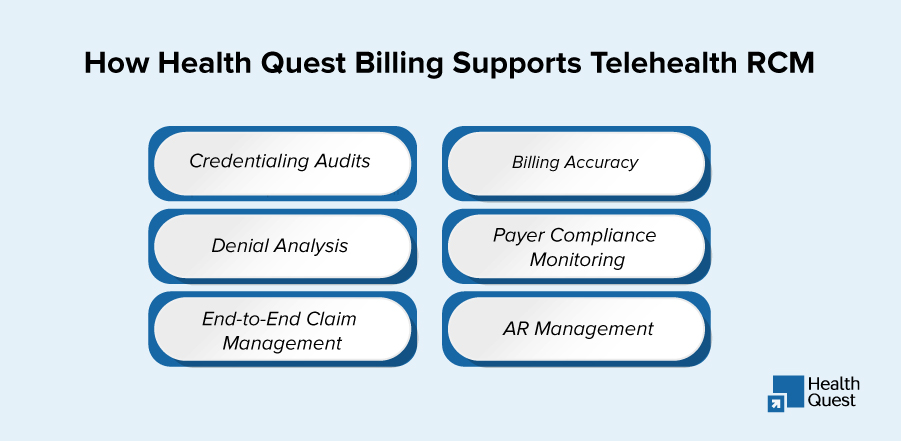
Health Quest Billing is your partner in turning telehealth revenue challenges into a seamless, profitable operation. We ensure every provider is fully credentialed, every claim is coded accurately, and every denial is analyzed to prevent future rejections. By staying on top of payer-specific rules and managing the full claim lifecycle from submission to payment we keep your revenue flowing without disruption. Our proactive AR management reduces outstanding balances and boosts cash flow, while our compliance monitoring safeguards your practice from costly errors. With Health Quest Billing, telehealth billing becomes effortless, denials are minimized, and your practice can focus on delivering care, knowing your financial stability is in expert hands.
Conclusion
As telehealth continues to play a vital role in healthcare delivery in 2026, providers must address operational gaps, billing complexities, and regulatory challenges to ensure financial stability. Effective revenue cycle management, credentialing audits, and payer compliance are crucial for reducing claim denials and optimizing reimbursements.
At Health Quest Billing, we offer tailored solutions to streamline your telehealth billing processes and ensure timely, accurate reimbursements. Our end-to-end services provide the support needed to navigate the evolving telehealth landscape efficiently.
Contact us today to learn how Health Quest Billing can help you optimize your telehealth revenue cycle and achieve long-term financial success.