
When clinics think about revenue cycle management, most focus on coding accuracy, denial management, and reducing AR days. But there’s one major revenue leak that happens long before a claim is ever billed:
Weak or outdated payer contracts.
Your reimbursement is determined the moment your clinic signs an agreement with a payer. In today’s healthcare climate, where reimbursement cuts, payer policy changes, and prior auth expansions are constant, no clinic can afford to sign a contract blindly.
Strong payer contract clauses protect your revenue, keep reimbursement predictable, and safeguard your clinic from unfair terms that payers often embed in fine print.
According to AMA (2024), 42% of small and mid-sized practices lose revenue due to unclear payer agreements. High-impact specialties such as cardiology, orthopedics, behavioral health, family medicine, and pain management feel these losses more than others.
In this blog, you will see how Health Quest Billing supports clinics in reviewing, negotiating, and strengthening their payer agreements.
Why This Matters Now More Than Ever
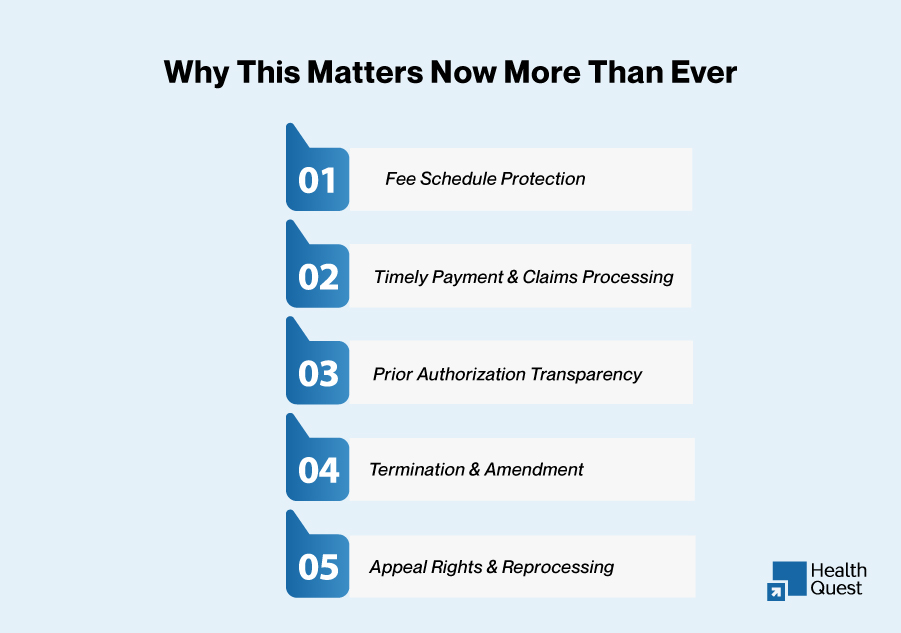
Payer contract negotiations have become increasingly complex due to:
- Frequent payer policy updates
- Lower reimbursement rates
- Denials caused by vague contract language
- Prior authorization expansion
- Fee schedule variability by region
States like Texas, Florida, California, New York, Illinois, and Georgia report the highest discrepancies in payer fee schedules (MGMA 2024), making contract clarity essential.
Strong clauses help your clinic:
- Prevent revenue loss
- Protect CPT-specific fee schedules
- Reduce future AR delays
- Avoid unfair takebacks
- Ensure predictable cash flow
1. Fee Schedule Protection Clause
The Most Critical Clause in Any Payer Agreement
Fee schedules determine your reimbursement. Without protection, payers may:
- Change your rates without notice
- Reprice procedures mid-contract
- Apply silent fee reductions
Fee schedules can vary 30–50% across states, which directly affects specialties like orthopedics, dermatology, GI, and cardiology.
A strong protection clause includes:
- CPT-level reimbursement clarity
- Prior written notice before fee updates
- Annual adjustments tied to a transparent formula (e.g., Medicare %)
2. Timely Payment & Claims Processing Clause
Your Shield Against Payer Slowdowns
Aged AR often happens because contracts don’t outline strict timelines for claim processing.
Your contract must specify:
- Processing timelines (15–30 days)
- Penalties if payers delay payments
- Restrictions on “administrative hold” delays
States like New Jersey, California, and Louisiana report the slowest payer turnaround times when contracts do not define processing rules.
This clause helps high-volume specialties such as family medicine, pediatrics, urgent care, internal medicine and multi-specialty groups maintain healthier AR cycles.
3. Prior Authorization Transparency Clause
Essential for High-Burden Specialties
Prior auth requirements are increasing nationally. Without this clause, your clinic may face:
- Sudden expansion of authorization requirements
- Increased denials due to unclear guidance
- Retroactive authorization expectations
Specialties most affected:
- Cardiology
- Radiology
- Behavioral Health
- Pain Management
- Oncology
Contracts should require payers to:
- Give advance notice of PA changes
- Provide updated PA lists regularly
- Define turnaround times to avoid care delays
4. Termination & Amendment Clause
Your Protection Against Sudden or Unfair Changes
Some payer contracts allow payers to modify terms—or terminate agreements—without giving clinics enough time to respond.
You need:
- 90–120 days’ written notice for amendments
- Mutual termination rights
- Clear definitions of “termination for cause”
This clause is critical for specialties like neurology, nephrology, surgery centers, endocrinology, and ACOs, where reimbursement changes can cause significant financial impact.
5. Appeal Rights & Reprocessing Clause
A Must-Have for Stronger Denial Management
Nearly 20% of denials occur due to vague contract language (HFMA 2024). This clause ensures payers cannot ignore or indefinitely delay your appeals.
It should require:
- Fair, documented review of all denied claims
- Clear payer deadlines for appeal responses
- Reprocessing when the payer is at fault
- Transparency during audits and reconsiderations
Specialties that benefit most: behavioral health, cardiology, OB-GYN, primary care, and multi-specialty clinics.
6. Credentialing & Enrollment Clause (Often Overlooked)
Most clinics focus on reimbursement—but forget credentialing terms within contracts.
A strong contract should define:
- Timeline for provider enrollment approval
- Effective date for billing (retroactive billing rights)
- Rules for adding new providers to the contract
- Reimbursement eligibility during credentialing
Without this clause, clinics may:
- Lose revenue during onboarding
- Face delays in provider activation
- Experience denied claims due to enrollment gaps
This is especially critical for growing practices and multi-provider clinics.
7. Audit & Recoupment Protection Clause
Payers increasingly conduct audits and post-payment reviews. Without safeguards, clinics may face aggressive recoupments.
Your contract should include:
- Defined audit lookback period (e.g., 12–24 months)
- Limits on extrapolation methods
- Transparent audit criteria
- Clear dispute resolution process
This protects your clinic from unexpected financial clawbacks and compliance risks.
Common Red Flags in Payer Contracts
Before signing any agreement, providers should watch for:
- Vague reimbursement language
- Missing appeal timelines
- Undefined prior authorization policies
- No penalties for delayed payments
- One-sided amendment rights
- Hidden addendums or policy links
These red flags often lead to long-term revenue loss and operational inefficiencies.
Why Clinics Often Miss These Clause Problems
Because payer contracts are:
- Long
- Complex
- Written in payer-favored legal language
- Updated with undisclosed addendums
With staffing shortages and rising admin burden, 72% of clinics never renegotiate their payer contracts, even when underpaid (MGMA).
How Weak Contract Clauses Hurt Your Revenue
Without the clauses above, clinics often suffer:
- Higher denial volume
- Unpredictable reimbursement
- Aged AR + cash flow delays
- Increased administrative workload
- Difficulty appealing underpayments
- Prior authorization setbacks
- 5–15% revenue loss annually
How Health Quest Billing Helps Clinics Strengthen Their Payer Contracts
While this blog doesn’t reveal the full contracting playbook, Health Quest Billing helps clinics by:
✔ Reviewing new and existing payer contracts
✔ Identifying missing or risky clauses
✔ Creating a customized payer agreement checklist
✔ Benchmarking fee schedules against state and national data
✔ Preventing future denials tied to bad contract language
✔ Supporting renegotiation strategies
✔ Enhancing AR prevention through contract clarity
✔ Ensuring ongoing compliance with payer updates
We specialize in contracts for:
- Primary Care
- Neurology
- Cardiology
- Orthopedics
- Pain Management
- Behavioral Health
- Dentistry & Oral Surgery
- Multi-Specialty Practices
- Ambulatory Surgical Centers
With Health Quest Billing, clinics don’t negotiate blindly; they negotiate from a position of strength.
Before signing your next payer agreement, ask:
“Does this contract protect my revenue — or the payer’s?”
If any of the five clauses above are missing, unclear, or outdated, the contract is already working against your clinic.
Final Words
Payer contracts define the financial foundation of your practice.
Getting them wrong costs you revenue.
Getting them right strengthens your reimbursement, cash flow, and long-term financial stability.
If your clinic is preparing to sign, renegotiate, or review payer contracts, Health Quest Billing is here to support you every step of the way.