
Vascular surgery is one of the most reimbursement-sensitive specialties in U.S. healthcare. From high-acuity procedures to long-term chronic disease management, every vascular encounter sits under payer scrutiny.
In 2024–2026, documentation rules, medical-necessity standards, Medicare LCD updates, and prior-auth requirements have tightened even further. Across the country, vascular disease continues to climb:
- ~8.5 million Americans are living with Peripheral Artery Disease (PAD) (CDC, 2024).
- More than 200,000 lower-extremity revascularization procedures were performed in 2024.
- Carotid artery procedures increased by ~11% due to improved screening guidelines.
- States with the highest vascular-disease burden: Texas, Florida, California, New York, Georgia, and Ohio.
Clinically, demand is rising. Financially, vascular billing is becoming a maze.
Why Vascular Surgery Billing is Uniquely Challenging in 2026
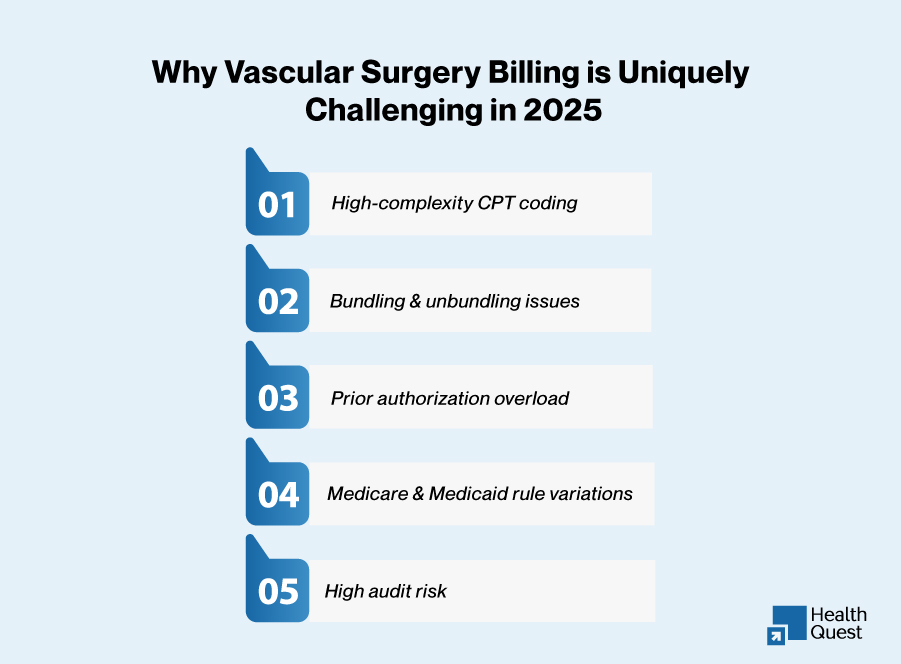
Vascular surgery blends: diagnostic testing, minimally invasive endovascular procedures, open surgical intervention, long-term chronic disease follow-up, and post-operative surveillance.
This combination means payers scrutinize everything, especially medical necessity and modifier usage.
Here’s the reality billers see daily:
1. High-complexity CPT coding
Vascular procedures involve:
- multiple vessels
- laterality
- imaging components
- catheter placements
- endovascular + open repairs
Each comes with its own coding pathways.
2. Bundling & unbundling issues
Vascular procedures often include:
- angioplasty
- stenting
- atherectomy
- catheterization
- imaging guidance
Bundling edits (NCCI) trigger denials if modifiers aren’t perfect.
3. Prior authorization overload
Most vascular services require PA in 2026:
- arterial ultrasounds
- CT angiography
- atherectomy
- vein ablations
- endovascular revascularization
One missed auth = one huge denial.
4. Medicare & Medicaid rule variations
Medicare LCDs for:
- lower-extremity revascularization
- venous insufficiency
- dialysis access
have tightened documentation expectations across states.
5. High audit risk
Vascular surgery is one of the top five specialties targeted by:
- RAC audits
- TPE reviews
- Medicare medical-necessity audits
Documentation must justify medical necessity every time.
What is Impacting Vascular Surgery Billing
1. PAD & chronic vascular disease rising
The CDC noted that vascular disease rates are increasing by 3–5% yearly, especially in older adults.
2. State-level Medicaid changes
States adopting expanded coverage and stricter documentation include:
- California – more detailed criteria for venous procedures
- Texas – increased PA requirements for endovascular services
- Florida – higher denials for ultrasounds without medical necessity indicators
3. Shift to outpatient vascular centers
More vascular surgeons now work in:
- OBLs (Office-Based Labs)
- ASCs
- Hybrid cath-lab facilities
Billing changes with these settings due to:
- technical vs professional split
- place-of-service rules
- global periods
4. Medicare’s 2026 policy updates
CMS added more audit focus on:
- repeated imaging
- high-volume atherectomy claims
- non-documented treatment failure before interventions
5. Payer demand for detailed documentation
2026 documentation must include:
- ABI/TBI findings
- conservative treatment tried & failed
- wound care notes
- duplex scan results
- exact vessel treated
If any of this is missing → denial.
The Vascular RCM Workflow: Where Revenue Leaks Happen
Here’s where practices lose the most money:
1. Incorrect CPT hierarchy
Billing atherectomy first vs angioplasty first can change reimbursement by hundreds of dollars.
2. Missing laterality
Left, right, bilateral missing RT/LT modifiers are one of the TOP denial causes.
3. Imaging bundled incorrectly
Diagnostic ultrasounds performed before intervention need proper sequencing and modifiers.
4. Bad prior authorization tracking
Most vascular denials in 2024–2026 are PA-related.
5. Documentation gaps
Missing:
- occlusion severity
- claudication level
- wound severity
- imaging interpretation
- medical necessity criteria
results in “documentation insufficient” denials.
6. Global period conflicts
Reinterventions during the global period often require:
- modifier 58 (staged)
- modifier 78 (unplanned return to OR)
- modifier 79 (unrelated procedure)
Incorrect modifier = instant denial.
Vascular Surgery Coding Cheat-Sheet
| Coding Focus Area | Key CPT/HCPCS Notes (2026) |
| Endovascular procedures | 37220–37235: angioplasty, stent, atherectomy; sequence correctly based on primary vessel treated. |
| Open vascular surgery | 35500–35671: bypass grafting procedures document graft type and target vessel. |
| Dialysis access procedures | 36901–36909: imaging + angioplasty + thrombectomy often bundled; require strict documentation. |
| Venous ablation | 36475–36479: thermal/non-thermal ablations; require ultrasound mapping justification. |
| Diagnostic imaging | 93922–93926, 93970–93971: duplex scans must support symptoms + medical necessity. |
| Catheter placement | 36245–36248: selective vs nonselective placement makes a major payment difference. |
| Modifiers | -59, -XS, -RT/LT, 26/TC, 58/78/79 for global period reinterventions. |
Most Common Denials in Vascular Surgery in 2026
1. Medical necessity not met
payer wants stronger clinical justification
2. Service bundled into primary procedure
incorrect modifier usage
3. Prior authorization missing/invalid
especially for vein procedures & atherectomy
4. Incorrect place of service
office vs ASC vs hospital confusion
5. Duplicate imaging
needs a proper modifier and rationale
6. Incomplete documentation
payers need vessel-level detail
What Successful Vascular Practices Will Focus on in 2026
1. Stronger documentation workflows
Clear templates for:
- PAD severity
- ulcer staging
- vein reflux findings
- conservative treatment results
2. Real-time eligibility + auth checks
Especially for:
- CT angiography
- endovenous ablations
- atherectomy
3. Accurate coding audits every month
Small coding errors = thousands lost.
4. Capturing both technical + professional components
Especially for OBLs and ASCs.
5. Global period tracking
Avoid unintended bundling.
6. Payer-specific rule monitoring
Every payer updates their vascular policies quarterly.
How Health Quest Billing Supports Vascular Surgery Practices

Health Quest Billing specializes in high-complexity specialty RCM, and vascular surgery is one of our strongest and most detail-intensive service lines.
Here’s how we help you reclaim revenue without changing your clinical workflow:
Certified vascular coders & auditors
We handle:
- catheter placements
- complex endovascular coding
- imaging bundling
- global period modifiers
Prior authorization department
We manage PAs for:
- ultrasounds
- CTA/MRA
- atherectomy
- ablation
- dialysis access procedures
Strict documentation readiness
We provide templates and checklists tailored to vascular requirements.
Denial prevention + aggressive AR follow-up
We don’t “wait and see”; we resolve claims before they age out.
State-specific Medicare & Medicaid navigation
Every state has different:
- LCDs
- Medicaid coverage limits
- medical-necessity policies
We maintain all of them.
Detailed reporting
You get fast insights on:
- CPT utilization
- denial trends
- payer mix
- missed revenue
Revenue recovery
Most vascular practices using Health Quest recover 12–20% lost revenue within months.
Conclusion:
Vascular surgery is expanding and so is payer complexity. With more prior auth requirements, tighter documentation rules, and increased audit activity, your billing workflow must be accurate, fast, and compliant.
Health Quest Billing helps vascular surgeons safeguard revenue, reduce denials, and strengthen cash flow through specialty-focused billing systems that adapt to 2026 requirements.
If your practice is experiencing:
- rising denials
- missing modifiers
- unclear documentation
- slow AR
- Repeated prior auth issues
It’s time for a better RCM partner.
Request a complimentary vascular RCM performance review from Health Quest Billing.
Let’s protect your revenue; one claim at a time.