
Vascular surgery is one of the most financially critical and compliance-sensitive specialties in modern healthcare. From complex endovascular interventions and bypass grafting to high-volume diagnostic imaging and vein procedures, vascular care commands high reimbursement but also carries significant billing risk.
In 2026, vascular surgery billing has evolved into one of the most technically demanding areas of medical revenue cycle management. With rising rates of peripheral artery disease (PAD), increased procedural volume, and stricter payer oversight, even small coding or documentation errors can lead to substantial financial losses.
Across the United States, vascular disease continues to rise:
- Over 8.5 million Americans are living with Peripheral Artery Disease (PAD)
- More than 200,000 lower-extremity revascularization procedures are performed annually
- Vascular-related procedures have increased by 10–15% over the past three years
- Denial rates in vascular billing are 20–30% higher than general surgery specialties
This growing demand should translate into increased revenue. However, due to coding complexity, payer scrutiny, and documentation gaps, many vascular practices are experiencing the opposite rising denials, delayed reimbursements, and shrinking margins.
Unlike other specialties, vascular surgery involves a mix of:
- Diagnostic imaging
- Catheter-based interventions
- Open surgical procedures
- Chronic disease management
All of which must be billed correctly across multiple care settings (OBLs, ASCs, hospitals) with varying payer rules. In 2026, even a small mistake—such as incorrect CPT sequencing, missing laterality, or incomplete documentation—can result in full claim denial or significant underpayment.
What Is Vascular Surgery Billing?
Vascular surgery billing is the process of managing the full revenue cycle for procedures involving the diagnosis and treatment of vascular conditions, including peripheral artery disease (PAD), carotid artery disease, venous insufficiency, dialysis access, and aneurysm repair.
This includes:
- Insurance verification
- Prior authorization
- CPT and ICD-10 coding
- Claim submission
- Payment posting
- Denial management
- Accounts receivable (AR) follow-up
Unlike many other specialties, vascular surgery billing involves a combination of diagnostic imaging, catheter-based interventions, and open surgical procedures, often performed across multiple care settings. The presence of bundled services, strict medical necessity requirements, and payer-specific rules creates a highly complex billing environment that requires specialized expertise to optimize reimbursement and ensure compliance.
Why Vascular Surgery Billing is Uniquely Challenging in 2026
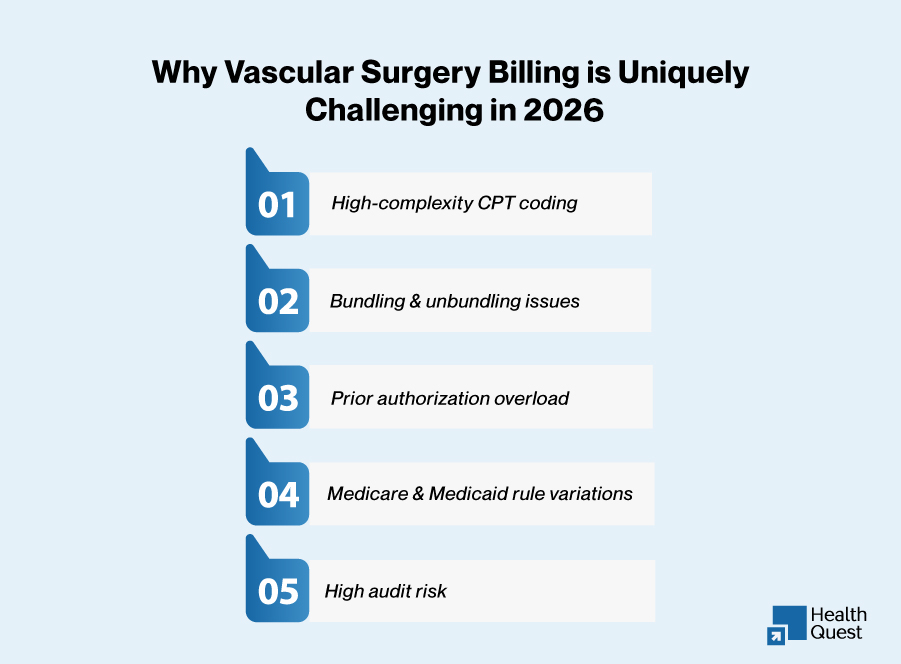
Vascular surgeons perform procedures that frequently involve multiple vessels, imaging guidance, staged interventions, and overlapping services, making billing significantly more complex than standard surgical specialties.
Some of the key challenges include:
Global Surgical Period Complexity:
Follow-up interventions, staged procedures, and reoperations often fall within global periods. Billing these services without proper modifier usage (-58, -78, -79) can result in automatic denials.
Modifier Usage for Multi-Vessel Procedures:
Modifiers such as -59, -XS, and RT/LT are critical for distinguishing separate procedures, laterality, and distinct services. Errors in modifier application are among the leading causes of vascular claim denials.
Bundling and NCCI Edits:
Procedures such as angioplasty, stenting, atherectomy, and catheter placement are often bundled. Improper unbundling or failure to apply appropriate modifiers leads to payment reductions or rejections.
Place-of-Service Complexity:
Determining whether a procedure is performed in an OBL, ASC, or hospital setting directly impacts reimbursement. Incorrect place-of-service coding can trigger payer audits and reduced payments.
Medicare vs. Commercial Payer Variability:
Medicare LCDs and commercial payer policies differ significantly in vascular care, especially for procedures like vein ablation, revascularization, and imaging. Coders must understand these differences to prevent revenue leakage.
Strict Documentation Requirements:
Every claim must demonstrate clear medical necessity including:
- ABI/TBI results
- Imaging findings
- Severity of disease
- Failed conservative treatments
- Exact vessel treated
Incomplete documentation is one of the top reasons for denials and audit failures.
Even minor errors, such as incorrect sequencing or missing laterality, can lead to significant revenue loss in high-value vascular procedures.
The Financial Risk of Billing Errors in Vascular Surgery
Many practices assume that denials and delays are unavoidable. In reality, most revenue loss is preventable with proper billing systems. Industry benchmarks show:
- 10-18% of vascular claims are denied on first submission
- Claims older than 90 days have less than a 25% chance of full recovery
- 5-8% of vascular revenue is lost annually due to coding and documentation errors
- Prior authorization failures are among the top causes of denials
Because vascular procedures carry high reimbursement values, each denied or underpaid claim has a significant financial impact on overall practice performance.
State-by-State Billing Pressure in 2026
Reimbursement challenges vary by state due to Medicaid policies and payer behavior. High-pressure states include:
- California: Strict documentation audits and denial rates
- Texas: Complex Medicaid managed care and frequent eligibility issues
- Florida: High Medicare Advantage penetration and imaging denials
- New York: Strict Medicaid oversight and bundling enforcement
- Georgia & Ohio: Increasing vascular disease burden and payer scrutiny
Manual billing workflows often fail to keep up with these complexities, increasing the need for specialized billing solutions.
How Vascular Surgery Billing Impacts Cash Flow
Billing inefficiencies directly affect:
- Payroll stability
- Equipment investment
- Staff retention
- Practice growth
When claims exceed 60-90 days in AR, recovery rates drop significantly. Increasing patient volume cannot compensate for inefficient billing optimized RCM is the key to financial stability.
Specialty-Specific Billing Risks in Vascular Surgery
Vascular surgery spans multiple care environments, each with unique risks:
- OBLs: Split billing (technical vs professional components)
- ASCs: Lower reimbursement and strict bundling rules
- Hospitals: Complex inpatient coding and DRG-based payments
Common risks include:
- Incorrect place-of-service coding
- Overlapping E/M and procedure billing
- Imaging billing errors
- ASC vs hospital reimbursement discrepancies
Vascular Surgery Coding Cheat Sheet
Below is a high-level reference for commonly billed vascular procedures:
| Procedure Description | Common CPT Codes | Billing Notes |
|---|---|---|
| Endovascular interventions | 37220–37235 | Sequence based on primary vessel treated |
| Open bypass surgery | 35500–35671 | Document graft type and vessel |
| Dialysis access procedures | 36901–36909 | Often bundled; requires detailed documentation |
| Venous ablation | 36475–36479 | Requires ultrasound mapping and necessity |
| Diagnostic imaging | 93922–93926, 93970–93971 | Must support symptoms and diagnosis |
| Catheter placement | 36245–36248 | Selective vs non-selective impacts payment |
| Modifiers | -59, -XS, -RT/LT, -26/TC, -58/-78/-79 | Critical for compliance |
Accurate coding depends not only on correct CPT selection but also on proper sequencing, modifier usage, and complete documentation.
What Successful Vascular Practices Will Focus on in 2026
1. Stronger documentation workflows
Clear templates for:
- PAD severity
- ulcer staging
- vein reflux findings
- conservative treatment results
2. Real-time eligibility + auth checks
Especially for:
- CT angiography
- endovenous ablations
- atherectomy
3. Accurate coding audits every month
Small coding errors = thousands lost.
4. Capturing both technical + professional components
Especially for OBLs and ASCs.
5. Global period tracking
Avoid unintended bundling.
6. Payer-specific rule monitoring
Every payer updates their vascular policies quarterly.
How to Optimize Vascular Billing
Improving vascular surgery billing is not about fixing one issue—it requires a systematic, end-to-end revenue cycle strategy. From documentation to denial management, every step must be aligned with payer expectations, coding accuracy, and operational efficiency.
Based on real-world billing data and performance trends, vascular practices that consistently outperform their peers focus on the following six areas:
1. Strong Documentation Workflows
Documentation is the foundation of vascular billing. In 2026, payers are no longer accepting generic or incomplete clinical notes—they require detailed, structured, and procedure-specific documentation to justify every claim.
From a billing standpoint, insufficient documentation is the #1 reason for:
-
Medical necessity denials
-
Downcoding
-
Audit exposure
-
Delayed reimbursements
To prevent this, practices must implement standardized documentation workflows tailored specifically for vascular procedures.
What an Optimized Documentation Workflow Includes:
a. PAD Severity and Clinical Justification
Every vascular claim should clearly define:
-
Severity of disease (mild, moderate, severe)
-
Claudication level or rest pain
-
Functional limitations
Payers expect clear evidence that the condition justifies intervention—not just diagnosis.
b. Ulcer and Wound Staging
For patients with ulcers or critical limb ischemia:
-
Document wound size, depth, and stage
-
Include progression history
-
Note infection or tissue necrosis
Incomplete wound documentation is a major trigger for denials in revascularization cases.
c. Imaging and Diagnostic Findings
All imaging must be:
-
Clearly interpreted
-
Linked to the diagnosis
-
Referenced in the treatment decision
Include:
-
Duplex scan results
-
CTA/MRA findings
-
ABI/TBI values
Without this, payers often reject claims due to “lack of medical necessity.”
d. Conservative Treatment History
Before approving interventions, most payers require proof of failed conservative treatment, such as:
-
Medication therapy
-
Compression therapy (for venous disease)
-
Lifestyle modifications
This must be clearly documented with duration and outcomes.
e. Procedure-Specific Detail
Operative notes must include:
-
Exact vessel treated
-
Laterality (RT/LT)
-
Type of intervention performed
-
Devices used (stent, balloon, catheter)
Generic operative notes lead to coding ambiguity and reimbursement loss.
Bottom Line:
A structured documentation workflow doesn’t just improve compliance—it directly increases clean claim rates and faster reimbursements.
2. Real-Time Eligibility and Authorization Checks
One of the most preventable causes of revenue loss in vascular billing is failure in eligibility verification and prior authorization.
In 2026, prior authorization requirements have expanded significantly, especially for:
-
CT angiography (CTA)
-
Endovenous ablation
-
Atherectomy
-
Revascularization procedures
Why This Matters:
Industry data shows that:
-
20–30% of vascular denials are linked to authorization issues
-
Many of these claims are never successfully appealed
Best Practices for Optimization:
a. Real-Time Insurance Verification
Before scheduling procedures:
-
Confirm active coverage
-
Verify plan-specific benefits
-
Identify referral requirements
b. Procedure-Specific Authorization Tracking
Authorization must match:
-
Exact CPT code
-
Diagnosis code
-
Site of service
Even small mismatches can result in denial.
c. Automated Alerts and Follow-Ups
Implement systems that:
-
Track authorization status
-
Flag missing approvals
-
Send reminders before procedure dates
d. Documentation Alignment
Ensure clinical documentation supports the authorization request. If documentation and authorization don’t match, claims are denied.
Preventing authorization-related denials is far more efficient than appealing them. A strong front-end process protects revenue before the claim is even submitted.
3. Monthly Coding Audits
Vascular surgery coding is highly complex, and even experienced coders can make errors. Without regular audits, these mistakes go unnoticed—leading to ongoing revenue leakage.
Why Monthly Audits Are Critical:
-
Identify undercoding and missed charges
-
Detect incorrect CPT sequencing
-
Ensure compliance with payer rules
-
Reduce audit risk
What an Effective Audit Process Includes:
a. CPT Code Accuracy Review
Verify that:
-
Correct primary procedures are selected
-
Secondary procedures are appropriately billed
-
No services are missed
b. Procedure Sequencing Validation
In vascular coding, sequence determines payment. Audits should confirm:
-
Correct hierarchy of procedures
-
Proper reporting of multi-vessel interventions
c. Modifier Usage Review
Check for:
-
Missing modifiers
-
Incorrect modifier combinations
-
Overuse of modifiers triggering audits
d. Documentation vs Coding Alignment
Ensure that:
-
Clinical documentation supports billed codes
-
No discrepancies exist between operative notes and claims
e. Trend Analysis
Identify patterns such as:
-
Frequent denials for specific CPT codes
-
Repeated payer rejections
Bottom Line:
Regular audits convert hidden errors into actionable insights—helping practices recover lost revenue and prevent future mistakes.
4. Accurate Modifier Usage
Modifiers play a critical role in vascular billing. They communicate context, complexity, and uniqueness of procedures to payers.
Incorrect modifier usage is one of the top reasons for claim denials and underpayments.
Key Modifier Strategies:
a. Distinct Procedure Modifiers (-59 / -XS)
Used when procedures are separate and not bundled. Must be supported by documentation.
b. Laterality Modifiers (RT / LT)
Indicate which side of the body was treated. Missing laterality leads to automatic denials.
c. Professional vs Technical Split (-26 / -TC)
Critical for imaging services, especially in OBLs and ASCs.
d. Global Period Modifiers (-58, -78, -79)
Used for:
-
Staged procedures
-
Unplanned returns to OR
-
Unrelated procedures
Incorrect use leads to payment rejection.
Best Practices:
-
Train coders specifically in vascular modifier usage
-
Cross-check modifiers during claim submission
-
Align documentation with modifier justification
Bottom Line:
Modifiers are not optional—they are essential for ensuring full and accurate reimbursement.
5. Proactive Denial Management
Denial management is where many practices lose control of their revenue cycle. A reactive approach—waiting for denials to accumulate—results in aging AR and lost revenue.
What Proactive Denial Management Looks Like:
a. Root Cause Analysis
Identify why denials occur:
-
Coding errors
-
Authorization issues
-
Documentation gaps
b. Fast Turnaround on Appeals
Appeals should be:
-
Submitted quickly
-
Supported with strong documentation
-
Tailored to payer requirements
c. Denial Tracking System
Track:
-
Denial rates by payer
-
Denial reasons
-
Recovery success rates
d. Prevention Strategy
Use denial data to:
-
Improve front-end processes
-
Reduce repeat errors
e. Dedicated AR Follow-Up
Ensure claims are followed up before they age beyond 60–90 days.
Bottom Line:
Denial management is not just about recovery—it’s about prevention and continuous improvement.
6. Payer-Specific Rule Monitoring
One of the biggest challenges in vascular billing is the constant evolution of payer rules.
Medicare, Medicaid, and commercial payers frequently update:
-
Coverage policies
-
Documentation requirements
-
Reimbursement structures
-
Prior authorization rules
Why This Matters:
Failure to stay updated leads to:
-
Increased denials
-
Compliance risks
-
Lost revenue opportunities
How to Stay Ahead:
a. Monitor Medicare LCD Updates
Especially for:
-
PAD interventions
-
Venous procedures
-
Imaging requirements
b. Track Commercial Payer Policies
Each payer has different:
-
Bundling rules
-
Authorization criteria
-
Documentation expectations
c. State-Level Medicaid Changes
Medicaid policies vary significantly by state and change frequently.
d. Continuous Staff Training
Billing and coding teams must be regularly trained on updates.
e. Use Data and Reporting
Analyze payer behavior to:
-
Adjust billing strategies
-
Improve reimbursement rates
How Health Quest Billing Supports Vascular Surgery Practices

Health Quest Billing specializes in high-complexity specialty RCM, and vascular surgery is one of our strongest and most detail-intensive service lines.
Here’s how we help you reclaim revenue without changing your clinical workflow:
Certified vascular coders & auditors
We handle:
- catheter placements
- complex endovascular coding
- imaging bundling
- global period modifiers
Prior authorization department
We manage PAs for:
- ultrasounds
- CTA/MRA
- atherectomy
- ablation
- dialysis access procedures
Strict documentation readiness
We provide templates and checklists tailored to vascular requirements.
Denial prevention + aggressive AR follow-up
We don’t “wait and see”; we resolve claims before they age out.
State-specific Medicare & Medicaid navigation
Every state has different:
- LCDs
- Medicaid coverage limits
- medical-necessity policies
We maintain all of them.
Detailed reporting
You get fast insights on:
- CPT utilization
- denial trends
- payer mix
- missed revenue
Revenue recovery
Most vascular practices using Health Quest recover 12–20% lost revenue within months.
Conclusion:
Vascular surgery is expanding and so is payer complexity. With more prior auth requirements, tighter documentation rules, and increased audit activity, your billing workflow must be accurate, fast, and compliant.
Health Quest Billing helps vascular surgeons safeguard revenue, reduce denials, and strengthen cash flow through specialty-focused billing systems that adapt to 2026 requirements.
If your practice is experiencing:
- rising denials
- missing modifiers
- unclear documentation
- slow AR
- Repeated prior auth issues
It’s time for a better RCM partner.
Request a complimentary vascular RCM performance review from Health Quest Billing.
Let’s protect your revenue; one claim at a time.