
Orthopedic practices continue to experience strong patient demand in 2026, driven by an aging population, rising rates of musculoskeletal disorders, sports injuries, and increasing demand for joint replacement procedures. However, growing patient volume alone is no longer enough to ensure financial success.
Rising staffing costs, reimbursement pressures, prior authorization requirements, and increasing patient financial responsibility are creating significant challenges for orthopedic providers. As a result, many practices are shifting their focus from simply generating revenue to protecting the revenue they already earn.
This guide explores the most common sources of revenue leakage in orthopedic practices and how effective Orthopedic RCM strategies can help providers improve cash flow, reduce denials, strengthen collections, and increase overall profitability.
The State of Orthopedic Practices in 2026
Orthopedic care remains one of the most in-demand specialties in healthcare. An aging population, increasing rates of musculoskeletal disorders, sports injuries, arthritis, and joint degeneration continue to drive demand for orthopedic services.
At the same time, orthopedic practices are facing significant operational and financial pressures.
Several factors are reshaping the specialty:
- Rising labor and staffing costs
- Increased prior authorization requirements
- Growing payer scrutiny of surgical procedures
- Expansion of value-based care initiatives
- Higher patient deductibles and out-of-pocket expenses
- Ongoing reimbursement challenges
- Greater investment in healthcare technology and automation
As reimbursement models become more complex, many providers are investing in Orthopedic RCM solutions to improve operational efficiency, enhance reimbursement accuracy, and protect long-term financial performance.
The practices that adapt quickly are often better positioned to improve collections, reduce administrative burden, and maintain financial stability despite an increasingly complex reimbursement environment.
Why Revenue Protection Has Become the New Growth Strategy
For years, healthcare organizations focused primarily on increasing patient volume and expanding service lines to drive revenue growth. While those strategies remain important, they are no longer sufficient on their own.
Today, many orthopedic practices are discovering that substantial revenue is being lost before payment is ever received.
Revenue leakage can occur throughout the patient journey:
- Scheduling errors
- Insurance verification failures
- Missing authorizations
- Coding inaccuracies
- Documentation deficiencies
- Claim submission errors
- Denial management delays
- Underpaid claims
- Poor patient collection processes
Even small breakdowns can create significant financial consequences when multiplied across thousands of patient encounters annually.
Protecting earned revenue through proactive Orthopedic RCM is becoming just as important as generating new patient volume.
Where Orthopedic Practices Are Losing Revenue
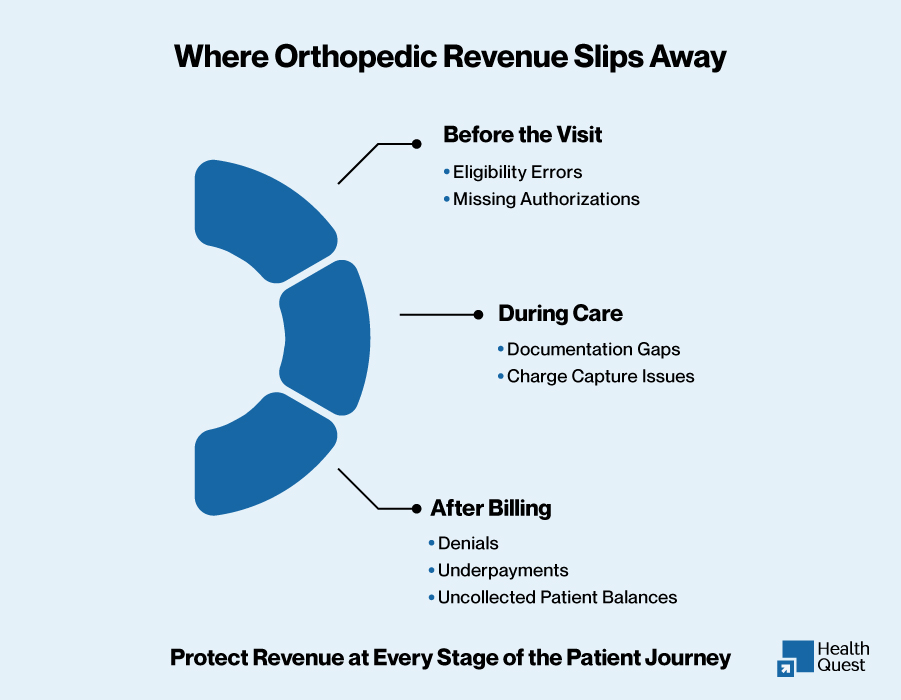
Most revenue loss in orthopedic practices does not occur because providers fail to deliver quality care. Instead, it stems from inefficiencies throughout the orthopedic revenue cycle. Identifying and addressing these gaps can help practices reduce denials, improve collections, and strengthen overall financial performance.
| Revenue Cycle Challenge | Common Cause | Financial Impact |
|---|---|---|
| Prior Authorization Failures | Missing, incomplete, or expired authorizations before treatment or surgery | Claim denials and delayed reimbursements |
| Eligibility Verification Errors | Inactive coverage, incorrect insurance information, or benefit verification issues | Claim rejections and unpaid balances |
| Coding & Modifier Mistakes | Incorrect CPT coding, modifier errors, or incomplete charge capture | Underpayments, denials, and compliance risks |
| Documentation Deficiencies | Insufficient clinical documentation or lack of medical necessity support | Denials, audits, and reimbursement delays |
| Underpaid Claims | Payer reimbursement discrepancies that go unnoticed | Lost revenue and reduced profitability |
| Delayed Accounts Receivable Follow-Up | Lack of proactive claim tracking and insurance follow-up | Aging AR and slower cash flow |
| Patient Collection Challenges | Inadequate collection processes for deductibles, copays, and coinsurance | Increased bad debt and reduced collections |
Warning signs of revenue leakage often include rising denial rates, growing accounts receivable balances, increasing claim rework, delayed approvals, and declining net collections despite stable patient volume. Effective orthopedic RCM helps practices identify these issues early and recover revenue that might otherwise be lost.
Delayed Accounts Receivable Follow-Up
Claims that are not actively monitored often age unnecessarily, reducing collection opportunities and impacting cash flow.
Warning signs of revenue leakage include increasing denial rates, growing accounts receivable balances, rising claim rework, delayed approvals, and declining net collections despite stable patient volume.
High-Value Orthopedic Services Face the Greatest Revenue Risk
Not all orthopedic services carry the same reimbursement risk. High-value procedures often face greater payer scrutiny because they represent larger financial expenditures.
Common services frequently targeted for authorization reviews, medical necessity audits, and documentation validation include:
- Total knee replacements
- Total hip replacements
- Spine surgeries
- Arthroscopic procedures
- MRI and advanced imaging services
- Pain management injections
- Durable medical equipment (DME)
Because these procedures generate substantial revenue, even small increases in denials or underpayments can significantly affect practice profitability. Accurate coding, complete documentation, proper authorization management, and proactive denial prevention are essential to protecting reimbursement.
Is Your Orthopedic Practice Leaving Money on the Table?
Many practices assume their revenue cycle is functioning properly because patient volume remains strong.
However, growing procedure volume can sometimes hide operational inefficiencies.
Warning signs that may indicate revenue leakage include:
- Increasing denial rates
- Delayed surgical approvals
- Growing accounts receivable balances
- Rising patient collection challenges
- Frequent payer underpayments
- Higher claim rework rates
- Increasing staff workload
- Declining net collections despite stable patient volume
If these challenges are becoming more common, it may be time to evaluate revenue cycle performance more closely.
High-Risk Orthopedic Services That Require Special Billing Attention in 2026
Not all orthopedic services carry the same reimbursement risk. High-value procedures often face increased payer scrutiny due to their cost, documentation requirements, and authorization complexity. The following services require strong Orthopedic RCM to ensure accurate reimbursement and minimize denials.
| Orthopedic Service | Common Billing Challenges | Revenue Risk |
|---|---|---|
| Joint Replacement Procedures (Knee & Hip Replacements) | Prior authorization requirements, medical necessity documentation, implant reporting, and post-operative compliance | High |
| Spine Surgery | Extensive documentation requirements, payer reviews, authorization delays, and coding complexity | High |
| Arthroscopic Procedures | Modifier usage, procedure bundling edits, and coding accuracy requirements | Moderate to High |
| Sports Medicine Services | Documentation for injections, rehabilitation services, and surgical interventions | Moderate |
| Pain Management Injections | Frequency limitations, medical necessity reviews, and payer-specific coverage policies | Moderate to High |
| Durable Medical Equipment (DME) | Separate billing rules, documentation requirements, and reimbursement limitations | High |
| Advanced Imaging (MRI, CT, Diagnostic Studies) | Authorization requirements, medical necessity validation, and utilization reviews | Moderate to High |
Because these services generate substantial revenue, even small coding errors, authorization issues, or documentation deficiencies can result in denials, underpayments, and delayed reimbursements. Effective orthopedic billing services and proactive Orthopedic RCM strategies are essential for protecting reimbursement and maximizing practice profitability.
Why Front-End Revenue Cycle Performance Matters More Than Ever
Many billing problems originate long before a claim is submitted. Front-end revenue cycle processes play a major role in determining whether claims are paid accurately and on time.
Key areas requiring attention include:
Insurance Eligibility Verification
Verifying active coverage before appointments helps prevent claim rejections and payment delays.
Prior Authorization Management
Obtaining required approvals before treatment reduces denial risk and protects reimbursement.
Referral Validation
Many orthopedic services require referrals depending on payer requirements.
Patient Financial Responsibility Estimates
Providing cost estimates before treatment helps improve transparency and collection rates.
Point-of-Service Collections
Collecting patient balances early reduces bad debt and improves cash flow.
Practices that strengthen front-end workflows often experience lower denial rates and faster reimbursement cycles.
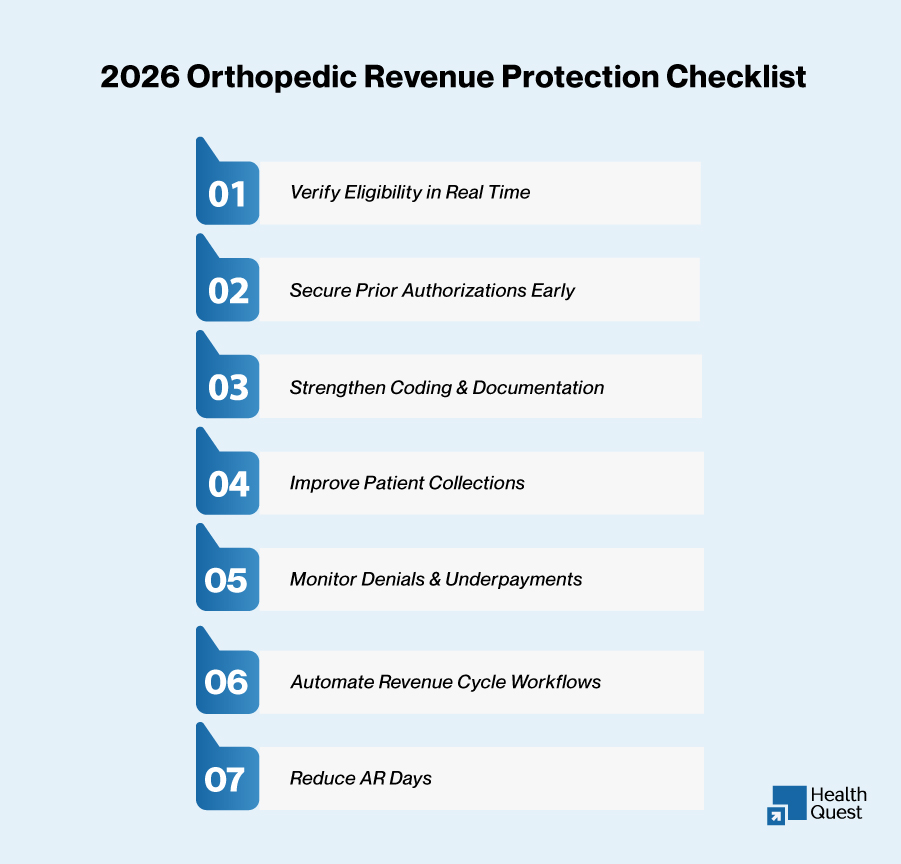
Orthopedic Revenue Protection Checklist 2026
The Most Common Orthopedic Billing Denials in 2026
Denials remain one of the biggest challenges affecting orthopedic revenue cycle management. Understanding the most common denial categories can help practices improve claim accuracy, reduce revenue leakage, and accelerate reimbursements.
| Denial Type | Common Cause | Impact on Revenue |
|---|---|---|
| Prior Authorization Denials | Missing, incomplete, or expired authorizations before surgery or treatment | Delayed payments or complete claim denials |
| Medical Necessity Denials | Documentation does not adequately support the need for treatment or procedure | Reduced reimbursement and increased appeal workload |
| Modifier-Related Denials | Incorrect, missing, or inappropriate modifier usage | Claim rejections, underpayments, and delayed reimbursement |
| Eligibility Denials | Inactive coverage, incorrect insurance information, or benefit limitations | Avoidable claim rejections and patient collection issues |
| Bundling & Coding Edit Denials | Coding combinations that conflict with payer edits or NCCI guidelines | Claim corrections required before payment can be issued |
| Documentation Denials | Missing operative reports, incomplete clinical notes, or insufficient supporting records | Increased audit risk and reimbursement delays |
| Timely Filing Denials | Claims submitted after payer filing deadlines | Permanent revenue loss if appeals are not accepted |
Practices that invest in orthopedic denial management, accurate coding, proactive authorization tracking, and comprehensive documentation can significantly reduce denial rates and improve overall reimbursement performance.
The Growing Importance of Coding and Documentation Accuracy
Orthopedic billing remains one of the most documentation-intensive specialties in healthcare.
Procedures often involve:
- Multiple anatomical sites
- Surgical implants
- Laterality requirements
- Modifier usage
- Complex procedural coding
- Extensive operative reports
Even minor coding inaccuracies can result in:
- Underpayments
- Denials
- Delayed reimbursement
- Compliance concerns
- Audit exposure
Regular coding audits and provider education can help practices maintain strong clean claim rates and reduce revenue loss.
Workers’ Compensation and Personal Injury Claims Create Unique Challenges
Many orthopedic practices manage a significant number of Workers’ Compensation and Personal Injury cases.
These claims often involve:
- Separate authorization requirements
- Extended review periods
- Legal involvement
- Additional documentation requests
- Unique payer guidelines
- Longer reimbursement timelines
Without dedicated workflows, these claims can remain unresolved for months and contribute significantly to aging receivables.
Successful practices often implement specialized processes to manage these accounts more effectively and reduce reimbursement delays.
Case Study: How an Orthopedic Practice Increased Revenue by 25%
A multi-provider orthopedic practice partnered with HealthQuest Billing after experiencing rising denial rates, authorization delays, and growing accounts receivable balances. Despite maintaining strong patient volume, reimbursement challenges were limiting profitability and creating cash flow concerns.
Our orthopedic revenue cycle management team conducted a comprehensive review of the practice’s billing workflows and identified several areas for improvement, including authorization management, claim follow-up, coding accuracy, and denial resolution.
Within months of implementing specialized orthopedic billing services and proactive accounts receivable management strategies, the practice achieved:
- 25% increase in collections
- Lower denial rates
- Faster reimbursement turnaround times
- Reduced aging accounts receivable
- Improved cash flow visibility
This success highlights how strategic orthopedic revenue cycle management can uncover hidden revenue opportunities and strengthen overall financial performance.
How Health Quest Billing Helps Orthopedic Practices Strengthen Financial Performance
Orthopedic reimbursement is complex, and small billing errors can lead to significant revenue loss. Health Quest Billing provides specialized Orthopedic Revenue Cycle Management services designed to optimize coding accuracy, authorization management, claims processing, denial prevention, and accounts receivable recovery. Our orthopedic billing experts help practices improve collections, accelerate reimbursements, reduce revenue leakage, and maximize overall financial performance.
Final Thoughts
In 2026, successful orthopedic practices are focusing on more than patient volume, they are focusing on revenue protection. Every stage of Orthopedic RCM, from insurance verification and prior authorization management to coding accuracy, denial prevention, and accounts receivable follow-up, directly impacts profitability.
Practices that invest in effective Orthopedic RCM strategies are better positioned to reduce denials, improve cash flow, increase collections, and achieve sustainable growth. Whether managed internally or through a specialized orthopedic billing company, a strong revenue cycle strategy is essential for long-term financial success.