
Icon-05

How Much Do Medical Billing Services Cost in 2026?

Medical billing services cost is one of the most important factors healthcare providers consider when evaluating their revenue cycle. Whether you’re a solo provider, a specialty clinic, or a growing healthcare organization, understanding billing costs can help you make informed financial decisions and maximize reimbursements.

One question continues to come up among physicians, practice managers, and healthcare administrators: “How much should medical billing services actually cost?”
The answer depends on several factors, including practice size, specialty, claim volume, service scope, and the pricing model used by the billing company.

However, pricing alone doesn’t tell the full story. Two billing companies may charge similar rates while offering very different levels of service. In this guide, Health Quest Billing explains average medical billing costs, common pricing models, hidden fees, and what providers should look for when choosing a billing partner.

What Does a Medical Billing Company Actually Do?

Before discussing costs, it’s helpful to understand what medical billing companies are responsible for.

A medical billing company helps healthcare providers get paid accurately and on time by managing the revenue cycle process. While many providers think billing is simply submitting claims, it also includes verifying insurance, scrubbing claims, posting payments, managing denials, following up on unpaid claims, sending patient statements, and tracking reimbursements.

Common services include:

  • Insurance Eligibility & Benefits Verification
  • Charge Entry & Claim Submission
  • Claim Scrubbing
  • Payment Posting
  • Denial Management & Appeals
  • Accounts Receivable Follow-Up
  • Patient Billing Support
  • Revenue Cycle Reporting

In simple terms, a medical billing company handles the financial side of healthcare so providers can focus more on patient care.

Why Medical Billing Costs Vary So Much

One of the biggest surprises for healthcare providers is the wide range of pricing they receive when requesting billing quotes.

A company may quote 3%, while another quotes 7% or more.

Naturally, providers often wonder:

“Why is there such a large difference?”

The answer usually comes down to the level of service being provided.

For example:

Service Level What’s Typically Included
Basic Billing Claim submission only
Standard Billing Claims, payment posting, and basic follow-up
Full-Service Revenue Cycle Management Eligibility verification, claim submission, payment posting, denial management, AR follow-up, patient billing, reporting, and ongoing support

A lower percentage doesn’t necessarily mean lower overall costs.

If claims aren’t followed up properly or denials remain unresolved, a practice may lose far more revenue than it saves on billing fees.

That’s why providers should evaluate both pricing and service scope when comparing billing companies.

Average Medical Billing Costs in 2026

Medical billing fees vary depending on specialty, claim volume, and the services included in the agreement.

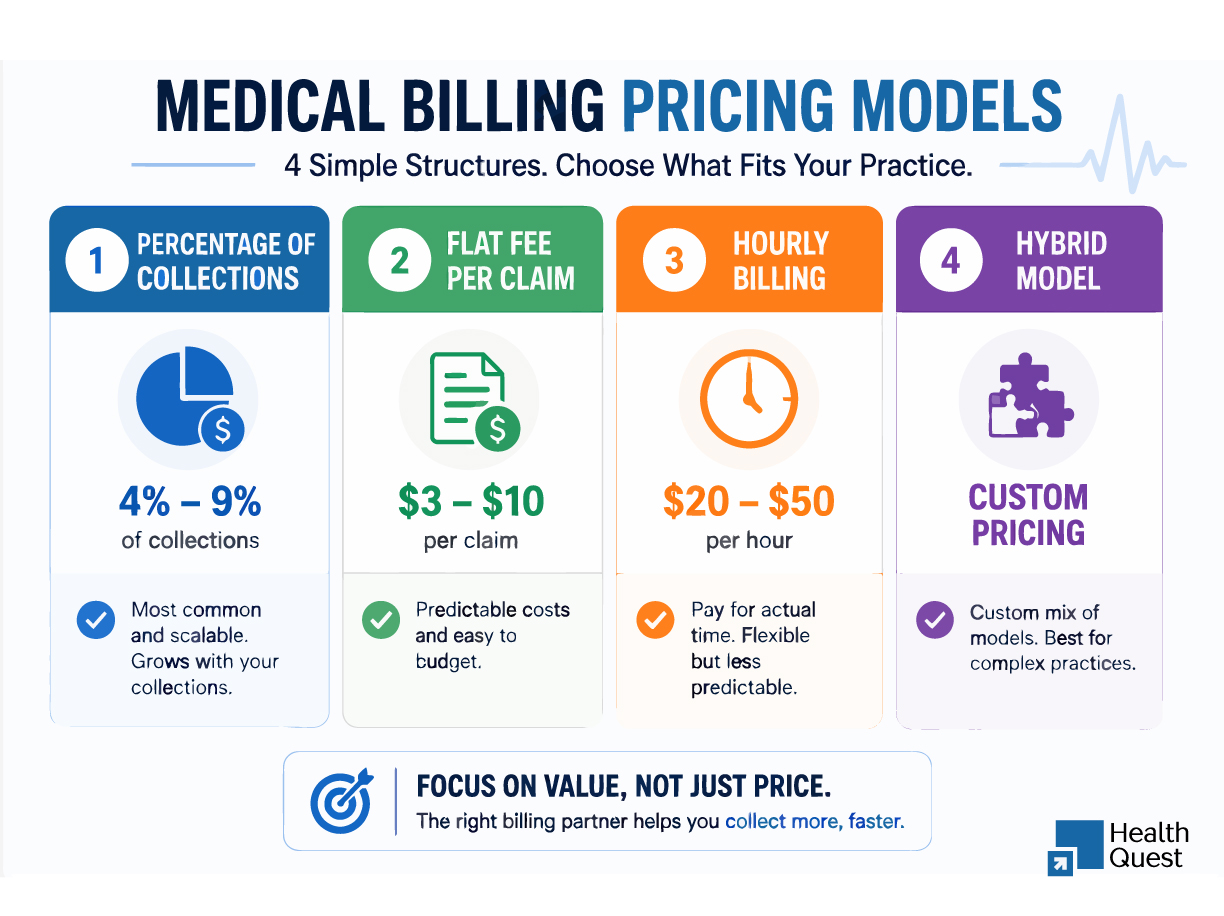
Across the industry, providers can generally expect pricing within the following ranges:

Pricing Model Typical Cost
Percentage of Collections 4% – 9%
Flat Fee Per Claim $3 – $10 per claim
Hourly Billing $20 – $50 per hour
Hybrid Pricing Custom Pricing

These ranges represent general industry averages. Actual costs can vary significantly depending on the complexity of the practice and the level of support required.

What Does Medical Billing Actually Cost a Practice?

Percentages often sound abstract until they’re applied to real numbers.

Let’s assume a healthcare practice collects $100,000 per month.

Pricing Structure Estimated Monthly Cost
4% Collection Rate $4,000
5% Collection Rate $5,000
6% Collection Rate $6,000
Flat Fee ($5 per claim, 1,000 claims) $5,000
Hourly Billing (120 hours at $30/hour) $3,600

These examples help illustrate how pricing models work, but it’s important to remember that the true cost of billing is not just what you pay the billing company.

The real question is:

How much revenue is your billing partner helping you collect?

A billing company that improves collections, reduces denials, and shortens reimbursement timelines may provide a significantly higher return on investment than a lower-cost vendor that offers limited support.

Factors That Influence Medical Billing Costs

No two healthcare practices operate exactly the same way. A solo family medicine provider will have very different billing needs than a multi-specialty group or surgical practice.

That’s why billing costs can vary significantly from one organization to another.

Here are the primary factors that influence medical billing pricing.

1. Claim Volume

Claim volume refers to the number of insurance claims submitted each month.

A practice submitting 300 claims monthly requires far fewer billing resources than a practice processing 5,000 claims.

Higher claim volumes typically require:

  • More charge entry
  • More claim scrubbing
  • Increased payment posting
  • Additional denial management
  • More accounts receivable follow-up

Many billing companies offer volume-based pricing adjustments because larger claim volumes create operational efficiencies.

Monthly Claims Typical Pricing Trend
Under 500 Claims Higher Percentage Rate
500–2,000 Claims Standard Pricing
2,000+ Claims Volume Discounts May Apply

2. Scope of Services

Not all billing companies provide the same level of support.

Some companies simply submit claims. Others manage the entire revenue cycle from patient eligibility verification to denial appeals and reporting.

The more services included, the more resources are required.

Examples of comprehensive revenue cycle services include:

  • Eligibility Verification
  • Benefits Verification
  • Charge Entry
  • Coding Support
  • Claim Submission
  • Payment Posting
  • Denial Management
  • AR Follow-Up
  • Patient Statements
  • KPI Reporting

Providers should always compare service offerings alongside pricing.

3. Specialty Complexity

Certain specialties require more expertise due to coding complexity, payer requirements, and documentation standards.

Examples include:

  • Orthopedics
  • Cardiology
  • Pain Management
  • Gastroenterology
  • Behavioral Health
  • Chiropractic
  • Surgery

More complex specialties often require experienced billing professionals and specialty-specific workflows.

4. Practice Size

A multi-provider organization typically has more complex billing needs than a solo practice.

Additional providers often mean:

  • More payer contracts
  • More claims
  • More reporting requirements
  • Greater administrative support

This can influence pricing and service requirements.

5. Technology Requirements

Technology plays a major role in modern revenue cycle management.

EMR integrations, practice management systems, clearinghouses, reporting dashboards, and analytics platforms all contribute to operational costs.

Providers should ask whether these expenses are included in their billing agreement.

Understanding Medical Billing Charges

When providers receive a billing quote, it’s important to understand what the charges actually cover.

Medical billing costs generally fall into three categories.

Transactional Fees

Transactional fees are directly related to claim processing activities.

Think of these as the day-to-day tasks required to move claims through the reimbursement process.

Examples include:

  • Claim Submission
  • Payment Posting
  • Denial Processing
  • Secondary Claims
  • Patient Statements
  • Electronic Claim Transmission

Because these activities are tied to workload, costs often increase as claim volume increases.

Administrative Fees

Administrative fees support the overall management of the revenue cycle.

These may include:

  • Insurance Verification
  • Patient Registration Review
  • Account Management
  • Revenue Reporting
  • Operational Support

Unlike transactional fees, administrative fees are often fixed monthly costs.

Setup and Implementation Fees

Some billing companies charge a one-time onboarding fee.

This fee may cover:

  • EMR Integration
  • Data Migration
  • Workflow Configuration
  • Staff Training
  • Clearinghouse Setup

Always ask whether implementation fees are included before signing an agreement.

Medical Billing Service Pricing Models

Most billing companies use one of four common pricing structures.

Understanding how each model works can help providers choose the best fit for their practice.

Percentage of Collections Model

The percentage-of-collections model is the most common pricing structure in healthcare billing.

Under this arrangement, the billing company receives a percentage of the money successfully collected on behalf of the practice.

For example:

If your practice collects $100,000 in a month and your billing rate is 5%, the billing company would receive $5,000.

Typical Pricing

Service Type Typical Range
Insurance Billing 4% – 8%
Patient Billing 2% – 5%
Full-Service RCM 5% – 9%

Advantages

  • Billing company succeeds when your practice succeeds
  • Minimal upfront investment
  • Scales easily with practice growth

Considerations

⚠ Fees increase as collections increase

⚠ Service inclusions vary between vendors

Flat Fee Per Claim Model

With this model, providers pay a fixed amount for each claim submitted.

For example, if the fee is $5 per claim and 1,000 claims are submitted during the month, the total cost would be $5,000.

Typical Pricing

Service Type Average Cost
Insurance Claims $3 – $7
Patient Statements $1 – $3
Full-Service Claims $5 – $10

Advantages

  • Predictable costs
  • Easy budgeting
  • Straightforward pricing

Considerations

⚠ May not account for claim complexity

⚠ Additional services may cost extra

Hourly Billing Model

Hourly billing is commonly used for consulting projects, audits, temporary staffing, and specialized billing support.

Typical Rates

Service Typical Rate
Insurance Billing $20 – $35/hr
Patient Billing $15 – $30/hr
Revenue Cycle Consulting $30 – $50+/hr

Advantages

  • Pay only for actual work performed
  • Useful for short-term projects

Considerations

⚠ Difficult to estimate monthly costs

⚠ Expenses may vary significantly

Hybrid Pricing Model

Hybrid pricing combines multiple billing structures.

Examples include:

  • Monthly Fee + Percentage of Collections
  • Per Claim Fee + Consulting Services
  • Flat Fee + Denial Management Services

This approach provides flexibility for organizations with unique requirements.

Which Pricing Model Is Best for Your Practice?

There is no universal pricing model that works for every healthcare organization.

The best choice depends on practice size, growth goals, claim volume, and operational needs.

Practice Type Recommended Model
Solo Practice Percentage of Collections
New Practice Percentage of Collections
Established Clinic Percentage or Hybrid
Large Group Practice Flat Fee or Hybrid
Temporary Billing Support Hourly Billing

For most small and mid-sized practices, percentage-based pricing remains the most popular option because it aligns costs with collections.

Hidden Fees Providers Should Watch For

Not all billing contracts are structured the same way.

Some companies advertise attractive rates but charge additional fees for services that providers assume are included.

Common hidden fees include:

Fee Type Question to Ask
Setup Fee Is onboarding included?
Clearinghouse Fee Monthly or per claim?
Credentialing Fee Separate charge?
Patient Statements Included or extra?
Denial Appeals Additional fee?
Reporting Extra cost for custom reports?

A transparent billing partner should clearly explain every cost before services begin.

What Are Clearinghouse Fees?

Many providers hear the term “clearinghouse” but aren’t entirely sure what it means.

A clearinghouse acts as a checkpoint between your practice and the insurance payer.

Before a claim reaches the insurance company, the clearinghouse reviews it for formatting errors, missing information, and payer-specific requirements.

This helps reduce rejections and improve clean claim rates.

Some billing companies include clearinghouse fees in their pricing, while others charge separately.

Always ask how clearinghouse costs are handled.

Why Some Practices Choose to Outsource Medical Billing

Managing billing internally involves much more than claim submission.

Practices must:

  • Hire billing staff
  • Provide training
  • Purchase software
  • Maintain compliance
  • Monitor denials
  • Follow up on aging claims

For many organizations, outsourcing provides access to experienced billing professionals without the overhead associated with maintaining an internal billing department.

The goal is not simply reducing workload, it’s improving financial performance.

Healthcare Software Pricing for Medical Service Providers

Medical billing costs are not limited to billing company fees. Healthcare practices must also invest in the technology that supports billing, scheduling, documentation, reporting, and revenue cycle management.

The cost of healthcare software varies based on several factors:

  • Number of Providers
  • Number of Users
  • Features Included
  • Cloud-Based vs. On-Premise Deployment
  • Integration Requirements
  • Ongoing Support and Maintenance

For example, a solo provider may only need a basic EHR and billing platform, while a multi-specialty practice may require advanced reporting, patient engagement tools, analytics dashboards, and revenue cycle management software.

Common Healthcare Software Pricing Models

Subscription Model

The subscription model is the most common pricing structure used today.

Practices pay a monthly or annual fee to access the software.

This fee typically includes:

  • Software Access
  • Updates
  • Technical Support
  • Security Maintenance
  • Cloud Hosting

Many providers prefer this model because it requires little upfront investment and ensures they always have access to the latest features.

Per Provider Pricing

Some software vendors charge based on the number of providers using the platform.

For example:

Providers Monthly Cost
1 Provider $200–$500
5 Providers $1,000–$2,500
10+ Providers Custom Pricing

This model allows costs to scale as the practice grows.

Perpetual License Model

Under a perpetual licensing model, the practice purchases the software outright with a one-time payment.

While this eliminates recurring subscription fees, providers may still incur costs for:

  • Software Updates
  • Technical Support
  • Maintenance
  • Server Infrastructure

Although less common today, some organizations still use perpetual-license systems.

Freemium Model

Some healthcare software companies offer free versions of their products with limited functionality.

Additional features such as:

  • Advanced Reporting
  • E-Prescribing
  • Revenue Cycle Management
  • Patient Engagement Tools

are typically available through paid upgrades.

Typical Healthcare Technology Expenses

Technology Typical Cost Structure
Electronic Health Records (EHR) Monthly Subscription
Practice Management Software Monthly Subscription
Clearinghouse Services Monthly or Per Claim
Medical Coding Software Monthly Subscription
Revenue Cycle Analytics Additional Subscription
Patient Engagement Platforms Per Provider or Monthly Fee

When evaluating a billing company, providers should determine whether software costs are included in the service agreement or billed separately.

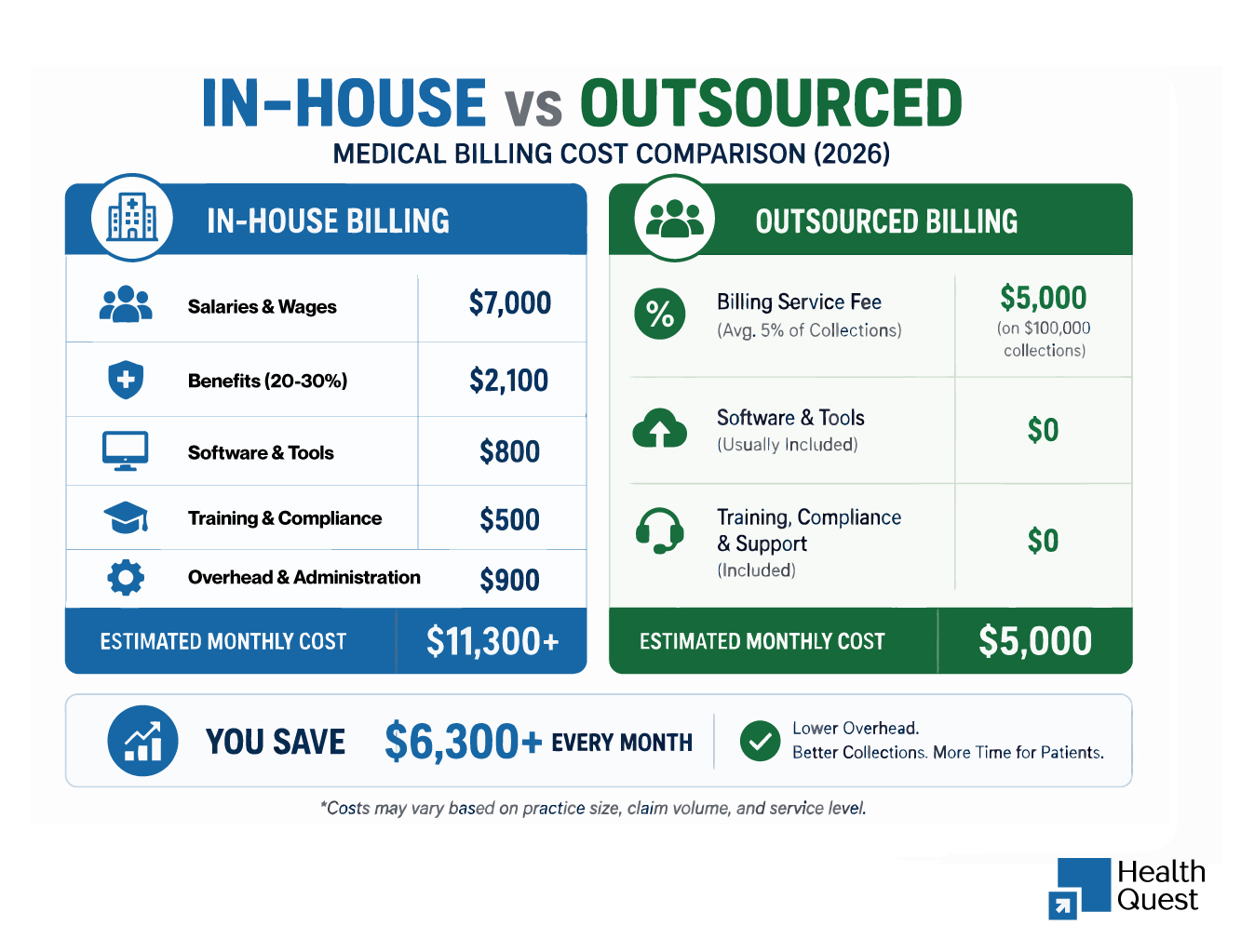
In-House Billing vs. Outsourced Medical Billing

One of the biggest decisions healthcare providers face is whether to manage billing internally or outsource it to a specialized billing company.

While both approaches have advantages, understanding the true costs involved is critical.

In-House Medical Billing

With an in-house model, the practice manages billing operations internally using its own staff and systems.

This typically requires:

  • Billing Specialists
  • Coding Staff
  • Management Oversight
  • Billing Software
  • Ongoing Training
  • Compliance Monitoring

While providers maintain complete control, operational costs can become substantial.

Outsourced Medical Billing

With outsourcing, a third-party billing company manages some or all revenue cycle activities.

This can reduce:

  • Staffing Costs
  • Training Expenses
  • Technology Investments
  • Administrative Burden

Many practices choose outsourcing because it allows clinical staff to focus more on patient care while billing specialists manage reimbursement workflows.

Cost Comparison

Expense Category In-House Billing Outsourced Billing
Staff Salaries High Included
Employee Benefits High Included
Software Licensing Additional Cost Often Included
Training Ongoing Cost Included
Compliance Updates Internal Responsibility Managed by Vendor
Scalability Limited High
Management Oversight Required Minimal

For many growing practices, outsourcing often provides greater flexibility and access to specialized expertise.

What Is Value-Based Reimbursement?

Traditionally, healthcare providers have been paid using a fee-for-service model.

Under this approach, providers are reimbursed based on the number of services performed.

The more services delivered, the more claims submitted.

Value-based reimbursement takes a different approach.

Instead of focusing solely on service volume, reimbursement is increasingly tied to:

  • Patient Outcomes
  • Quality Measures
  • Preventive Care
  • Cost Efficiency
  • Care Coordination

The goal is to improve patient outcomes while controlling healthcare spending.

As value-based care continues to expand, accurate documentation, coding, and reporting become increasingly important.

Pay-for-Performance (P4P)

Pay-for-Performance is one of the most common forms of value-based reimbursement.

Under a P4P model, healthcare providers may receive financial incentives for meeting specific quality benchmarks.

Examples include:

  • Improved Patient Satisfaction Scores
  • Chronic Disease Management Performance
  • Preventive Screening Compliance
  • Reduced Hospital Readmissions
  • Quality Reporting Measures

In simple terms, providers are rewarded not only for delivering care but also for achieving measurable outcomes.

This creates a greater need for accurate documentation and performance reporting.

Accountable Care Organizations (ACOs)

An Accountable Care Organization (ACO) is a group of healthcare providers that work together to coordinate patient care.

The goal is simple:

Deliver better care while reducing unnecessary healthcare costs.

When ACOs successfully improve outcomes and reduce spending, participating providers may share in the savings generated.

Benefits of ACO participation may include:

  • Better Care Coordination
  • Improved Patient Outcomes
  • Reduced Duplicate Services
  • Potential Shared Savings Payments

As healthcare reimbursement evolves, billing and reporting systems must support these quality-based initiatives.

Understanding Care Episodes

A care episode refers to the complete course of treatment related to a specific medical condition or procedure.

For example, a knee replacement episode may include:

  1. Initial Consultation
  2. Diagnostic Testing
  3. Surgical Procedure
  4. Rehabilitation Services
  5. Follow-Up Care

Rather than evaluating each service separately, some value-based reimbursement models assess the quality and cost of the entire episode of care.

This encourages providers to focus on long-term patient outcomes rather than individual services.

What Should Be Included in a Medical Billing Fee?

One of the biggest mistakes providers make is comparing billing percentages without comparing services.

For example:

A company charging 3% may only submit claims.

A company charging 5% may provide full revenue cycle management, denial appeals, payer follow-up, patient billing support, and reporting.

Without understanding what’s included, providers may not be making an accurate comparison.

A comprehensive billing service should typically include:

  • Eligibility Verification
  • Benefits Verification
  • Charge Entry
  • Claim Scrubbing
  • Claim Submission
  • Payment Posting
  • Accounts Receivable Follow-Up
  • Denial Management
  • Appeals Processing
  • Patient Statements
  • Revenue Cycle Reporting

Always request a detailed breakdown of services before evaluating pricing.

Health Quest Billing’s Revenue Cycle Management Pricing

At Health Quest Billing, we use a tiered pricing model designed to support practice growth.

Unlike many billing companies that charge the same percentage regardless of collection volume, our pricing decreases as collections increase.

Core Pricing Options

Plan Monthly Collections Rate Monthly Minimum
Starter Up to $50,000 4.99% $1,500
Growth $50,001–$100,000 4.49% $2,500
Professional $100,001–$150,000 3.99% $4,500
Enterprise $150,001+ 2.99% $6,500

This structure allows practices to retain more revenue as they scale while maintaining dedicated billing support and operational consistency.

What’s Included in Health Quest Billing’s Core RCM Services?

Our Core Revenue Cycle Management services include:

  • Eligibility and Benefits Verification
  • Demographic and COB Validation
  • Charge Entry
  • Claim Editing and Scrubbing
  • Electronic Claim Submission
  • Rejection Management
  • Payment Posting
  • Denial Management
  • First-Level and Second-Level Appeals
  • Payer Follow-Up
  • Patient Statements
  • Basic Patient Billing Support
  • Refund and Credit Balance Processing
  • KPI Reporting and Month-End Reviews

These services are designed to help providers improve collections while maintaining compliance and operational efficiency.

Additional Services Available

Some practices require support beyond traditional billing functions.

Health Quest Billing offers additional services that can be customized based on practice needs.

These may include:

  • Medical Coding
  • Provider Credentialing
  • Prior Authorization Support
  • Advanced Revenue Analytics
  • Patient Call Center Services
  • Contract Analysis
  • Payer Enrollment Assistance

Why Credentialing Matters

Many providers focus heavily on billing but overlook credentialing.

However, reimbursement cannot occur if providers are not properly enrolled with insurance payers.

Credentialing involves:

  • Medicare Enrollment
  • Medicaid Enrollment
  • Commercial Payer Enrollment
  • CAQH Maintenance
  • Re-Credentialing
  • Provider Data Updates

Effective credentialing helps prevent claim denials, reimbursement delays, and participation issues with insurance networks.

Questions to Ask Before Hiring a Medical Billing Company

Before selecting a billing partner, healthcare providers should ask:

Pricing Questions

  • What pricing model do you use?
  • Are there monthly minimums?
  • Are there setup fees?
  • Are clearinghouse fees included?

Service Questions

  • What services are included?
  • How do you manage denials?
  • Are patient statements included?
  • Do you provide AR follow-up?

Performance Questions

  • What is your average clean claim rate?
  • How often do you provide reporting?
  • What KPIs do you track?
  • How do you measure success?

Technology Questions

  • Which EHR systems do you support?
  • Do you integrate with our current software?
  • Is reporting included?

These questions help providers make informed decisions and avoid unexpected costs.

Conclusion

Choosing a medical billing company is about more than finding the lowest rate; it’s about finding a partner that protects your revenue. The right billing team should help you reduce denials, accelerate reimbursements, improve cash flow, maintain compliance, and uncover opportunities for long-term financial growth. While medical billing costs vary based on your practice’s size, specialty, and operational needs, understanding pricing models and service offerings allows you to make a confident, informed decision. Ultimately, the true value of a billing partner lies not in what they charge, but in how much revenue they help you recover, retain, and grow.

Partner with Health Quest Billing and turn every claim into a collection opportunity.
Schedule your free revenue cycle assessment today and discover how much more your practice could be collecting.

Let’s Get Started

    Services Interested In*


    Disclaimer:
    For your privacy, please do not submit any patient or medical information in this form.