More than 78 million Americans receive healthcare coverage through Medicaid, making it one of the largest public health insurance programs in the United States. For healthcare providers, participating in Medicaid opens the door to serving millions of eligible patients, but only after completing your state’s Medicaid credentialing and provider enrollment process.
Unlike Medicare, Medicaid is administered by individual states, which means enrollment requirements, applications, and approval timelines vary across state Medicaid agencies. Missing documentation, incorrect provider information, or failure to meet state-specific requirements can delay enrollment, postpone reimbursements, and increase administrative workload.
This guide explains everything healthcare providers need to know about Medicaid credentialing, including eligibility requirements, required documents, enrollment steps, processing timelines, common mistakes, and best practices to help you become Medicaid billing-ready faster.
Medicaid Credentialing Overview
| Category | Details |
| What is Medicaid Credentialing? | The verification and enrollment process that authorizes healthcare providers to participate in their state’s Medicaid program and bill for covered services. |
| Managed By | Individual State Medicaid Agencies (under CMS oversight) |
| Enrollment System | State-specific Medicaid Provider Enrollment Portals |
| Primary Identifier | National Provider Identifier (NPI) |
| Approval Result | Medicaid Provider ID (varies by state) and Medicaid billing privileges |
| Average Processing Time | Typically 30–90 days depending on the state and application completeness |
| Who Needs It? | Physicians, nurse practitioners, physician assistants, therapists, behavioral health providers, dentists, hospitals, clinics, home health agencies, laboratories, DME suppliers, and other eligible healthcare organizations |
| Required Information | NPI, professional license, TIN/EIN, malpractice insurance, ownership details, and state-specific documentation |
| Revalidation | Required periodically based on state Medicaid regulations and federal CMS requirements |
What is Medicaid Credentialing?
Medicaid credentialing is the process of verifying a healthcare provider’s qualifications and enrolling them with a state Medicaid program so they can provide covered services to Medicaid beneficiaries and receive reimbursement.
During enrollment, the state Medicaid agency verifies the provider’s professional license, education, certifications, ownership information, practice location, National Provider Identifier (NPI), and compliance with federal and state regulations.
Once approved, providers receive a Medicaid Provider ID (or state-specific enrollment approval) that allows them to submit Medicaid claims for eligible services.
Unlike Medicare, which follows a standardized federal enrollment process through PECOS, Medicaid credentialing requirements differ from one state to another. Each state operates its own provider enrollment portal, documentation requirements, and approval workflow.
Who Needs Medicaid Credentialing?
Any healthcare provider or organization that plans to treat Medicaid beneficiaries and receive reimbursement from a state Medicaid program must complete Medicaid credentialing before submitting claims.
Common providers that require Medicaid credentialing include:
- Physicians (MD & DO)
- Nurse Practitioners (NPs)
- Physician Assistants (PAs)
- Clinical Nurse Specialists (CNSs)
- Physical, Occupational, and Speech Therapists
- Behavioral Health Providers
- Clinical Psychologists
- Licensed Clinical Social Workers
- Dentists
- Home Health Agencies
- Hospitals and Health Systems
- Rural Health Clinics (RHCs)
- Federally Qualified Health Centers (FQHCs)
- Clinical Laboratories
- DMEPOS Suppliers
- Group Practices and Multi-Specialty Clinics
Tip: Providers who participate in both Medicare and Medicaid must complete separate enrollment and credentialing processes, as each program has different requirements.
Medicaid vs. Medicare Credentialing
Although Medicare and Medicaid are both government-funded healthcare programs, their credentialing and enrollment processes are different. Understanding these differences helps providers choose the correct enrollment pathway and avoid unnecessary delays.
| Medicare | Medicaid |
| Federal health insurance program | Joint federal and state health insurance program |
| Managed by the Centers for Medicare & Medicaid Services (CMS) | Administered by individual state Medicaid agencies |
| Enrollment completed through PECOS | Enrollment completed through state Medicaid provider portals |
| Standardized national enrollment requirements | Requirements vary by state |
| Primarily serves adults 65+ and certain individuals with disabilities | Primarily serves eligible low-income adults, children, pregnant women, seniors, and individuals with disabilities |
| Providers receive a PTAN after approval | Providers receive a state Medicaid Provider ID (varies by state) |
| Medicare revalidation follows CMS guidelines | Revalidation schedules vary by state Medicaid agency |
Related Guide: If your practice also plans to treat Medicare beneficiaries, learn about the Medicare enrollment process in our Medicare Credentialing Guide.
Medicaid Credentialing Eligibility Requirements
Before applying for Medicaid enrollment, healthcare providers must meet both federal and state-specific eligibility requirements. While requirements differ by state, most Medicaid agencies require providers to have:
- An active, unrestricted professional license
- A valid National Provider Identifier (NPI)
- A Tax Identification Number (TIN/EIN) or Social Security Number (SSN)
- Required education, training, and specialty certifications
- No exclusions from federal healthcare programs
- A verified practice location and contact information
- Compliance with state Medicaid enrollment regulations
Certain provider types may also need additional documentation, such as DEA registration, board certifications, malpractice insurance, or accreditation, depending on state requirements and the services provided.
Best Practice: Verify your eligibility before starting the application to reduce requests for additional information and avoid enrollment delays.
Documents Required for Medicaid Credentialing
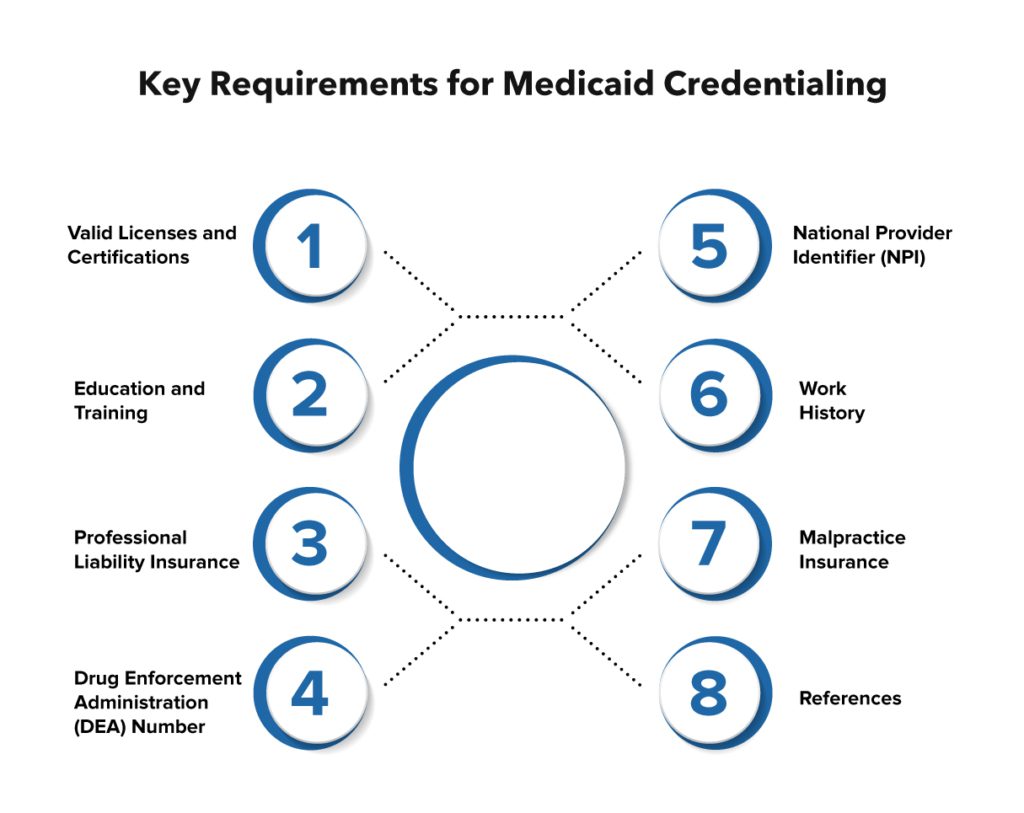
Preparing accurate documentation before starting your application helps streamline the enrollment process and reduces the risk of delays or rejections.
| Required Document | Purpose |
| State Professional License | Verifies authorization to practice |
| National Provider Identifier (NPI) | Identifies the provider for enrollment and billing |
| Tax ID (TIN/EIN) or SSN | Required for provider enrollment |
| Curriculum Vitae (CV) | Verifies education and professional experience |
| Malpractice Insurance | Confirms professional liability coverage |
| DEA Registration (if applicable) | Required for providers prescribing controlled substances |
| Board Certifications (if applicable) | Verifies specialty qualifications |
| W-9 Form | Tax reporting information |
| Ownership & Practice Information | Required for organizations and group practices |
| State-Specific Enrollment Forms | Required by individual Medicaid agencies |
Best Practice: Ensure your NPI Registry (NPPES), state licensing records, IRS information, and enrollment documents contain consistent provider information. Even minor discrepancies can delay Medicaid approval.
Step-by-Step Medicaid Credentialing Process
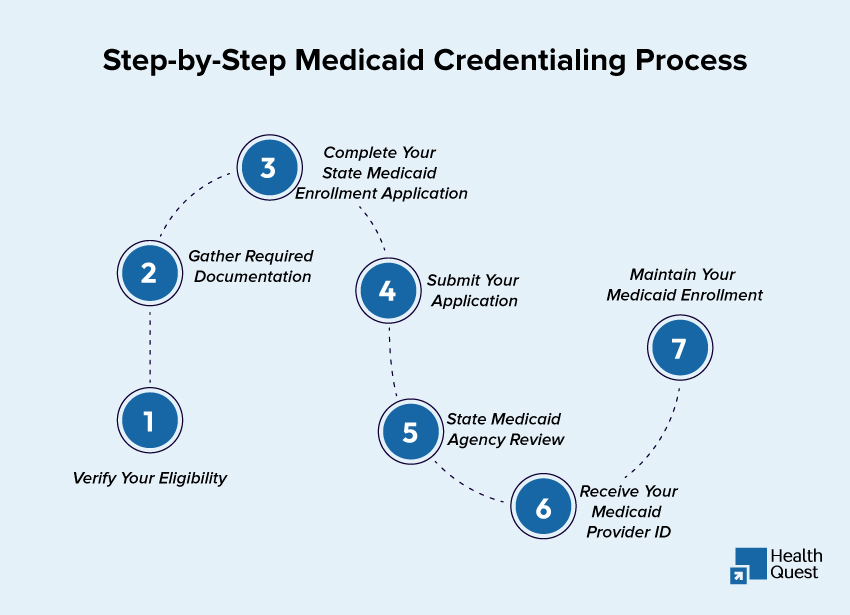
Successfully enrolling in Medicaid requires more than submitting an application. Providers must verify their qualifications, complete state-specific enrollment forms, provide supporting documentation, and undergo a review by their state’s Medicaid agency. Although each state follows its own enrollment process, the overall workflow is similar across the United States.
Step 1: Verify Your Eligibility
Before applying, confirm that you meet your state’s Medicaid enrollment requirements. Ensure you have an active professional license, a valid National Provider Identifier (NPI), the appropriate Tax Identification Number (TIN/EIN or SSN), and any required certifications for your specialty.
Step 2: Gather Required Documentation
Prepare all required documents before beginning your application. Verify that your provider information is consistent across your NPI Registry (NPPES), state licensing board, IRS records, and other supporting documents to minimize processing delays.
Step 3: Complete Your State Medicaid Enrollment Application
Unlike Medicare, Medicaid enrollment is completed through your state’s Medicaid provider enrollment portal. Carefully complete the required application forms and submit all requested documentation based on your provider type and practice structure.
Step 4: Submit Your Application
Submit your completed enrollment application through your state’s online portal or other approved submission method. Review all information carefully before submission, as incomplete or inaccurate applications are one of the leading causes of enrollment delays.
Step 5: State Medicaid Agency Review
The state Medicaid agency reviews your application, verifies your credentials, and may request additional documentation or clarification. Responding quickly to these requests helps keep the enrollment process on schedule.
Step 6: Receive Your Medicaid Provider ID
Once your application is approved, you’ll receive your state’s Medicaid Provider ID (or equivalent enrollment approval), allowing you to begin billing Medicaid for covered services in accordance with state program requirements.
Step 7: Maintain Your Medicaid Enrollment
Enrollment doesn’t end after approval. Providers must keep their information current, report ownership or practice changes, renew licenses, and complete Medicaid revalidation or recredentialing as required by their state.
How Long Does Medicaid Credentialing Take?
Processing times vary by state, provider type, application accuracy, and enrollment volume. While some states process applications within a few weeks, others may take several months, particularly if additional documentation is required.
| Enrollment Stage | Estimated Timeline |
| Gather required documents | 1–2 weeks |
| Complete enrollment application | 2–7 days |
| Submit application | Same day |
| State review & verification | 2–8 weeks |
| Enrollment approval | 2–6 weeks |
| Typical Total Timeline | 30–90 days |
Planning Tip: If you’re opening a new practice, hiring providers, or expanding into a new state, begin Medicaid credentialing at least 90 days before your anticipated start date to help prevent reimbursement delays.
Medicaid Credentialing by Provider Type
Although the Medicaid enrollment process follows the same general workflow, documentation requirements, enrollment portals, and approval criteria vary by provider type and state Medicaid agency.
| Provider Type | Typical Enrollment Requirements | Key Requirements |
| Individual Physicians & NPPs | State Medicaid enrollment | NPI, active license, malpractice insurance |
| Group Practices | Organizational enrollment | TIN/EIN, ownership information, provider affiliations |
| Behavioral Health Providers | State-specific behavioral health enrollment | Professional license, specialty credentials |
| Telehealth Providers | Medicaid enrollment (where applicable) | State licensure, telehealth compliance |
| Therapy Practices (PT, OT, SLP) | Individual or group enrollment | Professional licensing and Medicaid participation requirements |
| Hospitals & Healthcare Facilities | Facility enrollment | Facility licensing, ownership disclosures, compliance documentation |
| Home Health Agencies | Agency enrollment | State certification, licensing, Medicare/Medicaid compliance |
| DMEPOS Suppliers | State Medicaid supplier enrollment | Accreditation, licensing, supplier compliance |
Quick Notes
- Individual providers must obtain an NPI before enrolling in Medicaid.
- Group practices require organizational enrollment, while each rendering provider must also be individually enrolled when required by the state.
- Behavioral health, telehealth, and therapy providers should verify state-specific coverage and enrollment policies before applying.
- Healthcare facilities, home health agencies, and DME suppliers often have additional licensing and compliance requirements.
Tip: Always review your state’s Medicaid enrollment requirements before submitting your application, as provider eligibility and documentation vary by state.
State-Specific Medicaid Enrollment Requirements
Unlike Medicare, Medicaid is administered by individual states. As a result, provider eligibility requirements, enrollment portals, screening procedures, documentation, provider screening levels, revalidation schedules, and approval timelines vary from state to state. A provider enrolling in California may follow a completely different process than one enrolling in Texas, Florida, Illinois, or New York.
Before submitting your application, always review your state’s Medicaid provider enrollment requirements to ensure you’re using the correct forms, submitting the required documentation, and meeting all applicable state regulations. Taking this step can significantly reduce enrollment delays, requests for additional information, and claim reimbursement issues.
Provider Tip: If your practice operates in multiple states or plans to expand, you’ll typically need to complete a separate Medicaid enrollment with each state’s Medicaid agency, as approval in one state does not automatically authorize participation in another state’s Medicaid program.
Common State Medicaid Enrollment Portals
Because each state administers its own Medicaid program, providers must complete enrollment through their state’s designated provider portal. While the application process differs by state, most portals allow providers to submit enrollment applications, upload supporting documents, monitor application status, complete revalidation, and update provider information.
Some commonly used Medicaid provider enrollment systems include:
| State | Provider Enrollment Portal |
| California | Provider Application and Validation for Enrollment (PAVE) |
| Florida | Florida Medicaid Provider Portal |
| Texas | Texas Medicaid & Healthcare Partnership (TMHP) |
| New York | eMedNY Provider Enrollment |
| Illinois | Illinois Medicaid Provider Enrollment (IMPACT) |
| Michigan | CHAMPS (Community Health Automated Medicaid Processing System) |
Provider Tip: Always use your state’s official Medicaid provider enrollment portal and follow the latest enrollment requirements published by your state Medicaid agency. Portal features, screening requirements, documentation, and approval timelines vary significantly from one state to another.
Medicaid Revalidation Requirements
Medicaid enrollment is not permanent. Most state Medicaid agencies require providers to periodically revalidate or recredential their enrollment information to ensure they continue to meet program requirements.
Failure to complete revalidation by the required deadline may result in suspension or termination of Medicaid billing privileges, leading to claim denials and reimbursement interruptions.
To maintain active enrollment:
- Monitor revalidation notices from your state Medicaid agency.
- Keep your provider information and practice details up to date.
- Report ownership, address, or legal entity changes promptly.
- Renew professional licenses, certifications, and malpractice insurance before expiration.
- Complete any required state recredentialing or screening requirements on time.
Pro Tip: Maintaining accurate provider records throughout the year makes Medicaid revalidation faster and helps prevent unnecessary enrollment interruptions.
Common Reasons Medicaid Credentialing Is Delayed or Rejected
Most Medicaid enrollment delays are caused by incomplete applications or state-specific documentation issues—not provider eligibility. Reviewing your application carefully before submission can significantly reduce processing time.
| Common Issue | How to Avoid It |
| Incomplete enrollment application | Review every section before submission and provide all required information. |
| Incorrect or inconsistent provider information | Ensure your NPI, state license, IRS records, and application details match exactly. |
| Missing supporting documents | Include all required licenses, certifications, malpractice insurance, ownership documents, and state-required forms. |
| Failure to meet state-specific requirements | Review your state’s Medicaid enrollment guidelines before applying. |
| Delayed response to agency requests | Respond promptly to requests for additional documentation or clarification. |
| Ownership or practice information doesn’t match | Verify legal business name, TIN/EIN, addresses, and ownership disclosures. |
| Failure to maintain provider records | Keep your NPI, licenses, and enrollment information updated after approval. |
Expert Tip: The fastest way to avoid Medicaid enrollment delays is to verify that all provider information is accurate, complete, and consistent before submitting your application.
Can You Bill Medicaid Before Credentialing Approval?
In most cases, no. Healthcare providers should wait until their Medicaid enrollment has been approved and they have received authorization from their state Medicaid agency before submitting claims.
Submitting claims before approval may result in:
- Claim denials or rejections
- Delayed reimbursements
- Additional administrative work
- Missed timely filing deadlines
Some states may allow limited retroactive billing under specific circumstances, but these rules vary by Medicaid program. Always verify your effective enrollment date and state billing policies before providing services to Medicaid beneficiaries.
Best Practice: Begin Medicaid credentialing 90–120 days before your planned start date to ensure you’re approved and billing-ready when you begin seeing Medicaid patients.
Medicaid Credentialing Checklist
Before submitting your Medicaid enrollment application, use this checklist to ensure everything is complete and accurate.
- Obtain a National Provider Identifier (NPI).
- Verify your professional license is active and unrestricted.
- Gather all required documents, including malpractice insurance, CV, W-9, DEA registration (if applicable), and ownership information.
- Review your state’s Medicaid enrollment requirements.
- Ensure your NPI, IRS records, state license, and practice information match exactly.
- Complete your state’s Medicaid enrollment application accurately.
- Review every section before submitting your application.
- Keep copies of all submitted documents and confirmation receipts.
- Respond promptly to requests for additional information.
- Confirm your Medicaid Provider ID before billing patients.
- Track future revalidation or recredentialing deadlines.
Pro Tip: Most Medicaid enrollment delays are caused by incomplete documentation, inconsistent provider information, or missing state-specific requirements—not provider eligibility.
Medicaid Enrollment Statistics & Industry Insights
Understanding Medicaid’s scale highlights why timely credentialing is essential for healthcare providers seeking to expand patient access and revenue opportunities.
| Metric | Insight |
| Medicaid beneficiaries | More than 78 million Americans are enrolled in Medicaid and CHIP. |
| Enrollment administration | Medicaid programs are managed individually by each state under federal CMS oversight. |
| Typical processing time | Most Medicaid applications are processed within 30–90 days, depending on the state. |
| Enrollment requirements | Every state has its own provider enrollment portal, documentation, and approval process. |
| Revalidation | Providers must periodically revalidate or recredential based on state requirements. |
| Common causes of delays | Missing documents, inconsistent provider information, incomplete applications, and failure to meet state-specific requirements. |
Practice Tip: Starting the credentialing process at least 3–4 months before your anticipated start date helps prevent reimbursement delays and ensures uninterrupted patient care.
Benefits of Professional Medicaid Credentialing Services
Managing Medicaid enrollment can be time-consuming, especially for multi-provider practices and organizations operating in multiple states. Professional credentialing services help streamline the process, reduce administrative burden, and improve enrollment accuracy.
Our Medicaid credentialing specialists can help you:
- Verify provider documentation before submission
- Complete state Medicaid enrollment applications accurately
- Manage provider enrollments across multiple states
- Track application status and respond to agency requests
- Assist with provider additions, revalidation, and recredentialing
- Reduce enrollment delays and claim denials
- Allow your staff to focus on patient care instead of paperwork
Whether you’re a solo provider, group practice, behavioral health organization, therapy clinic, home health agency, or DME supplier, professional credentialing support can help you become Medicaid billing-ready faster.
Need help with Medicaid credentialing?
Successfully enrolling in Medicaid requires more than completing an application. Providers must navigate state-specific enrollment requirements, submit accurate documentation, respond to requests from state Medicaid agencies, maintain compliance with ongoing revalidation requirements, and ensure their enrollment is completed the first time correctly. Even small errors can delay approval, postpone reimbursements, and create unnecessary administrative burdens.
Schedule a free consultation with our credentialing experts to discuss your Medicaid enrollment needs and receive a customized credentialing strategy that helps reduce delays, accelerate approvals, and keep your practice focused on delivering quality patient care.