
Clean claim submission has become a key financial performance factor in healthcare revenue cycles. In 2026, industry benchmarks show that only 85%–90% of claims are initially accepted as clean, while 10%–15% require corrections or rework before payment. This directly increases AR days, administrative workload, and delays in reimbursement.
Research also indicates that up to 60%–75% of claim denials are preventable, with most errors coming from eligibility issues, coding mistakes, missing prior authorizations, or documentation gaps. With stricter payer rules and growing Medicare Advantage and Medicaid managed care complexity, clean claim accuracy has never been more important.
A clean claim is achieved through a structured process involving accurate patient registration, eligibility verification, correct ICD-10/CPT coding, prior authorization management, and claim scrubbing before submission. Improving this process helps reduce denials and ensures faster, more predictable reimbursement.
What Is a Clean Claim in Medical Billing?
A clean claim is a claim submitted to the insurance payer that is accurate, complete, and free of errors, allowing it to be processed without rejection or additional information. In many practices, working with a medical billing service helps ensure claims meet all payer requirements from the start and reduces avoidable denials.
A clean claim must:
- Include correct patient and insurance details
- Use accurate ICD-10, CPT, and HCPCS codes
- Meet payer-specific requirements
- Pass clearinghouse edits
- Require no follow-up for processing
Improving clean claim rates reduces denials, shortens payment cycles, and strengthens financial stability.
What Does a Medical Claim Include?
A clean medical claim must be complete, accurate, and compliant to avoid denials and delays. Even small errors can trigger rejections or slow reimbursement.
A standard claim includes five key components:
- Patient Information: Name, DOB, insurance ID, and policy details. Errors here can cause immediate rejection.
- Provider Information: Rendering provider details, NPI, and credentials. Mismatches can delay payment.
- Procedure & Diagnosis Codes: ICD-10 and CPT codes must align to support medical necessity.
- Charges: Itemized service costs that match documentation and payer guidelines.
- Insurance Information: Payer details and policy data to ensure correct claim routing.
Accuracy across all sections is essential to maintain a high clean claim rate and reduce AR delays.
Clean Claim Submission Process in Medical Billing (Step-by-Step)
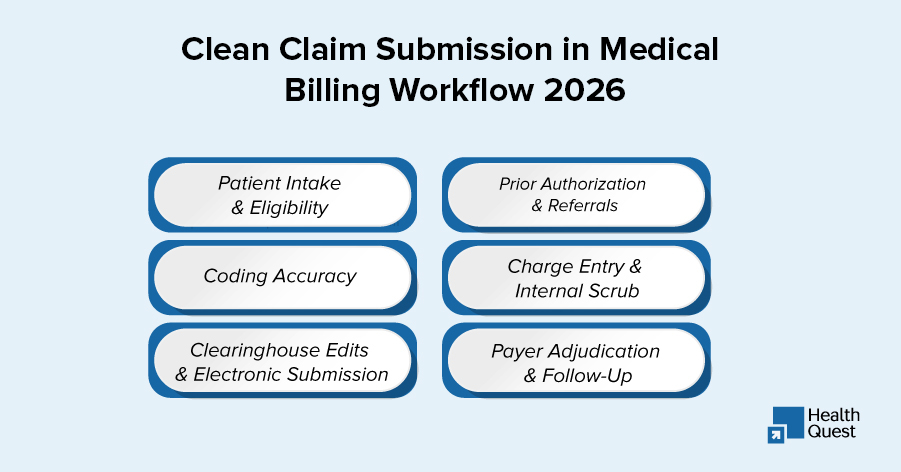
The clean claim submission process in medical billing is a structured workflow that starts at patient intake and continues until final payment. Each step directly impacts claim accuracy, denial risk, and reimbursement speed. If one step fails, the entire revenue cycle is affected.
1. Patient Registration & Insurance Verification
The process begins at the front desk. Accurate patient data and insurance verification are essential to avoid early claim rejection. This includes confirming patient demographics, insurance eligibility, policy details, and coverage benefits. Errors at this stage are one of the most common reasons for preventable denials, especially in high-utilization specialties like mental health and therapy services.
2. Prior Authorization & Referral Checks
Before services are delivered, required authorizations must be verified. Many payers require approval for procedures, visits, or therapy sessions. If authorization details do not match CPT codes, dates, or service limits, the claim is automatically denied. Proper tracking of approvals, expirations, and visit limits is critical for clean claim success.
3. Medical Coding (CPT, ICD-10, HCPCS)
Accurate coding is the core of clean claim performance. CPT, ICD-10, and HCPCS codes must fully match documentation and medical necessity. Common issues include missing modifiers, incorrect diagnosis linkage, or unbundling errors. Even small coding mistakes can lead to denials, downcoding, or payment delays.
4. Charge Entry & Internal Claim Scrubbing
Before submission, claims must go through internal review. This step ensures charges match documentation, provider details are correct, and payer rules are followed. Claim scrubbing helps identify errors early—such as missing data, incorrect fees, or coding inconsistencies—before the claim reaches the clearinghouse.
5. Clearinghouse Submission & Edits
Claims are then submitted electronically through a clearinghouse. While this speeds up processing, it also applies automated edits that can reject claims instantly. Common issues include formatting errors, missing modifiers, or enrollment mismatches. Continuous monitoring and quick correction are essential to avoid delays.
6. Payer Adjudication & Follow-Up
After submission, the payer reviews the claim and decides on payment. Claims may be approved, denied, or underpaid based on policy rules. A strong clean claim process doesn’t stop here—it includes follow-ups, denial management, underpayment reviews, and appeal handling to ensure full reimbursement.
Top Claim Denial Reasons in Medical Billing (And Why They Hurt Your Revenue)
Claim denials in medical billing are not just administrative setbacks; they are direct threats to cash flow, operational efficiency, and revenue cycle stability.
Understanding the most common claim denial reasons in medical billing is critical to improving clean claim rates and strengthening denial management processes. Most denials fall into predictable categories. When left unaddressed, they increase accounts receivable (AR) days, reduce reimbursement accuracy, and strain billing teams.
Below are the most damaging denial drivers in today’s healthcare claim process.
- Eligibility & Demographic Errors: If patient details or insurance information are incorrect or outdated, the claim is rejected before processing even begins.
- Timely Filing Issues: Every payer has strict deadlines. Missing these limits means the claim is denied, even if everything else is correct.
- Coding & Documentation Errors: Wrong ICD-10/CPT codes, missing modifiers, or poor documentation can lead to denial or reduced payment.
- Prior Authorization Problems: If approval is missing or doesn’t match the service provided, insurers often deny the claim completely.
- Medical Necessity & Coverage Limits: Payers may deny services if they are not considered necessary or not covered under the patient’s plan.
- Duplicate or Administrative Errors: Duplicate submissions, incorrect routing, or missing attachments can also trigger rejections or payment delays.
Understanding these denial reasons helps practices improve clean claim rates and maintain a more stable and predictable revenue cycle.
Specialty-Specific Clean Claim Challenges
The clean claim submission process in medical billing differs across specialties due to variations in coding rules, documentation needs, payer policies, and authorization requirements. Understanding these differences helps reduce denials and improve reimbursement accuracy.
Clean Claim Challenges by Specialty
| Specialty | Billing Complexity | Common Denial Triggers | Key Clean Claim Focus Areas |
|---|---|---|---|
| Mental Health / Behavioral Health | Time-based CPT codes, telehealth visits, session limits | Missing modifier 95, exceeding visit limits, weak documentation | Time accuracy, telehealth compliance, authorization tracking |
| Plastic Surgery | Cosmetic vs medically necessary procedures | Lack of medical necessity, missing pre-approvals, ICD-10 mismatch | Strong diagnosis linkage, documentation for medical necessity |
| Cardiology | High-cost procedures, imaging, stress tests | Authorization errors, bundling issues, modifier mistakes | CPT precision, NCCI compliance, prior authorization accuracy |
| Orthopedics | Surgical coding, global periods, laterality rules | Global period errors, incorrect modifiers (-25, -59), sequencing issues | Surgical coding accuracy, modifier use, post-op billing rules |
| Oncology | Drug/infusion billing, HCPCS J-codes | Incorrect drug units, authorization gaps, dosage errors | Drug unit validation, payer alignment, documentation strength |
| Imaging Centers | Technical vs professional billing split | Missing modifier 26/TC, authorization issues | Component billing accuracy, frequency control, payer rules |
| Pain Management | Injections and interventional procedures | Missing authorization, frequency limit violations | Procedure-specific authorization, detailed documentation |
| Physical Therapy | Visit limits, treatment plans | Exceeding visit caps, missing updated care plans | Visit tracking, GP modifier compliance, plan-of-care updates |
| Emergency Medicine | E/M coding complexity | Downcoding due to poor documentation | E/M coding accuracy, documentation support |
| Pediatrics | Immunizations, Medicaid-heavy billing | Vaccine coding errors, VFC program issues | CPT/HCPCS accuracy, Medicaid compliance |
Each specialty has its own billing risks, but most denials come from similar issues authorization gaps, coding errors, and documentation weaknesses. Strengthening these areas is essential for improving clean claim rates and ensuring faster reimbursement.
Why the Clean Claim Rate Matters in Revenue Cycle Management
The clean claim rate is one of the most important metrics in revenue cycle management (RCM). It measures how many claims are paid on the first submission without rejection or denial.
A high clean claim rate means:
- Faster payer adjudication
- Fewer denials
- Lower rework costs
- Reduced AR days
- More predictable cash flow
A declining clean claim rate does the opposite. It increases administrative workload, slows reimbursement, and destabilizes revenue.
Even a 3–5% improvement in clean claim performance can significantly reduce denials and strengthen monthly cash flow for physician practices.
In today’s reimbursement environment, your clean claim rate isn’t just a billing metric it’s a financial performance indicator.
How HealthQuest Billing Helps Providers Improve Clean Claim Submission
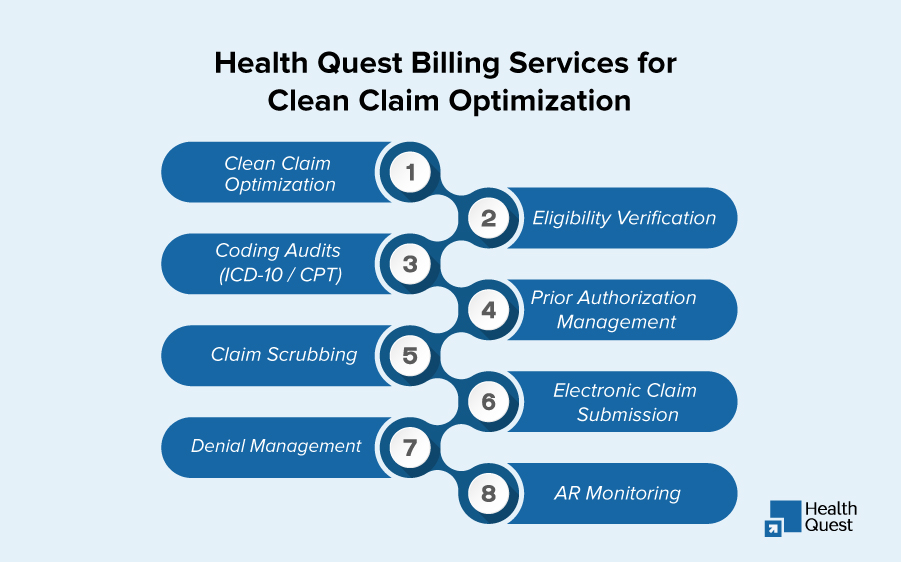
HealthQuest Billing helps providers improve clean claim submission by combining accurate coding, structured workflows, and deep payer knowledge instead of relying only on billing software. Our team strengthens every stage of the revenue cycle, from eligibility verification and prior authorization tracking to ICD-10/CPT coding accuracy and claim scrubbing, helping catch errors before claims are submitted. We also focus on denial prevention and recovery through structured follow-up and AR monitoring, giving providers better visibility into payments and underpayments. The result is fewer claim denials, faster reimbursements, improved clean claim rates, and a more stable, efficient revenue cycle without adding extra administrative burden on your practice.
Conclusion
Improving the clean claim submission in medical billing strengthens revenue cycle performance in 2026. The clean claim submission process in medical billing is the backbone of reimbursement success. Every step from patient registration and eligibility verification to medical coding, claim scrubbing, electronic submission, and denial management directly impacts your clean claim rate and cash flow. When clean claims increase, denials decrease, AR days shorten, and revenue becomes predictable. When they decline, administrative burden rises and payments slow.
In 2026, improving clean claim performance is not optional it is a revenue protection strategy. If your practice is facing rising denials or inconsistent reimbursement, HealthQuest Billing can help strengthen your clean claim process, reduce preventable errors, and stabilize your revenue cycle.