



A healthcare practice’s financial stability depends directly on the efficiency of its revenue cycle management (RCM). When evaluating administrative vendor partnerships, medical billing services cost is inevitably the primary metric analyzed by medical practice owners, clinic executives, and financial officers.
In 2026, the standard market rate for outsourced medical billing services ranges between 4% and 10% of net monthly collections. However, evaluating an enterprise RCM partner solely on a baseline percentage can introduce significant operational risk. A lower-priced vendor that lacks comprehensive denial management workflows or proactive clinical documentation checks can cause systemic revenue leakage—ultimately costing your practice far more than a premium, full-service RCM provider.
This guide details the actual costs of medical billing services, breaks down the industry’s predominant pricing structures, exposes hidden contractual expenses, and provides an actionable framework to calculate your true return on investment (ROI).
What Does a Full-Service Medical Billing Company Actually Do?
A full-service medical billing company manages the end-to-end operational lifecycle of a medical claim to optimize cash flow and reduce revenue cycle leakage. Core workflows include front-end patient insurance eligibility verification, certified medical coding review, real-time clearinghouse claim scrubbing, systematic electronic remittance advice (ERA) posting, aggressive aging accounts receivable (A/R) recovery, and structural denial management and appeals.
Many medical group practices suffer from cash flow bottlenecks because they mistake basic clearinghouse routing services for comprehensive revenue cycle management. The scope of your vendor’s manual labor directly dictates your pricing tier:
| Service Level Tier | Included RCM Workflows | Target Practice Profile |
| Basic Claim Submission | Manual data entry, basic demographic checks, and electronic batch claim routing. No denial appeals. | High-volume, low-complexity facilities with large internal administrative teams. |
| Standard Medical Billing | Insurance claim routing, electronic payment posting, and basic out-of-network follow-up. | Mid-sized independent practices with a stable, highly predictable commercial payer mix. |
| Full-Service RCM Excellence | Real-time insurance eligibility checks, clinical documentation integrity (CDI) reviews, certified coding audits, multi-level structural denial appeals, aged A/R recovery, and custom financial KPI reporting. | Multi-specialty groups, surgical centers, and clinics navigating high-complexity regulatory fields (e.g., Workers’ Compensation). |
Average Medical Billing Services Cost: 2026 Pricing Models
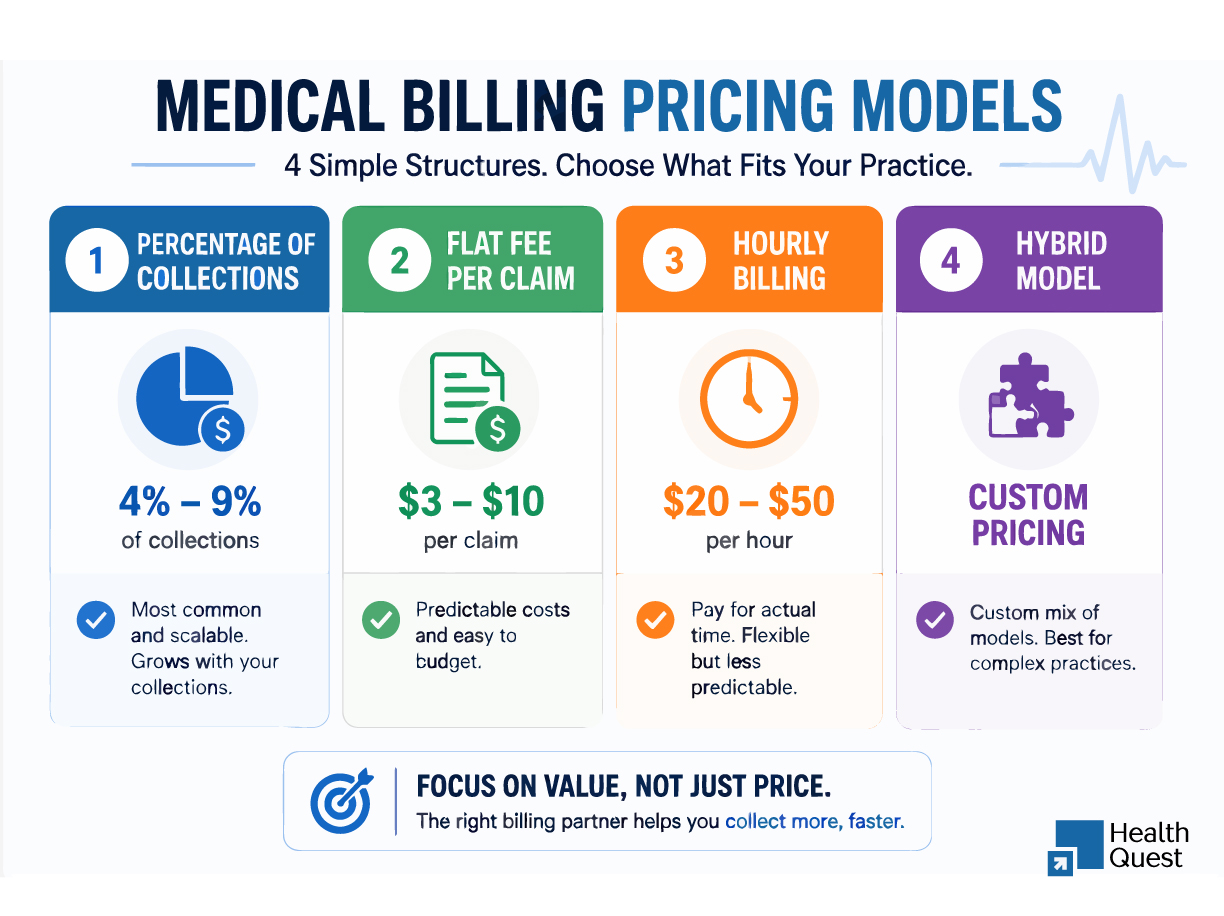
The cost of outsourced medical claims processing depends on the structural pricing architecture outlined in your service level agreement (SLA). The medical billing industry primarily operates on four pricing structures in 2026:
1. Percentage of Collected Revenue Model
This is the most common pricing framework in the United States healthcare sector because it aligns the billing vendor’s financial incentives directly with practice performance.
-
The Market Range: Typically ranges from 4% to 10% of net collections for standard medical claims.
-
Specialty Complexity Variances: High-complexity specialties—such as cardiology, oncology, behavioral health, and orthopedic surgery—frequently see quotes scaling to 8% to 12%. This premium accounts for the intensive prior authorization tracking, specialized modifier execution, and higher initial payer denial rates associated with these fields.
-
Important Nuance: Confirm whether the vendor calculates their fee on gross charges (everything billed before adjustments) or net collections (what is actually paid). A 5% fee on gross charges will almost always cost significantly more than a 7% fee on net collections.
2. Flat Fee Per Claim Model
Under this structure, practices pay a fixed monetary amount for every individual encounter form or claim layout successfully transmitted across the electronic data interchange (EDI).
-
The Market Range: On average, ranges between $3.00 and $12.00 per submitted claim, scaling based on claim acuity and primary vs. secondary payer routing.
-
The Clinical Advantage: Provides highly predictable monthly operational budgeting. This model is ideal for low-volume, high-ticket clinical specialties where a percentage model would become cost-prohibitive.
3. Hourly and Hybrid Billing Structures
-
Hourly Rates ($20 to $50/hour): Generally reserved for short-term revenue cycle consulting, retrospective coding audits, or clearing out a legacy, unrecovered aging A/R backlog.
-
Hybrid Pricing: An increasingly popular 2026 model combining a low base flat monthly fee (e.g., $750) with a reduced percentage rate (e.g., 3%) on collections above a defined performance floor.
Financial Analysis: Calculating the True Revenue Impact
Percentages can sound abstract until they are calculated against real-world clinical cash flow. Consider a mid-sized medical practice collecting a baseline of $100,000 per month across various pricing structures:
[Practice Monthly Collections: $100,000]
├── 4% Basic Collections Fee ➔ $4,000 Monthly Billing Cost
├── 7% Full-Service RCM Plan ➔ $7,000 Monthly Billing Cost
├── Flat-Fee Per Claim Model ➔ $5,500 Monthly Cost (Based on 1,000 Claims @ $5.50/each)
└── Hourly Recovery Project ➔ $3,600 Monthly Cost (Based on 120 Hours @ $30/hr)
When analyzing these numbers, the critical metric is your First-Pass Claim Acceptance Rate (FPCR). If a discount 4% vendor allows your denial rate to drift to 12%, your practice loses thousands in unrecovered care. If a 7% enterprise provider optimizes your clean claim rate above 95% and drops your days in A/R below 35, the net revenue recovered far exceeds the incremental service fee.
In-House Billing vs. Outsourced Medical Billing Cost
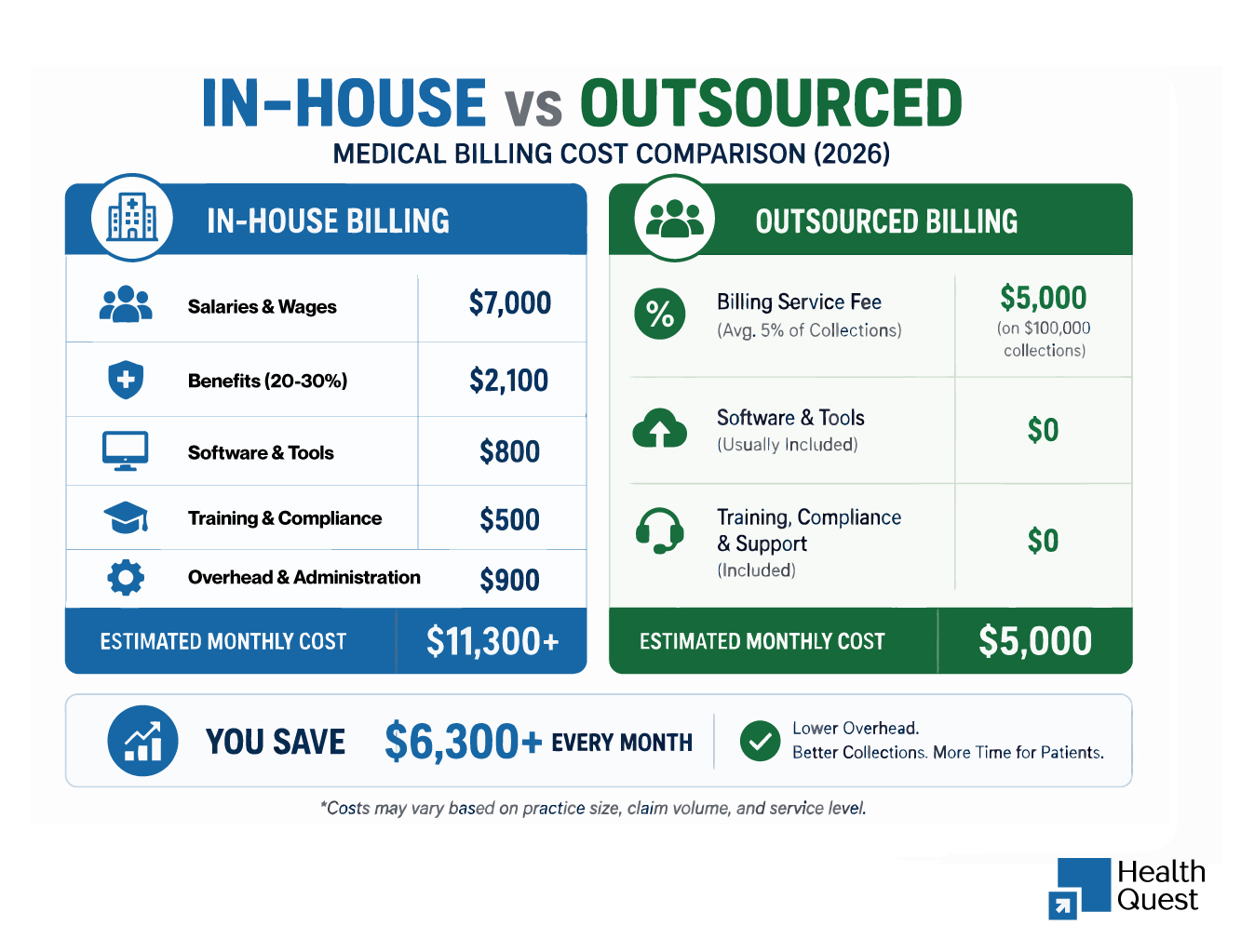
Choosing whether to build an internal billing department or outsource to an enterprise RCM vendor requires analyzing hidden operational overhead.
According to national administrative benchmarks compiled by the Medical Group Management Association (MGMA), running an internal billing department consumes an average of 13.7% of a practice’s total net collections. This steep operational percentage accounts for non-negotiable overhead categories that rarely show up in basic internal cost projections:
| Expense Category | In-House Billing Infrastructure | Outsourced RCM Partnership |
| Personnel Surcharges | W-2 salaries ($45K–$70K annually per biller/coder), health benefits, payroll taxes, and PTO. | Handled entirely by the vendor’s dedicated staffing pools. |
| Technology Licenses | Independent licensing for Electronic Health Records (EHR), Practice Management (PM) tools, and clearinghouses. | Software access is typically bundled into or subsidized by the RCM service percentage. |
| Compliance & CE | Annual cost for mandatory ICD-10-CM updates, annual CPT code updates, and HIPAA security certifications. | Managed and maintained entirely by the vendor’s internal compliance officers. |
| Labor Redundancy | Disrupted billing workflows and revenue drops during staff turnover, illness, or medical leave. | Continuous, redundant staffing bands ensure an unbroken claim submission pipeline. |
Hidden Contractual Fees to Monitor
To protect your cash flow and ensure accurate cost comparisons, practices must read the fine print of an RCM service agreement to flag potential cost inflators:
-
Implementation & Onboarding Fees: Setup costs can range from $2,000 to $10,000 for initial system configuration, software bridges, and data migration. Secure an agreement detailing whether this is waived with a long-term contract.
-
Patient Statement Pass-Throughs: Printing, mailing, and processing digital patient statements can add $0.50 to $2.00 per statement if not bundled into the primary collections percentage.
-
Provider Credentialing Fees: If your outsourced billing partner manages payer enrollments and CAQH updates, check if they charge separate fees per provider, per enrollment (typically $150 to $500).
Navigating Value-Based Reimbursement and 2026 Market Dynamics
The macroeconomic healthcare climate in 2026 makes billing precision non-negotiable. Payer scrutiny is at an all-time high, with industry metrics showing inpatient denied amounts rising 12% and outpatient denied amounts climbing 14% year-over-year.
Simultaneously, the steady expansion of value-based care models—including Accountable Care Organizations (ACOs) and Pay-for-Performance (P4P) initiatives—means provider reimbursement is increasingly tied to quality metrics, preventative care tracking, and patient outcomes rather than simple service volume. An advanced RCM partner ensures your clinical notes are accurately mapped to satisfy these complex documentation requirements, protecting you from underpayments, unbundling rejections, and compliance audits.
Health Quest Billing’s Tiered Revenue Cycle Pricing
At Health Quest Billing, we believe your billing partner should reward practice scalability rather than penalizing growth. To support expanding healthcare organizations, we deploy a transparent, tiered pricing model where your RCM percentage fee dynamically decreases as your net collection volume increases.
| Plan | Monthly Collections | Rate | Monthly Minimum |
| Starter | Up to $50,000 | 4.99% | $1,500 |
| Growth | $50,001–$100,000 | 4.49% | $2,500 |
| Professional | $100,001–$150,000 | 3.99% | $4,500 |
| Enterprise | $150,001+ | 2.99% | $6,500 |
This structure allows practices to retain more revenue as they scale while maintaining dedicated billing support and operational consistency.
What Is Included in Our Core RCM Protocol?
Unlike cut-rate options that skip intensive back-end labor, every tier of Health Quest Billing’s Revenue Cycle Management service provides end-to-end operational support:
-
Real-time patient insurance eligibility and Coordination of Benefits (COB) validation.
-
Multi-layered charge entry optimization utilizing advanced electronic claim scrubbing.
-
Prompt clearinghouse rejection correction and daily batch claim routing.
-
Comprehensive denial management, including first-level and second-level appeal execution.
-
Rigorous aging accounts receivable (A/R) tracking and direct payer escalation.
-
Compliant patient statement generation and baseline patient billing helpdesk support.
-
Transparent practice KPI reporting and collaborative month-end financial reviews.
Conclusion
Choosing an RCM specialist is a critical business decision that defines your clinic’s financial trajectory. Ultimately, the true value of a medical billing partner is not measured solely by what they charge, but by the volume of net practice revenue they help you successfully recover, retain, and scale.
Are you ready to audit your current revenue cycle and uncover hidden operational inefficiencies? Contact Health Quest Billing today to schedule a comprehensive, zero-obligation revenue cycle assessment and safeguard your practice’s cash flow.