
In the high-stakes world of medical reimbursement, anesthesia billing remains the ultimate administrative stress test. If your practice is still billing like it’s 2024, you are leaving up to 20% of your hard-earned revenue on the table. Between the newly implemented 2026 CMS split-conversion factors, aggressive automated payer audits, and strict concurrency caps, even a single minute or a misplaced modifier can trigger an immediate denial.
At HealthQuest, we engineer revenue cycle management (RCM) workflows specifically designed to adapt to these shifts. This comprehensive guide breaks down how your practice can navigate 2026’s complex billing architecture, turn compliance into financial stability, and consistently outperform industry benchmarks.
What Is Anesthesia Billing Service?
Anesthesia billing service is a specialized medical billing process that calculates reimbursement using ASA base units, anesthesia time units, physical status modifiers, qualifying circumstances, provider modifiers, and payer-specific conversion factors.
Unlike most physician specialties that primarily bill using Relative Value Units (RVUs), anesthesia reimbursement depends on accurately documenting how complex the procedure was, how long anesthesia was administered, who provided the service, and whether Medicare or commercial payer requirements were met.
Because reimbursement is calculated differently than standard physician services, anesthesia claims require greater precision in documentation, coding, and compliance.
How Anesthesia Billing Works
Understanding the reimbursement methodology is the foundation of accurate anesthesia coding and billing. Unlike traditional physician billing, anesthesia reimbursement follows a unique formula that combines several billing components.
The Standard Anesthesia Billing Formula
(Base Units + Time Units + Additional Units) × Conversion Factor = Total Reimbursement
Each component contributes to the final payment amount.
1. Base Units
Every anesthesia CPT (ASA) code is assigned a specific number of base units based on the complexity of the surgical procedure, expected skill level, and associated patient risk.
More complex procedures generally receive higher base unit values.
For example:
| Procedure | Approximate Base Units |
|---|---|
| Upper abdominal surgery | 7 |
| Total knee arthroplasty | 7 |
| Major spinal surgery | 13 |
| Intracranial procedures | 10–20 |
Base units remain constant regardless of procedure duration.
2. Time Units
Time is one of the most significant factors in anesthesia reimbursement. Most payers calculate one anesthesia time unit for every 15 minutes of continuous anesthesia care, although rounding rules and calculations may vary by payer contract. Anesthesia time typically begins when the anesthesia provider starts preparing the patient for induction and ends when the patient is safely transferred to postoperative care.
Every anesthesia record should include accurate start and stop times, provider changes, temporary interruptions, and separate anesthesia periods when applicable.
3. Conversion Factor
After calculating total billable units, the result is multiplied by the applicable anesthesia conversion factor (CF). Conversion factors vary by Medicare, Medicaid, commercial insurers, managed care contracts, and geographic location. Example of an Anesthesia Billing Calculation
Consider the following scenario:
- Base Units: 7
- Time Units: 8
- Physical Status Units: 1
- Conversion Factor: $21.50
Total Units:
7 + 8 + 1 = 16 Units
Payment:
16 × $21.50 = $344.00
Although simplified, this example illustrates why every billable unit and every minute of documented anesthesia time matters.
Why Accurate Billing Matters in 2026
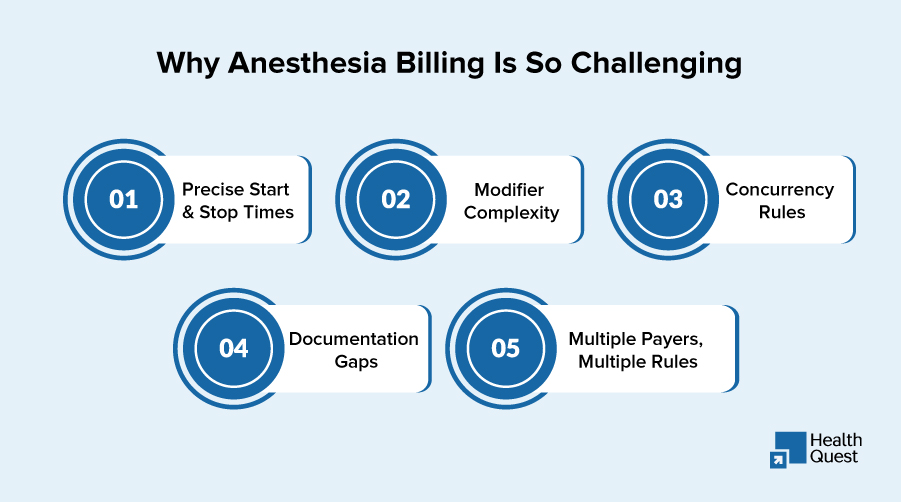
Healthcare reimbursement continues to evolve as Medicare and commercial insurers strengthen compliance programs, expand automated claim reviews, and rely more heavily on data analytics.
For anesthesia providers, success depends on more than submitting claims. Practices must also maintain accurate documentation, comply with medical direction requirements, monitor coding quality, and understand payer-specific billing rules.
Organizations that invest in billing accuracy, routine audits, and proactive revenue cycle management are generally better positioned to:
- Improve clean claim rates
- Reduce preventable denials
- Accelerate reimbursement
- Strengthen compliance
- Protect long-term financial performance
As payer expectations continue to change, maintaining an efficient anesthesia billing process has become a competitive advantage rather than simply an operational necessity.
Essential Components of Accurate Anesthesia Coding
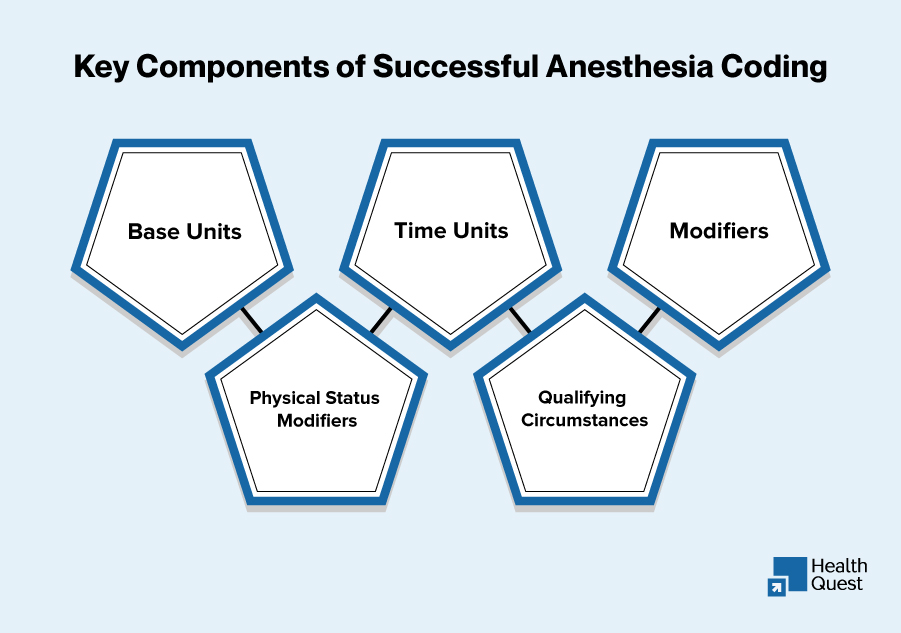
Submitting a successful anesthesia claim requires more than selecting the correct CPT code. Every claim should accurately represent the procedure performed, the duration of anesthesia care, the provider’s role, the patient’s condition, and the supporting clinical documentation.
The following components form the foundation of accurate anesthesia coding and reimbursement.
Anesthesia CPT Codes
| Anesthesia CPT Code | Procedure | Typical Base Units* |
|---|---|---|
| 00100 | Procedures on the head | 5 |
| 00210 | Intracranial procedures | 10+ |
| 00300 | Procedures on the cervical spine and spinal cord | 7 |
| 00400 | Shoulder and axilla procedures | 5 |
| 00520 | Closed chest procedures | 6 |
| 00670 | Major spine procedures | 13 |
| 00740 | Upper abdominal procedures | 7 |
| 00840 | Lower abdominal procedures | 7 |
| 00952 | Gynecologic procedures | 6 |
| 01402 | Total knee arthroplasty | 7 |
Anesthesia Modifiers
| Modifier | Description | Typical Use |
|---|---|---|
| AA | Anesthesiologist personally performed the anesthesia service | Solo anesthesiologist |
| QK | Medical direction of two to four concurrent anesthesia procedures | Anesthesiologist directing multiple CRNAs or anesthesia assistants |
| QY | Medical direction of one CRNA | One anesthesiologist and one CRNA |
| QX | CRNA service with medical direction | CRNA working under medical direction |
| QZ | CRNA service without medical direction | Independent CRNA services, subject to payer policy |
| AD | Medical supervision of more than four concurrent procedures | Limited reimbursement and additional documentation requirements |
Understanding Physical Status Modifiers (P1–P6)
Physical status modifiers describe the patient’s overall health before anesthesia administration. These modifiers help communicate the patient’s clinical condition and, depending on payer policy, may contribute additional billable units.
| Modifier | Patient Condition |
|---|---|
| P1 | Healthy patient |
| P2 | Patient with mild systemic disease |
| P3 | Patient with severe systemic disease |
| P4 | Patient with severe systemic disease that is a constant threat to life |
| P5 | Moribund patient who is not expected to survive without the operation |
| P6 | Declared brain-dead patient whose organs are being removed for donation |
Accurate physical status assignment should always be supported by the medical record. Overstating patient acuity without documentation may increase audit risk.
Qualifying Circumstances
Certain clinical situations require additional physician skill, monitoring, or complexity during anesthesia care. These may be reported using qualifying circumstance codes when supported by documentation and accepted by the payer.
Common examples include:
- 99100 – Extreme age
- 99116 – Controlled hypotension
- 99135 – Controlled hypotension (when applicable under payer policy)
- 99140 – Emergency conditions
Not every payer reimburses qualifying circumstance codes separately, so billing teams should review payer-specific guidelines before reporting them.
Documentation Checklist for Clean Claims
| Documentation Requirement | Purpose |
|---|---|
| ✔ Pre-anesthesia evaluation | Documents patient assessment before anesthesia |
| ✔ Medical history and risk assessment | Supports medical necessity |
| ✔ Procedure performed | Confirms the anesthesia service provided |
| ✔ ASA anesthesia CPT code | Determines base units |
| ✔ ICD-10-CM diagnosis code(s) | Links the diagnosis to the procedure |
| ✔ Physical status modifier | Reflects the patient’s condition |
| ✔ Accurate anesthesia start and stop times | Calculates time units |
| ✔ Intraoperative monitoring documentation | Supports clinical care provided |
| ✔ Provider signatures | Confirms service completion |
| ✔ Medical direction documentation (if applicable) | Required for medically directed services |
| ✔ Post-anesthesia evaluation | Completes the anesthesia record |
| ✔ Qualifying circumstances (when applicable) | Supports additional billable services |
Standardized documentation templates and routine chart audits help reduce preventable denials.
What’s New in 2026 Anesthesia Billing? Key CMS & Payer Updates
Healthcare providers should stay informed about the latest Medicare payment changes and evolving payer expectations. While the core anesthesia billing methodology remains the same, 2026 introduces updated conversion factors, separate payment rates for qualifying APM participants, and continued emphasis on documentation accuracy, medical direction compliance, and automated claim reviews.
| 2026 Update | What It Means for Providers |
|---|---|
| Updated Anesthesia Conversion Factors | CMS has released new 2026 anesthesia conversion factors by locality. Although anesthesia base units remain unchanged, reimbursement varies based on geographic location and payment policy. |
| Split Conversion Factors | Medicare now uses separate Physician Fee Schedule conversion factors for qualifying and non-qualifying Advanced Alternative Payment Model (APM) participants. Anesthesia payment files also include corresponding conversion factor updates where applicable. |
| Modifier Accuracy Remains Critical | Modifiers such as AA, QK, QY, QX, QZ, and AD continue to determine payment methodology and provider responsibility. Incorrect modifier combinations remain a common cause of claim denials and underpayments. |
| Medical Direction Requirements | Medicare continues to require documentation supporting medical direction when anesthesiologists supervise CRNAs or anesthesia assistants. Required activities must be documented to support payment. |
| Medical Supervision Rules | Cases billed under medical supervision remain subject to Medicare concurrency and supervision requirements, which differ from medical direction rules and may affect reimbursement. |
| Higher Documentation Expectations | Payers continue to expect complete anesthesia records, including pre-anesthesia evaluation, accurate start and stop times, provider signatures, physical status modifiers, and post-anesthesia documentation to support medical necessity and payment. |
| Expansion of Digital Audits | Medicare contractors and commercial insurers increasingly use data analytics to identify unusual billing patterns, modifier inconsistencies, and documentation deficiencies before and after payment. |
| More Automated Claim Reviews | Claims are increasingly processed through automated editing systems that validate coding, modifiers, time reporting, and payer-specific billing rules. Practices that perform pre-submission claim reviews are better positioned to reduce denials and payment delays. |
Common Reasons Anesthesia Claims Are Denied
Most anesthesia claim denials are preventable. Identifying common billing and documentation issues before claim submission helps improve clean claim rates, reduce payment delays, and protect reimbursement.
| Denial Reason | How It Impacts Reimbursement | Best Practice |
|---|---|---|
| Missing or Incorrect Anesthesia Time | Inaccurate or incomplete start and stop times can trigger claim edits, audits, or payment reductions. | Document precise anesthesia start and stop times for every case. |
| Incorrect Modifier Selection | Missing or incorrect modifiers (AA, QK, QY, QX, QZ, AD) may lead to underpayments or claim denials. | Verify modifier usage based on provider role and payer guidelines. |
| Incomplete Documentation | Missing signatures, anesthesia records, or physical status documentation may delay reimbursement. | Maintain complete, audit-ready clinical documentation. |
| Medical Direction Errors | Failure to document required medical direction steps may affect reimbursement eligibility. | Ensure all medical direction requirements are fully documented. |
| Coding Errors | Incorrect anesthesia CPT, diagnosis, or ASA code selection can result in claim rejection or medical necessity denials. | Perform coding reviews before claim submission. |
| Authorization & Eligibility Issues | Missing prior authorization or inactive insurance coverage can prevent payment. | Verify patient eligibility and authorization before the procedure. |
| Late Claim Submission | Filing after payer deadlines may result in permanent claim denial. | Track timely filing limits and submit claims promptly. |
Best Practices to Improve Anesthesia Reimbursement
Successful medical billing requires continuous monitoring, staff education, and proactive quality improvement.
Consider implementing these best practices:
- Verify insurance eligibility before each procedure.
- Document anesthesia time accurately and consistently.
- Use the correct ASA code and anesthesia modifiers.
- Review payer-specific billing guidelines regularly.
- Perform routine internal coding and documentation audits.
- Monitor denial trends and address recurring issues.
How HealthQuest Supports Anesthesia Practices
Every denied claim, delayed payment, or documentation error affects your practice’s financial performance. At HealthQuest, we help anesthesia providers simplify the billing process through accurate coding, proactive denial management, credentialing support, accounts receivable follow-up, and end-to-end revenue cycle management. Our experienced billing professionals work alongside hospitals, ambulatory surgery centers, pain management practices, and anesthesia groups to improve claim accuracy, strengthen compliance, and maximize reimbursement—allowing providers to focus on delivering exceptional patient care.