
Most clinics believe revenue cycle problems start with coding errors, denied claims or delayed follow-ups. In reality, many of these issues begin much earlier at the level of payer contract clauses for clinics, which directly determine how reimbursement is defined, processed, and protected. A poorly structured healthcare payer contract doesn’t just create occasional issues; it builds a system where underpayments, denials, and delays become routine. Over time, this leads to consistent financial leakage that often goes unnoticed because it is distributed across thousands of claims.
According to the American Medical Association (AMA), a significant percentage of practices lose revenue due to unclear or unfavorable contract terms. This is not because providers lack clinical excellence; it’s because contracts are written in a way that favors payers by default. The solution is not just reviewing contracts but strategically strengthening payer contract clauses for clinics to align with real-world billing, reimbursement, and compliance challenges.
Why Payer Contract Optimization Is Critical in 2026
Healthcare reimbursement systems are becoming more complex every year. Payers are continuously updating policies, tightening prior authorization rules, and revising fee schedules without always providing clear communication. This creates a situation where clinics operate under outdated assumptions while contracts quietly evolve in favor of payers, even when they are supported by in-house or outsourced medical billing services.
The most common consequences include:
- Increased claim denials
- Unpredictable reimbursement patterns
- Higher accounts receivable (AR) days
- Revenue leakage through underpayments
- Administrative overload in billing teams
The Medical Group Management Association (MGMA) reports that many practices across the U.S. experience inconsistent reimbursement due to poorly negotiated payer agreements. This makes payer contract review and negotiation a critical financial control mechanism not just a legal task.
What Should Be Included in a Payer Contract?
Every clinic should ensure that its provider payer agreements include clearly defined, enforceable clauses that protect revenue and reduce ambiguity.
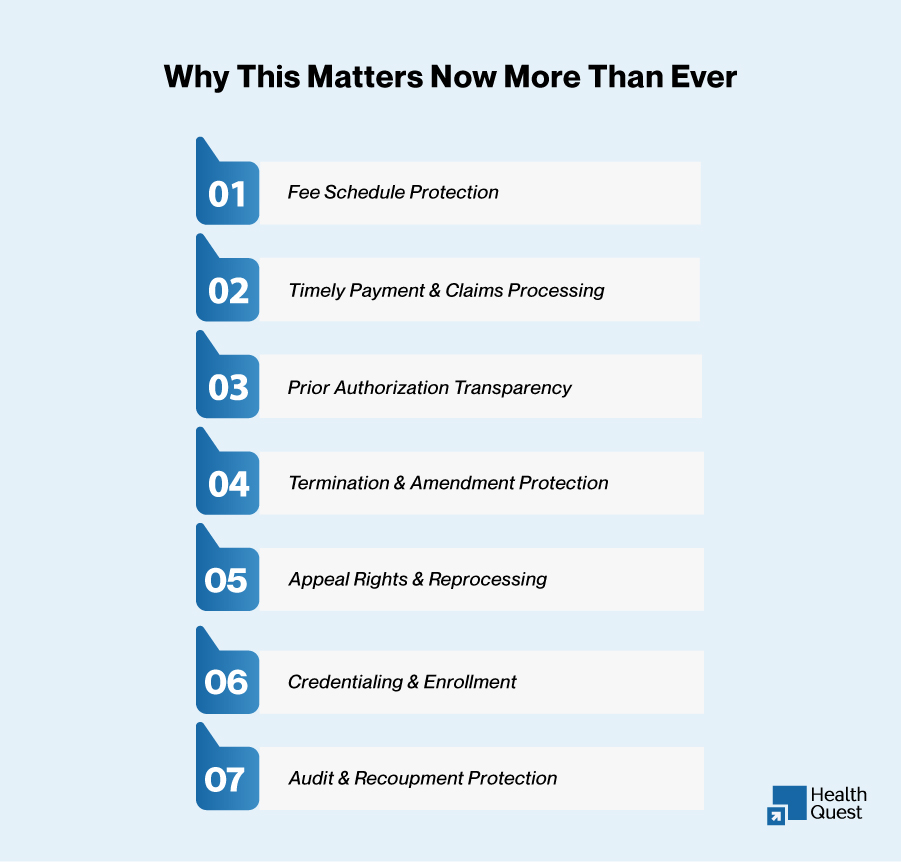
At a minimum, a strong contract should include:
- Fee Schedule Protection Clause
- Timely Payment & Claims Processing Clause
- Prior Authorization Transparency Clause
- Termination & Amendment Protection Clause
- Appeal Rights & Reprocessing Clause
- Credentialing & Enrollment Clause
- Audit & Recoupment Protection Clause
Missing even one of these clauses can result in long-term underpayment in medical billing and increased denial risk.
Why Weak Payer Contracts Quietly Destroy Revenue
A weak contract doesn’t fail all at once it fails gradually. At first, you may notice small discrepancies: slightly lower reimbursements, occasional unexplained denials, or minor delays in payments. Over time, these issues compound into larger problems such as increased accounts receivable, staff burnout, and inconsistent cash flow.
What makes this more challenging is that most billing teams try to fix these issues at the claim level. They rework denials, resubmit claims, and appeal underpayments—without realizing that the root cause is embedded in the payer agreement itself. This creates a reactive cycle where clinics spend more resources fixing problems that could have been prevented through proper payer contract negotiation and review. The real solution is to shift from a reactive billing approach to a proactive contract optimization strategy.
1. Fee Schedule Protection Clause
The fee schedule is the foundation of your reimbursement structure. It defines how much your clinic is paid for each CPT code and service. Without a strong fee schedule protection clause in healthcare contracts, payers may adjust reimbursement rates silently or interpret fee structures in ways that reduce payments over time.
This is one of the most common causes of hidden revenue loss in medical billing.
Why this clause matters:
Even a small percentage reduction across high-volume procedures can significantly impact annual revenue, especially for specialties like cardiology, orthopedics, gastroenterology, and dermatology.
- What clinics must ensure:
- CPT-level reimbursement clarity
- Written notice before any rate changes
- Annual updates tied to benchmarks (such as Medicare rates)
This clause directly protects clinics from systematic underpayment and reimbursement erosion.
2. Timely Payment Clause (Controlling Cash Flow Stability)
One of the most common issues clinics face is delayed payment but what many don’t realize is that delays often originate from contract language rather than billing performance.
If a contract does not clearly define payment timelines, payers have flexibility to delay reimbursements under administrative justifications.
This leads to unstable cash flow and growing AR challenges.
A strong contract should define:
- Payment processing timelines (typically 15–30 days)
- Penalties or interest for delayed payments
- Restrictions on administrative holds
Without these protections, clinics often struggle with unpredictable revenue cycles even with efficient billing operations.
3. Prior Authorization Transparency Clause (Denial Prevention Strategy)
Prior authorization requirements have expanded significantly, becoming one of the leading causes of claim denials across all specialties. The problem is not just the requirement itself, but the lack of transparency in how payers manage updates. Without clear prior authorization contract terms, clinics are often forced to deal with sudden policy changes, unclear guidelines, and retroactive denial risks.
Key protections should include:
- Advance notification of prior authorization changes
- Regularly updated authorization lists
- Defined turnaround times for approval decisions
High-risk specialties affected:
- Cardiology
- Radiology
- Behavioral Health
- Oncology
- Pain Management
This clause plays a direct role in reducing avoidable denials and improving operational predictability.
4. Termination & Amendment Clause (Protecting Contract Stability)
Many payer contracts are heavily skewed in favor of insurance companies, allowing unilateral changes to reimbursement structures or contract terms. This creates financial instability for clinics, especially when changes are implemented without sufficient notice. To avoid this, contracts must include balanced termination and amendment clauses.
Essential protections:
- 90-120 days’ written notice for any changes
- Mutual termination rights for both parties
- Clearly defined amendment procedures
Without this clause, clinics risk sudden shifts in reimbursement that can disrupt entire revenue cycles.
5. Appeal Rights & Reprocessing Clause (Strengthening Denial Recovery)
Denials are inevitable in healthcare billing, but unresolved or unchallengeable denials are where revenue loss occurs. Many payer contracts lack structured appeal rights, making it difficult for clinics to challenge underpayments or incorrect denials effectively. The Healthcare Financial Management Association highlights that unclear contract language is a major contributor to denial inefficiencies and revenue leakage.
A strong clause should ensure:
- Defined appeal submission timelines
- Mandatory payer review processes
- Reprocessing requirements for payer errors
This clause strengthens the entire denial management workflow by ensuring accountability from payers.
6. Credentialing & Enrollment Clause (Preventing Hidden Revenue Gaps)
Credentialing delays are one of the most overlooked causes of revenue loss in growing clinics. Without proper contract language, new providers may begin treating patients before being fully enrolled with payers, resulting in denied or non-payable claims. This creates a hidden revenue gap that often goes unnoticed until significant losses accumulate.
Contracts should clearly define:
- Credentialing and enrollment timelines
- Retroactive billing rights
- Rules for adding new providers to contracts
This is especially important for multi-provider practices and expanding healthcare organizations.
7. Audit & Recoupment Protection Clause (Financial Risk Control)
Payer audits have become more frequent and more aggressive, often using data-driven models to identify overpayments.
Without clear contractual protections, clinics may face:
- Extended audit lookback periods
- Large-scale recoupments
- Extrapolated repayment demands
Strong audit clauses should include:
- Defined audit lookback periods (12–24 months)
- Transparent audit criteria and methodology
- Clear dispute resolution processes
This ensures audits remain fair, structured, and financially manageable.
Common Payer Contract Mistakes Clinics Should Avoid
Many clinics unknowingly accept unfavorable contract terms due to complexity, lack of time, or limited negotiation expertise.
Common issues include:
- Vague reimbursement language
- Missing appeal timelines
- Undefined prior authorization rules
- One-sided amendment rights
- Lack of penalties for delayed payments
- Hidden addendums or policy references
These issues often lead to long-term revenue instability and increased administrative burden.
Why Clinics Struggle With Payer Contract Negotiation
Most healthcare providers are trained in clinical care not contract law or payer negotiation strategy. As a result, healthcare contract negotiation is often overlooked or delegated without deep analysis.
Key challenges include:
- Complex legal language
- Lack of benchmarking data
- Limited negotiation leverage
- Time constraints in busy practices
Because of this, many clinics never fully optimize their payer contract clauses for clinics, even when significant revenue is at stake.
How Weak Contracts Impact Revenue Cycle Performance
When payer contracts are not optimized, the impact is not isolated it affects the entire revenue cycle.
Clinics commonly experience:
- Increased denial rates
- Higher accounts receivable (AR) days
- Delayed reimbursements
- Cash flow instability
- Increased administrative workload
- Annual revenue loss of 5–15%
Even the most efficient billing teams cannot fully compensate for structural contract weaknesses.
How HealthQuest Billing Helps Clinics Strengthen Their Payer Contracts
Health Quest Billing provides complete payer contract support to help clinics protect revenue and avoid costly agreement mistakes. We review new and existing payer contracts, identify missing or risky clauses, benchmark reimbursement rates against state and national data, and support renegotiation strategies to improve payment terms. Our team also helps reduce contract-driven denials, strengthen AR performance, and ensure ongoing compliance with payer updates.
With HealthQuest Billing, clinics don’t rely on guesswork they make data-driven contract decisions that improve reimbursement and financial stability. If you are signing or renewing a payer agreement, contact us to review your contract and ensure it protects your revenue from day one.
Final Words
A payer contract is not just a legal document; it is the foundation of your entire revenue cycle and directly determines how smoothly your clinic gets paid. If your payer contract clauses for clinics are weak, unclear, or outdated, your practice is already exposed to financial risk through underpayments, delayed reimbursements, and avoidable denials. On the other hand, stronger and well-structured contracts create a stable financial environment by ensuring predictable reimbursement, reducing claim denials, improving cash flow consistency, and supporting long-term financial stability for sustainable practice growth.