
Every denied bronchoscopy claim, delayed pulmonary function test (PFT) reimbursement, or unpaid CPAP claim directly affects your practice’s cash flow. While pulmonologists focus on diagnosing and treating complex respiratory diseases, today’s reimbursement landscape has become increasingly difficult to navigate. Medicare policy changes, prior authorization requirements, modifier edits, respiratory DME documentation, and evolving payer rules all increase administrative workload and financial risk.
Whether you operate an independent pulmonology clinic, a multi-specialty practice, or a hospital-based pulmonary department, an optimized revenue cycle is essential for maintaining profitability. This guide explains where pulmonology practices lose revenue, how specialty-specific billing improves financial performance, and what providers should evaluate before outsourcing their revenue cycle.
What are pulmonology billing services?
Pulmonology billing services are specialized Revenue Cycle Management (RCM) solutions designed to manage the financial and administrative processes involved in respiratory care. Beyond simply submitting insurance claims, an experienced pulmonology billing team oversees the entire revenue cycle from patient registration and insurance verification to medical coding, claim submission, payment posting, denial management, accounts receivable (A/R) follow-up, and financial reporting. The goal is to ensure every medically necessary pulmonary service is accurately documented, coded, billed, and reimbursed according to Medicare, Medicaid, and commercial payer requirements.
Unlike general medical billing, pulmonology billing requires expertise in respiratory procedures, pulmonary diagnostics, sleep medicine, pulmonary rehabilitation, and respiratory DME. Services such as PFTs, bronchoscopy, thoracentesis, sleep studies, CPAP/BiPAP, oxygen therapy, and critical care involve complex CPT®, HCPCS, ICD-10-CM, NCCI, and payer-specific rules. Even small coding or documentation errors can result in denials, payment delays, or lost revenue.
A pulmonology-focused billing partner provides access to specialty-trained coders, denial experts, and compliance specialists who monitor CMS updates, payer policies, and coding changes. This helps practices improve clean claim rates, reduce administrative workload, accelerate A/R recovery, and maximize reimbursement while maintaining compliance.
Why Pulmonology Practices Lose Revenue
Pulmonology is one of the most documentation-intensive specialties because a single patient encounter may involve Evaluation & Management (E/M) services, pulmonary function testing (PFT), bronchoscopy, sleep medicine, pulmonary rehabilitation, respiratory Durable Medical Equipment (DME), diagnostic imaging, and critical care services each with different coding, documentation, and reimbursement requirements. Unlike many office-based specialties, pulmonologists must also comply with Medicare Local Coverage Determinations (LCDs), National Correct Coding Initiative (NCCI) edits, prior authorization rules, medical necessity requirements, and payer-specific billing policies. As a result, even small coding or documentation errors can delay payment, trigger audits, or result in denied claims.
According to industry revenue cycle benchmarks, healthcare organizations lose 3%–5% of net patient revenue annually due to preventable revenue leakage from coding inaccuracies, denied claims, underpayments, and inefficient billing workflows. For pulmonology practices performing high-value diagnostic and procedural services, these losses can have a significant impact on profitability.
Step-by-Step Pulmonology Billing Process
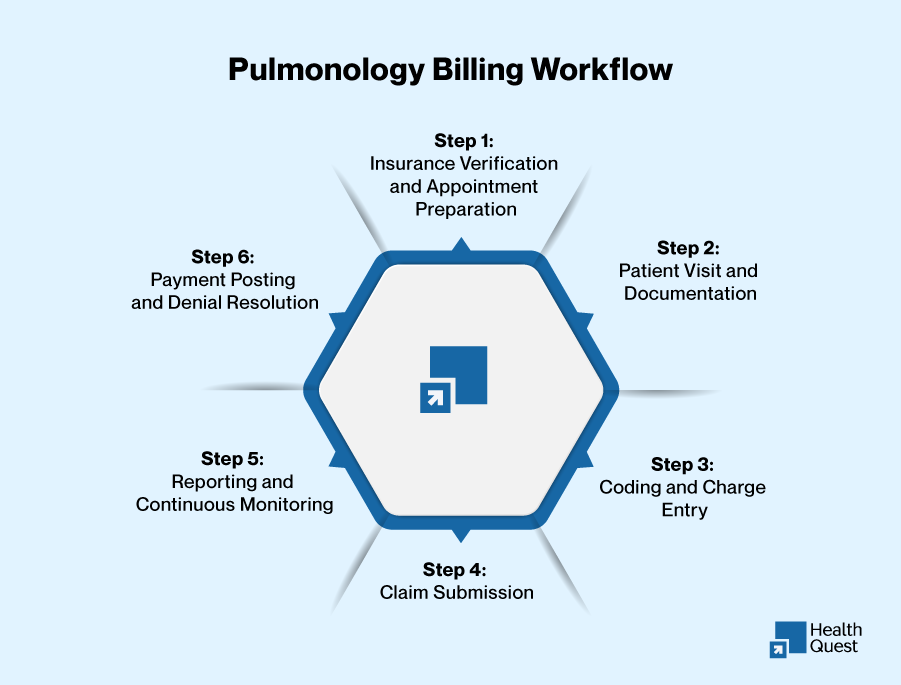
An efficient pulmonology billing process is essential for maintaining healthy cash flow, reducing claim denials, and ensuring compliance with Medicare, Medicaid, and commercial payer requirements. Because pulmonology involves complex diagnostic testing, respiratory procedures, sleep medicine, and DME billing, each stage of the revenue cycle must be managed carefully to maximize reimbursement.
Step 1: Insurance Verification and Appointment Preparation
Revenue cycle management begins before the patient is seen. Practices should verify insurance eligibility, confirm benefits, identify patient financial responsibility, and obtain any required prior authorizations for pulmonary procedures such as bronchoscopy, pulmonary rehabilitation, sleep studies, and respiratory DME. Addressing coverage requirements upfront helps prevent avoidable denials and delays in reimbursement.
Step 2: Clinical Documentation & Medical Necessity
Complete and accurate documentation is the foundation of successful reimbursement. Providers should clearly document the patient’s diagnosis, symptoms, physician assessment, procedure performed, test interpretation, treatment plan, and medical necessity. Proper documentation also supports compliance during payer audits and reduces the risk of denied or downcoded claims.
Step 3: Accurate Coding & Charge Capture
After the encounter, services are translated into the appropriate CPT®, HCPCS Level II, ICD-10-CM, and modifier codes. Pulmonary procedures—including spirometry, pulmonary function testing (PFT), bronchoscopy, sleep studies, pulmonary rehabilitation, and respiratory DME must be coded according to current CMS, NCCI, and payer-specific billing guidelines. Accurate coding minimizes claim rejections and ensures providers receive appropriate reimbursement.
Step 4: Claim Validation & Electronic Submission
Before claims are submitted, they should be reviewed for coding accuracy, documentation completeness, modifier usage, and payer-specific edits. Electronic claim submission, combined with claim-scrubbing technology, helps identify errors before they reach the payer, improving clean claim rates and accelerating payment.
Step 5: Payment Posting and Denial Resolution
Once claims are adjudicated, payments should be posted accurately and reconciled against contracted reimbursement rates. Denied, underpaid, or outstanding claims require prompt investigation, correction, appeal, and follow-up. A proactive denial management strategy helps recover lost revenue, reduce Days in Accounts Receivable (A/R), and improve overall financial performance.
Step 6: Reporting and Continuous Monitoring
Successful pulmonology practices continuously monitor key performance indicators (KPIs) such as Clean Claim Rate, First-Pass Acceptance Rate, Net Collection Rate, Days in A/R, Denial Rate, and Revenue per Encounter. Regular reporting, coding audits, payer trend analysis, and staff education help identify revenue leakage, improve operational efficiency, and strengthen long-term financial stability.
Best Practice: Pulmonology practices that combine accurate documentation, specialty-specific coding, proactive denial management, and continuous revenue cycle monitoring are better positioned to reduce reimbursement delays, improve collections, and maintain compliance with evolving payer and CMS requirements.
Common Pulmonology Billing Challenges That Reduce Revenue
Pulmonology practices face unique revenue cycle challenges because they combine office visits, diagnostic testing, interventional procedures, sleep medicine, pulmonary rehabilitation, and respiratory DME billing. Each service has different documentation standards, coding rules, prior authorization requirements, and payer policies. Without a specialty-focused billing process, even small errors can result in claim denials, underpayments, compliance risks, and delayed reimbursements.
| Revenue Cycle Challenge | How It Impacts Your Practice | Best Practice to Reduce Revenue Loss |
|---|---|---|
| Complex Procedure Coding & Modifier Errors | Pulmonology often involves multiple billable services during the same encounter, such as E/M visits, spirometry, PFTs, bronchoscopy, pulmonary rehabilitation, and sleep studies. Incorrect CPT®, HCPCS, ICD-10-CM codes or modifier errors (25, 26, TC, 59, XE, XS) can lead to claim denials, underpayments, or NCCI bundling edits. | Use specialty-trained coders, review NCCI edits, validate modifier usage, and perform coding audits before claim submission. |
| Incomplete Documentation & Medical Necessity | Missing physician interpretations, incomplete procedure reports, inadequate clinical documentation, or failure to demonstrate medical necessity can trigger denials, downcoding, or payer audits. | Ensure documentation supports diagnoses, procedures performed, physician findings, treatment plans, and payer-specific medical necessity requirements. |
| Prior Authorization & Payer Policy Compliance | Many pulmonary procedures—including bronchoscopy, pulmonary rehabilitation, sleep studies, advanced imaging, and respiratory DME—require prior authorization or must meet Medicare LCD/NCD and commercial payer policies. Missing approvals often result in avoidable denials. | Verify insurance benefits, obtain prior authorization before treatment, and monitor payer policy updates regularly. |
| Respiratory DME Billing Complexity | Billing for CPAP, BiPAP, oxygen therapy, ventilators, nebulizers, and other respiratory equipment requires physician orders, qualifying documentation, compliance records, and payer-specific coverage criteria. Missing documentation frequently delays or prevents reimbursement. | Maintain complete DME documentation, verify coverage requirements, and monitor ongoing compliance for recurring equipment claims. |
| Diagnostic Testing & Procedure Denials | Pulmonary function tests (PFTs), spirometry, bronchoscopy, sleep studies, and pulmonary rehabilitation claims are commonly denied due to diagnosis-code mismatches, frequency limitations, documentation deficiencies, or incorrect coding. | Validate diagnosis-to-procedure relationships, review payer frequency limits, and perform pre-submission claim scrubbing. |
| Accounts Receivable (A/R) & Underpayment Recovery | Unpaid, denied, or underpaid claims that are not followed up promptly increase Days in A/R, reduce cash flow, and may exceed timely filing deadlines, resulting in permanent revenue loss. | Implement proactive A/R follow-up, payment reconciliation, denial tracking, and timely appeals for underpaid or rejected claims. |
| Changing CMS & Payer Regulations | Annual updates to CPT®, HCPCS, ICD-10-CM, Medicare Physician Fee Schedule (MPFS), NCCI edits, and commercial payer policies can affect coding accuracy and reimbursement if practices fail to stay current. | Conduct regular coding updates, staff training, compliance audits, and monitor CMS and payer policy changes throughout the year. |
| Limited Revenue Cycle Visibility | Without monitoring KPIs such as Clean Claim Rate, First-Pass Acceptance Rate, Denial Rate, Net Collection Rate, and Days in A/R, practices may overlook recurring billing issues and revenue leakage. | Track revenue cycle KPIs through monthly reporting, analyze denial trends, and use performance data to optimize billing processes and financial outcomes. |
Pulmonology Coding Cheat Sheet (CPT, ICD-10, Modifiers & Documentation)
Quick reference guide for common pulmonary procedures, diagnosis codes, billing modifiers, and documentation requirements to help practices reduce denials and improve reimbursement accuracy.
| Pulmonary Service / Procedure | Common CPT / HCPCS Codes | Common ICD-10 Diagnosis Codes | Common Modifiers | Documentation Required |
|---|---|---|---|---|
| Spirometry / Pulmonary Function Testing (PFT) | 94010 (Spirometry), 94726 (Plethysmography), 94729 (DLCO) | J44.9 (COPD), J45.909 (Asthma), J84.9 (Interstitial Lung Disease) | 26 (Professional Component), TC (Technical Component) | Test indication, patient symptoms, physician interpretation, test results, medical necessity |
| Bronchoscopy (Diagnostic & Interventional) | 31622 (Diagnostic bronchoscopy), 31625 (Biopsy), 31628 (Transbronchial biopsy), 31635 (Foreign body removal) | R91.8 (Lung nodule), J98.09 (Airway disease), C34.90 (Lung cancer), J18.9 (Pneumonia) | 25 (Separate E/M service), 59 (Distinct procedure), 26/TC when applicable | Procedure report, findings, biopsy details, medical necessity, pathology documentation |
| Thoracentesis / Pleural Procedures | 32555 (Thoracentesis with imaging guidance) | J90 (Pleural effusion), J91.0 (Malignant pleural effusion) | 26, TC, 59 when applicable | Imaging guidance, fluid removal details, procedure notes, diagnosis justification |
| Sleep Studies / Sleep Medicine Services | 95806 (Home sleep study), 95810 (Polysomnography), 95811 (Sleep study with CPAP titration) | G47.33 (Obstructive Sleep Apnea), G47.30 (Sleep disorder) | 26, TC, 95 (Telehealth follow-up when applicable) | Sleep evaluation, physician order, test results, interpretation, treatment plan |
| Pulmonary Rehabilitation | 94625, 94626 (Pulmonary rehabilitation services) | J44.9 (COPD), J84.112 (Pulmonary Fibrosis), J96.10 (Respiratory Failure) | 25, 59 when applicable | Physician referral, treatment plan, supervised sessions, progress documentation |
| Respiratory Therapy / Inhaler & Nebulizer Training | 94640 (Nebulizer treatment), 94664 (Inhaler technique training) | J45.909 (Asthma), J44.9 (COPD), J98.4 (Other lung disease) | 25, 59 | Medication indication, training performed, patient education details |
| Critical Care & Complex Pulmonary Management | 99291, 99292 (Critical care services) | J96.01 (Acute respiratory failure), J44.1 (COPD exacerbation), J18.9 (Pneumonia) | 25, 59 | Critical care time, clinical complexity, patient condition, treatment decisions |
| Respiratory Durable Medical Equipment (DME) | E0601 (CPAP), E0470 (BiPAP), E1390 (Oxygen concentrator), E0466 (Ventilator) | G47.33 (OSA), J96.10 (Chronic respiratory failure), J44.9 (COPD) | RR (Rental), NU (Purchase), KX (Medical policy requirements when applicable) | Physician order, qualifying test results, face-to-face documentation, continued medical necessity |
| Telehealth Pulmonary Follow-Up Visits | 99212-99215 (E/M services), applicable telehealth codes | COPD, Asthma, Sleep Apnea, Chronic Respiratory Conditions | 95 (Synchronous telehealth), modifier requirements vary by payer | Patient consent, telehealth documentation, medical decision-making, visit details |
Pulmonology Documentation Requirements for Successful Reimbursement
Medicare and commercial payers evaluate whether documentation supports medical necessity before approving reimbursement. A correctly coded claim without supporting documentation can still result in denial.
Even the correct codes cannot guarantee payment without complete documentation. Pulmonology providers should ensure every medical record includes:
- Patient history and respiratory symptoms
- Physician assessment and medical decision-making
- Clear indication for diagnostic testing or procedures
- Medical necessity supporting each billed service
- Complete procedure report
- Physician interpretation (when applicable)
- Diagnostic test results
- Treatment recommendations
- Follow-up care plan
- Required supervision documentation
- Prior authorization details (when applicable)
Comprehensive documentation strengthens claim accuracy, supports compliance, reduces audit risk, and improves reimbursement consistency.
CMS & Payer Updates Affecting Pulmonology Billing (2026)
Staying current with CMS (Centers for Medicare & Medicaid Services) updates is essential for pulmonology practices to remain compliant and maximize reimbursements. In 2026, several changes and clarifications impact how respiratory services are coded, billed, and reimbursed:
| CMS Update (2026) | Why It Matters to Pulmonology Practices |
|---|---|
| Medicare Physician Fee Schedule (MPFS) | CMS updated physician payment rates and RVUs for 2026. Pulmonology practices should review reimbursement changes for office visits, bronchoscopy, pulmonary function testing (PFT), pulmonary rehabilitation, and sleep medicine services when forecasting revenue. |
| Telehealth Policy Changes | CMS simplified the process for adding services to the Medicare Telehealth Services List and permanently allows real-time audio/video direct supervision for services that require direct supervision. This benefits pulmonary follow-up visits, chronic disease management, and respiratory care programs. |
| Evaluation & Management (E/M) Documentation | E/M services billed on the same day as spirometry, bronchoscopy, or other pulmonary procedures remain under increased scrutiny. Documentation must clearly support modifier -25 and demonstrate a separately identifiable E/M service. This continues to be a common audit and denial issue. |
| Respiratory DME Documentation | Medicare contractors continue to closely review claims for CPAP, BiPAP, oxygen therapy, ventilators, and nebulizers. Providers must maintain complete physician orders, face-to-face documentation, qualifying test results, and proof of continued medical necessity to avoid denials or recoupments. |
| Pulmonary Rehabilitation Compliance | Pulmonary rehabilitation services remain subject to strict Medicare documentation requirements, including physician supervision, treatment plans, session records, and medical necessity. Incomplete documentation can delay or reduce reimbursement. |
| Annual Coding Updates | CMS adopted the latest CPT®, HCPCS Level II, and ICD-10-CM code updates for 2026. Practices should update charge masters, EHR templates, and coding workflows to ensure claims reflect current code sets and payer requirements. |
| Quality Payment Program (MIPS/APM) | Eligible pulmonologists continue to participate in the Quality Payment Program. Performance in quality, cost, interoperability, and improvement activities can affect future Medicare payment adjustments, making accurate clinical documentation and reporting increasingly important. |
Pulmonology Billing Best Practices to Maximize Reimbursement
Provider Self-Assessment: Is Your Revenue Cycle at Risk?
Practice owners and administrators should periodically evaluate their billing performance. If your answer is “Yes” to any of the following questions, your revenue cycle may benefit from further review.
| Question | Yes / No |
|---|---|
| Are pulmonary procedure denials increasing each quarter? | ☐ |
| Is your claim denial rate above 5%? | ☐ |
| Are more than 35 days passing before claims are paid? | ☐ |
| Do you frequently submit corrected or replacement claims? | ☐ |
| Are bronchoscopy, PFT, sleep study, or DME claims commonly denied? | ☐ |
| Do you regularly identify payer underpayments? | ☐ |
| Are appeals taking longer than expected to resolve? | ☐ |
| Do you monitor Clean Claim Rate, Net Collection Rate, and Days in A/R each month? | ☐ |
If several of these challenges apply to your practice, they often indicate opportunities to improve documentation, coding accuracy, billing workflows, and overall revenue cycle performance.
Why Choose Health Quest Billing for Pulmonology Billing Services?
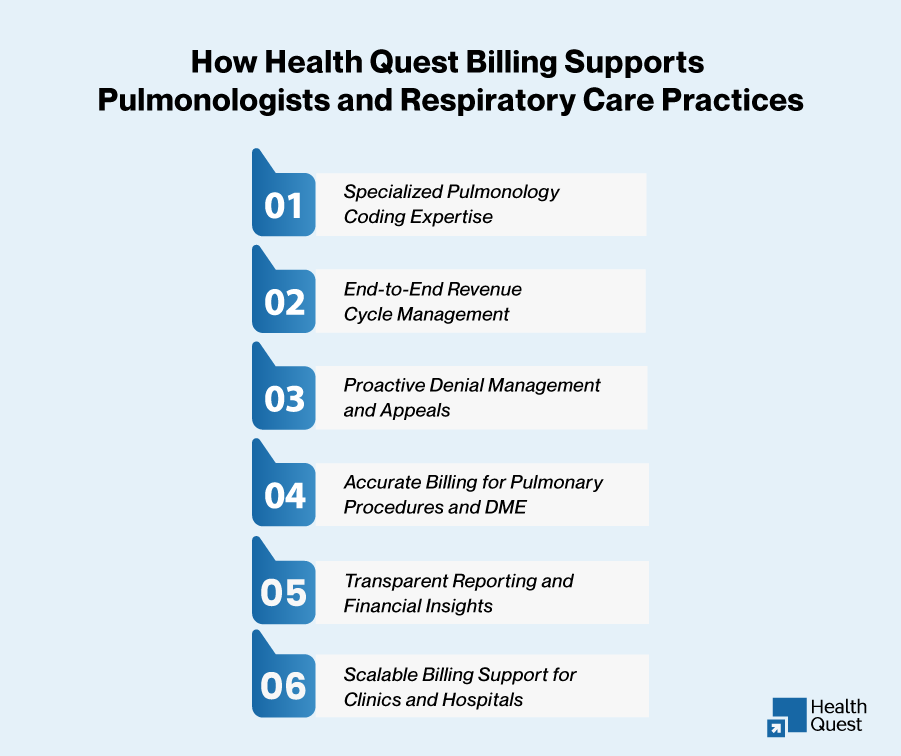
Every pulmonary procedure tells part of your patient’s story but every claim tells the story of your practice’s financial health. At Health Quest Billing, we help ensure neither is overlooked. Our team analyzes the revenue cycle beyond claim submission, uncovering documentation gaps, coding inconsistencies, payer-specific reimbursement trends, and unresolved accounts receivable that quietly erode profitability. By combining specialty-specific billing expertise with continuous performance monitoring, we help pulmonology practices gain greater visibility into their financial performance, recover missed revenue opportunities, and build a more predictable reimbursement process that supports long-term practice growth.
Ready to optimize your pulmonology revenue cycle? Contact Health Quest Billing today for a complimentary revenue cycle assessment and discover how our specialty-focused billing experts can help improve claim accuracy, accelerate reimbursements, and maximize your practice’s financial performance.