
In 2026, endocrinology practices are facing rising AR days due to stricter payer rules, complex chronic care billing, and increased documentation requirements for services like CGM, insulin pumps, and hormone therapies.
These delays often extend cash flow cycles to 60–120 days, creating financial strain and slowing practice growth.
Reducing AR days has become a critical priority not just for faster payments, but for maintaining financial stability. This guide breaks down the key causes of AR delays and how to fix them in 2026.
Why AR Days Matter for Endocrinology Practices
Cash Flow Stability
Healthy cash flow allows endocrinology practices to cover payroll, staffing, operational expenses, medical equipment, and technology investments. When AR days increase, incoming revenue slows down, making it difficult for practices to maintain stable operations and financial growth.
Revenue Cycle Performance
Delayed claims create bottlenecks throughout the revenue cycle. Claims that remain unresolved for long periods often require repeated follow-ups, manual corrections, and appeals, increasing administrative workload and operational inefficiency.
Reduced Profitability
High AR days increase the risk of claim denials, underpayments, and write-offs. Endocrinology practices dealing with complex chronic care billing and device-related claims are particularly vulnerable to revenue leakage caused by unresolved accounts.
Increased Administrative Burden
Billing teams spend more time handling denials, payer communication, authorization issues, and aging claims when AR cycles become extended. This reduces staff productivity and diverts attention away from patient-focused activities.
Long-Term Financial Risk
Practices with consistently high AR days may struggle with financial planning, expansion, hiring, and investment in patient care resources. Poor AR management can eventually threaten the long-term sustainability of the practice.
Why AR Days Are Increasing for Endocrinology Practices in 2026
Endocrinology billing has become significantly more complex in 2026 due to evolving payer policies, tighter Medicare oversight, AI-driven claim review systems, and stricter documentation requirements.
Services such as Continuous Glucose Monitoring (CGM), insulin pump therapy, obesity management, hormone replacement therapy, osteoporosis injections, thyroid procedures, and Remote Patient Monitoring (RPM) are now heavily reviewed for medical necessity and coding accuracy.
Increased Payer Scrutiny on Endocrinology Claims
Commercial payers and Medicare are closely reviewing endocrinology claims to ensure compliance with medical necessity requirements and coverage policies. Claims involving chronic care management and high-cost therapies are often flagged for additional review before reimbursement is issued.
Payers now require more detailed physician notes, glucose history documentation, failed treatment history, lab results, and diagnostic evidence before approving many endocrinology services.
AI-Driven Claim Review Systems
Insurance companies are increasingly using artificial intelligence and automated editing systems to review claims before payment. These systems quickly identify coding inconsistencies, modifier errors, missing documentation, or incomplete diagnosis linkage.
Even minor discrepancies can trigger claim denials, payment holds, or requests for additional information, extending reimbursement timelines significantly.
Rising Prior Authorization Requirements
Many endocrinology procedures and therapies now require prior authorization before services can be performed. Delays in obtaining approvals or submitting incomplete authorization requests often result in claims being delayed or denied entirely.
Staffing Shortages & Administrative Overload
Healthcare staffing shortages continue to affect billing departments nationwide. Many endocrinology practices are struggling with reduced staff capacity while managing increasing claim volumes and payer complexity.
This often leads to:
- Delayed claim submission
- Missed appeal deadlines
- Incomplete follow-up workflows
- Higher denial rates
- Increased AR aging
Complex Chronic Care Billing
Unlike episodic specialties, endocrinology practices frequently manage long-term chronic care conditions that involve recurring services, monitoring programs, medication management, and device billing.
These ongoing services require continuous documentation updates, coding accuracy, authorization management, and payer compliance, making reimbursement workflows more complicated.
Without structured AR management and specialty-specific billing expertise, endocrinology practices risk having substantial revenue tied up in unpaid claims for extended periods.
Prior Authorization Challenges in Endocrinology Billing
Prior authorization delays remain one of the biggest contributors to rising AR days in endocrinology practices.
Insurance companies now require authorization for many high-cost endocrinology services before claims can even be processed for reimbursement.
Common Endocrinology Services Requiring Prior Authorization
| Service | Authorization Requirement |
|---|---|
| Continuous Glucose Monitoring (CGM) | Medical necessity + glucose records |
| Insulin Pump Therapy | Prior treatment documentation |
| Osteoporosis Injections | Clinical justification |
| Thyroid Procedures | Imaging and diagnosis support |
| Remote Patient Monitoring (RPM) | Chronic care eligibility |
| Hormone Replacement Therapy | Treatment history documentation |
How Authorization Delays Increase AR Days
Missing Authorizations
Claims submitted without approved authorization are often denied immediately, regardless of medical necessity or coding accuracy.
Expired Authorizations
Some treatments require recurring authorization renewals. Expired approvals can delay reimbursement for weeks or months.
Incorrect Authorization Requests
Incorrect CPT codes, ICD-10 diagnoses, or incomplete clinical records frequently cause authorization denials or pending reviews.
Slow Insurance Response Times
Many payers now require additional documentation reviews before approving endocrinology services, extending the authorization process significantly.
Practices that implement proactive authorization tracking systems and dedicated workflow management can reduce reimbursement delays and improve AR performance.
Medicare Endocrinology Billing Rules in 2026
Medicare billing requirements for endocrinology services have become stricter in 2026, particularly for chronic disease management and device-related therapies.
Key Medicare Billing Requirements
Accurate CPT & ICD-10 Coding
Claims must clearly align diagnosis codes with the procedures performed to support medical necessity and reimbursement eligibility.
Detailed Clinical Documentation
Physician notes must include:
- Patient symptoms
- Treatment history
- Lab findings
- Glucose monitoring history
- Failed conservative treatment documentation
- Functional impact
Correct Modifier Usage
Improper modifier usage remains one of the leading causes of endocrinology denials and audit exposure.
LCD & NCD Compliance
Medicare contractors continue to enforce Local Coverage Determinations (LCDs) and National Coverage Determinations (NCDs) for endocrinology procedures and devices.
Post-Payment Audit Risk
Medicare audits involving CGM devices, insulin pumps, hormone therapies, and chronic care services have increased substantially in 2026.
Practices that fail to maintain accurate coding and documentation workflows face delayed reimbursements, recoupments, penalties, and financial risk.
CGM Billing & Coding Challenges in 2026
Continuous Glucose Monitoring (CGM) services remain among the most heavily scrutinized areas in endocrinology billing.
While CGM technology has become essential for diabetes management, payer documentation and reimbursement requirements have become significantly stricter.
Common CGM Billing Challenges
| Billing Issue | Financial Impact |
|---|---|
| Weak medical necessity documentation | Claim denial |
| Missing glucose history | Delayed reimbursement |
| Incorrect ICD-10 linkage | Payment rejection |
| Incomplete physician notes | Audit risk |
| Incorrect device coding | Underpayment or denial |
Best Practices to Improve CGM Reimbursements
Document Insulin Dependency Clearly
Payers require strong evidence showing why CGM therapy is medically necessary.
Maintain Detailed Physician Notes
Documentation should clearly explain diabetes management challenges, treatment goals, glucose monitoring history, and patient outcomes.
Follow Payer-Specific Rules
Each insurance payer may apply different CGM billing and documentation requirements. Staying updated on policy changes is essential for clean claim submission.
Validate Coding Before Submission
Accurate CPT, HCPCS, and ICD-10 coding significantly improves first-pass claim acceptance rates and reduces AR aging.
Common Endocrinology Claim Denials in 2026
Endocrinology practices continue to experience rising denial rates due to growing payer scrutiny and increasingly complex reimbursement requirements.
Most Common Denial Reasons
Medical Necessity Denials
Claims are often denied because documentation fails to clearly justify the need for CGM, insulin pumps, hormone therapy, or osteoporosis treatment.
Incorrect Coding
Errors involving CPT codes, ICD-10 diagnoses, HCPCS codes, or modifiers frequently trigger automated payer denials.
Prior Authorization Problems
Missing, expired, or incomplete authorizations remain a major source of endocrinology reimbursement delays.
Incomplete Documentation
Missing lab results, unclear treatment history, or insufficient physician notes can result in payment holds or denial.
Payer Policy Violations
Failure to follow Medicare LCD guidelines or commercial payer policies often causes immediate claim rejection.
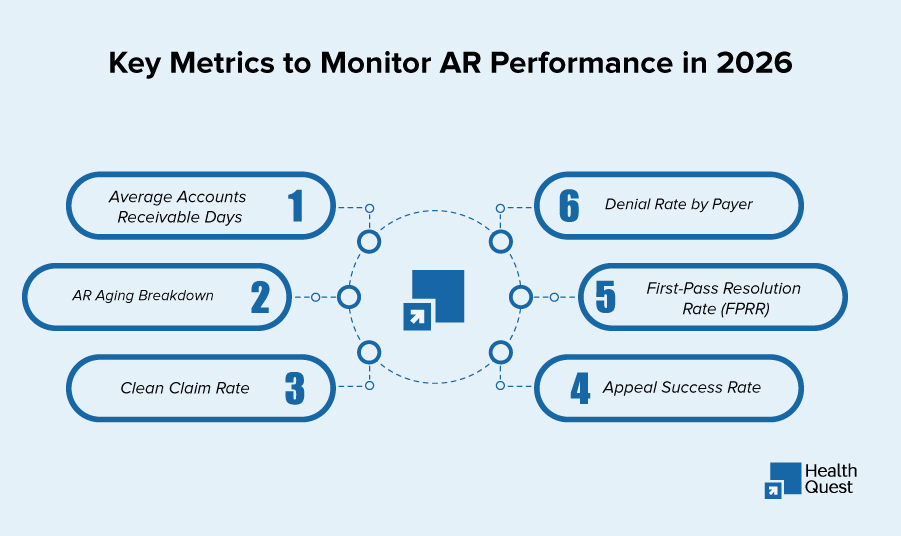
Key AR Metrics Endocrinology Practices Should Track
Tracking AR metrics helps practices identify reimbursement bottlenecks and improve financial performance.
| Metric | Why It Matters |
|---|---|
| Average AR Days | Measures payment speed |
| Clean Claim Rate | Indicates billing accuracy |
| Denial Rate by Payer | Identifies high-risk insurers |
| AR Aging Breakdown | Shows where claims are delayed |
| First-Pass Resolution Rate | Tracks claims paid without rework |
| Appeal Success Rate | Measures denial recovery effectiveness |
Ideal AR Benchmarks in 2026
- AR Days: 35–45 days
- Clean Claim Rate: 95%+
- Denial Rate: Below 5%
- First-Pass Resolution Rate: 90%+
Practices exceeding these benchmarks often experience increasing revenue leakage and operational stress.
How HealthQuest Billing Helps Endocrinology Practices Reduce AR Days
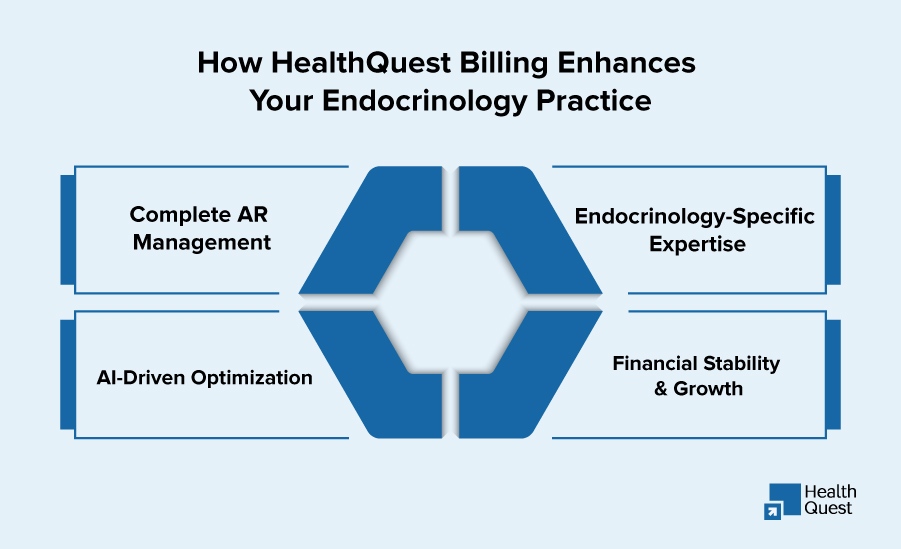
HealthQuest Billing provides specialized endocrinology revenue cycle management services designed to reduce AR aging, improve collections, strengthen cash flow, and maximize reimbursements in 2026. Our team understands the billing complexities associated with diabetes management, CGM devices, insulin pumps, hormone therapies, osteoporosis treatments, and chronic care services.
We focus on accurate CPT and ICD-10 coding, proactive prior authorization management, payer-compliant documentation workflows, denial prevention, and rapid claim follow-up to help practices reduce reimbursement delays and improve first-pass claim acceptance rates. Through AI-driven billing optimization, denial trend analysis, AR monitoring, and specialty-focused revenue cycle strategies, HealthQuest Billing helps endocrinology practices minimize administrative burden, accelerate payments, reduce revenue leakage, and maintain long-term financial stability while staying fully compliant with evolving Medicare and commercial payer regulations.